The Book of Tobit is a Jewish story, probably written in the third or second century BCE, about a devout exile named Tobit, his son Tobias and the angel Raphael; it is in Catholic and Orthodox Bibles but not in the Jewish or Protestant canon.[1][4]
Names
The book takes its name from its central figure, the elder Tobit.[2] In the Latin Vulgate (the Latin Bible translated largely by Jerome) and in one late Hebrew text, father and son both bear the name Tobias, and Latin manuscripts title the work Liber Tobiae ("Book of Tobias"), Liber Tobit et Tobiae or Liber utriusque Tobiae ("Book of both Tobiases").[3] For this reason older Catholic Bibles and church documents call it the Book of Tobias; the Council of Trent's list of 1546 names it simply "Tobias".[3][5] Encyclopaedia Britannica gives "The Book of Tobias" as an alternative title.[1]
Date, place and authorship
The author is unknown.[2] The story is set among Israelite exiles in Nineveh, the Assyrian capital, in the seventh century BCE, but it was written later.[1][2][4] Britannica's article argues that historical errors, archaisms and confused geography show that the book was not written at Nineveh in the early seventh century BCE, and suggests that it was composed, possibly at Antioch, during the reign of Antiochus IV Epiphanes of Syria (175–164 BCE), a period in which observant Jews were forbidden to bury their dead, a duty the book stresses.[1]
Other dates have been proposed. Crawford Howell Toy, writing in the Jewish Encyclopedia (1906), judged it more probable that the book was composed between about 200 and 50 BCE, and tied the place of composition to the unresolved question of its original language: Palestine if it was first written in Hebrew, Egypt if in Greek.[2] After the discovery of Semitic-language copies at Qumran, Annette H. M. Evans (2021) summarised the view that Tobit was most probably written in Aramaic between 225 and 175 BCE, and noted that Devorah Dimant (2009) preferred an earlier date, between 300 and 200 BCE.[4]
Original language and the Qumran copies
Until the twentieth century the oldest known texts of Tobit were Greek, and its original language was disputed.[2] The Catholic Encyclopedia (1912) took the original to have been Hebrew and lost.[3] The Dead Sea Scrolls found near Qumran changed the evidence: they include five fragmentary copies of Tobit, four in Aramaic (catalogued 4Q196–199) and one in Hebrew (4Q200), which are the oldest surviving copies of the book and predate Christianity.[4] Evans, citing Joseph Fitzmyer's 1995 study, dates the Hebrew copy to about 30 BCE to 20 CE, and reports that the Qumran finds have led scholars to regard Aramaic as the most probable original language.[4]
Greek, Latin and other versions
The book survives complete in Greek, Latin and Syriac, and in later Jewish Aramaic and Hebrew forms.[2] There are three Greek recensions (distinct editions of the same text).[2][3] One is the text of the Codex Vaticanus (fourth century) and Codex Alexandrinus (fifth century), two of the great early codices, or bound manuscript books, of the Greek Bible; another is that of the Codex Sinaiticus (fourth century); and the third, preserved in a small group of later manuscripts (numbered 44, 106 and 107 in the Holmes–Parsons edition of the Septuagint), differs from the others in its middle section (6:9–13:8).[2][3] The Sinaiticus text is fuller, and the Catholic Encyclopedia judged that the Vaticanus–Alexandrinus text had omitted many of its lines on purpose.[3] Scholars call the shorter form GI and the longer GII; Evans (2021) reports the view that GI is a reworking of GII and that GII stands closer to the Aramaic copies from Qumran.[4]
Jerome's Latin translation for the Vulgate was made from an Aramaic text.[2] According to the Catholic Encyclopedia, Jerome, who did not yet know Aramaic, worked with a rabbi who knew both Aramaic and Hebrew, completed the work in a single day, as he says in his preface to the book, and was influenced by the existing Old Latin translations.[3] Toy noted that the Old Latin and a later Aramaic text published by Adolf Neubauer broadly follow the Sinaiticus form, while the Syriac generally follows the Vaticanus.[2] He regarded the two Hebrew translations known in his day as late and without authority.[2]
Contents
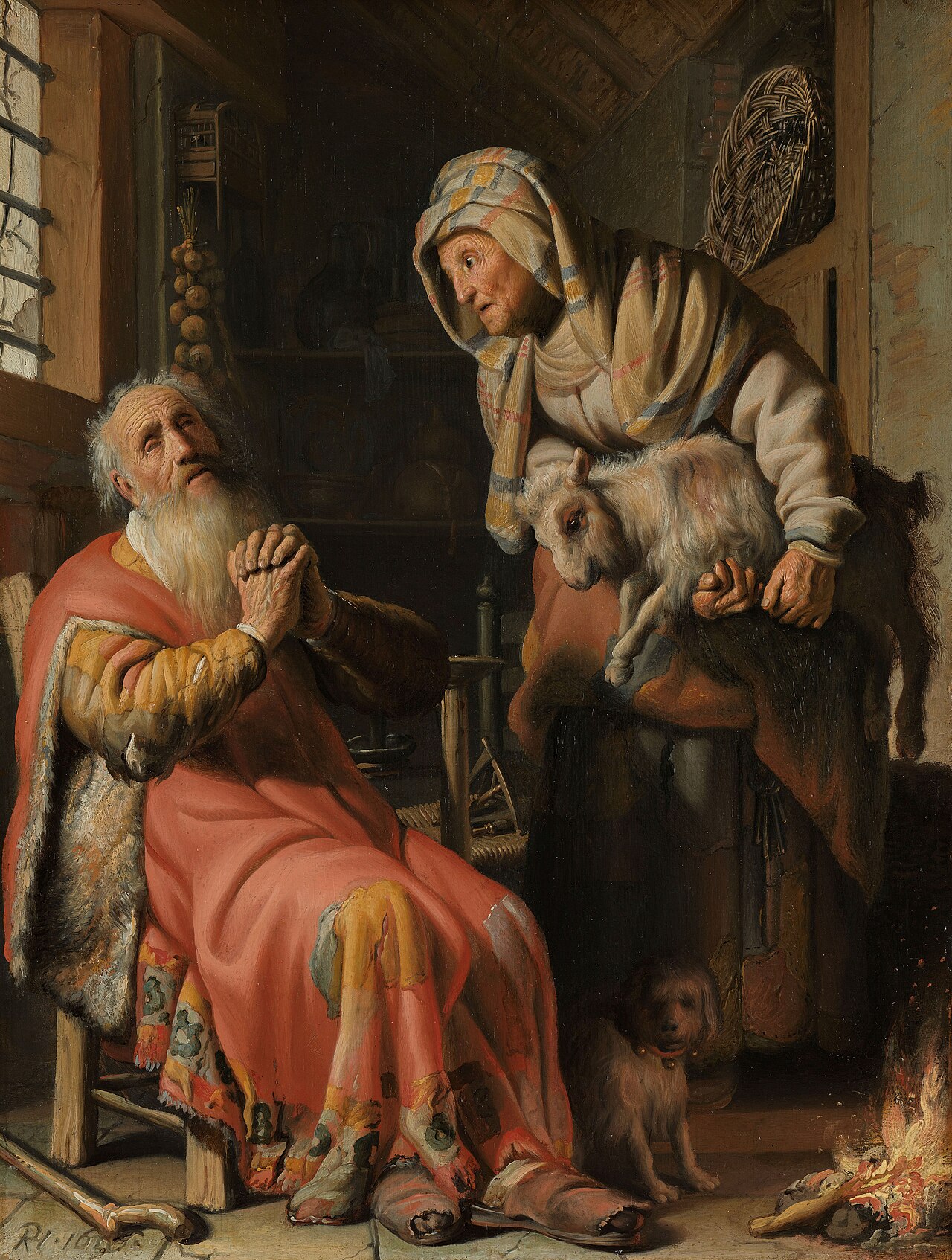
Tobit, a devout man of the tribe of Naphtali, is taken into exile in Nineveh.[2] There he keeps the Jewish law, gives alms and buries the slain, but he loses his sight and falls into poverty.[1][2] His nephew Achiacharus (Ahiqar), the Assyrian king's chancellor, appears in the story; Toy saw the reference as evidence that the author knew a separate Ahiqar story.[2]
Tobit and Anna with the Kid, painted by Rembrandt in 1626 (Rijksmuseum, Amsterdam), showing the blind Tobit seated by the fire with his hands folded while his w
In a parallel story, Sarah, the daughter of a relative of Tobit, has married seven times, and each husband has been killed by a demon on the wedding night.[1] The demon is named Asmodeus, and Toy considered the Sarah episode a separate story that the author skilfully combined with Tobit's.[2] Tobit and Sarah each pray for deliverance, and God sends the angel Raphael.[1]
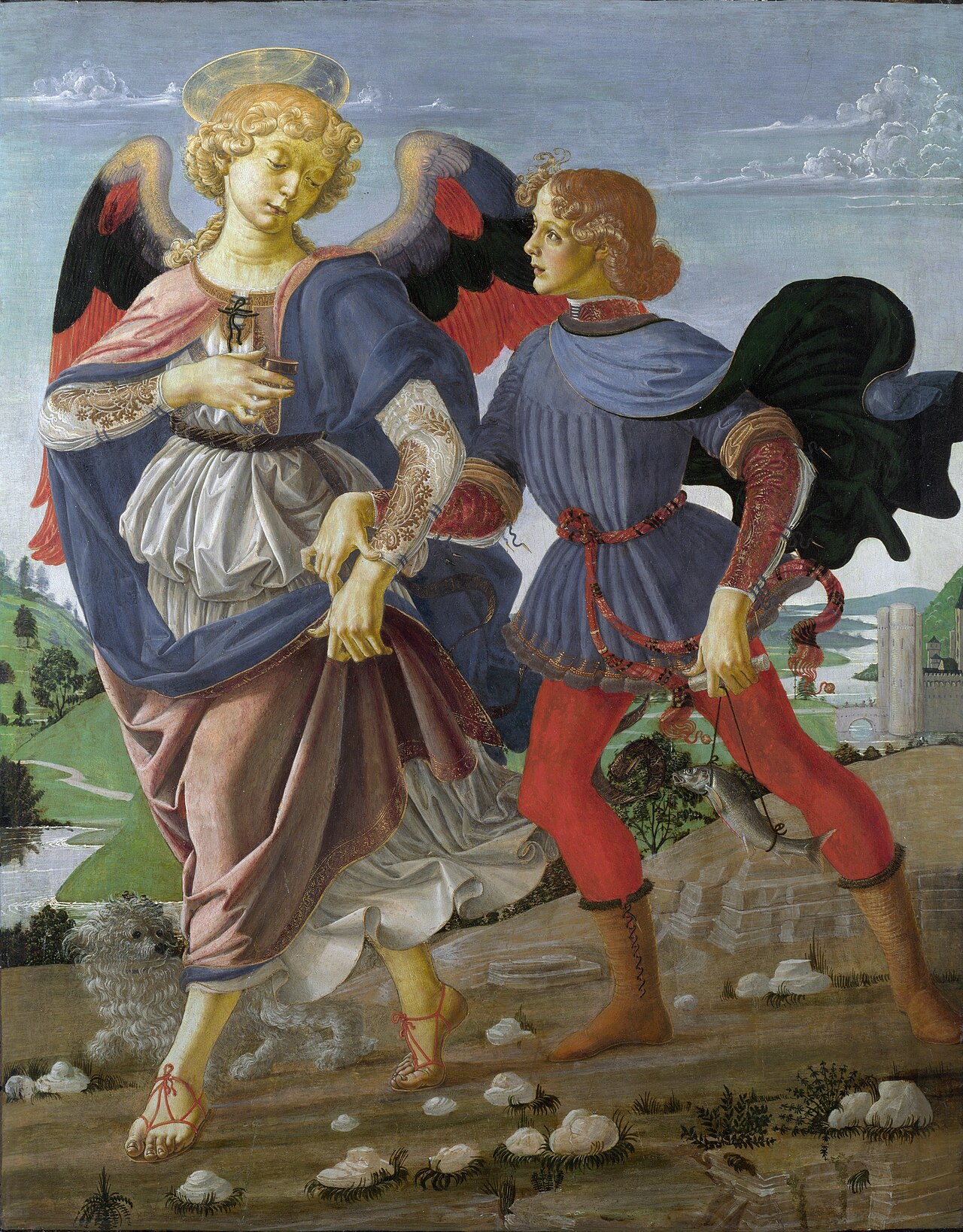
Tobit sends his son Tobias to recover money he had left with a man in Media.[2] Raphael travels with him, accompanied by Tobias's dog.[10] On the way Tobias catches a fish, and Raphael tells him that its organs can be used as a remedy.[10] Tobias uses them to drive away the demon, marries Sarah, and on his return cures his father's blindness.[2][10] The book closes with Tobit's song of thanksgiving and an account of his death.[1]
Britannica describes the book's main concern as reconciling the existence of evil with divine justice, and also points to its call for strict observance of the law by Jews living outside the land of Israel and its hope for Israel's restoration.[1] Toy compared its practical teaching to that of Proverbs and Sirach, noted its emphasis on almsgiving and burial of the dead, and observed that it contains no expectation of a messiah.[2]
Canonical status
A canon is the list of books a religious community accepts as scripture. Tobit was never received into the Jewish canon, and it is not part of the Hebrew Bible.[2] It was, however, included in the Septuagint, the ancient Greek translation of the Jewish scriptures used by early Christians, and through it entered the Catholic canon.[1] The Catholic Encyclopedia describes it as deuterocanonical, meaning a book found in the Greek ("Alexandrian") collection of scripture but not in the Hebrew ("Palestinian") one.[3]
Catholic Church. The earliest Christian canon lists include the book: those of the Council of Hippo (393), the Councils of Carthage (397 and 419), Augustine (397) and Pope Innocent I (405).[3] The Council of Trent, in its fourth session on 8 April 1546, listed "Tobias" among the books of the Old Testament and declared anathema anyone who did not accept those books as sacred and canonical.[5] The Catholic Church counts it as part of the Old Testament on that basis.[3]
Eastern Orthodox churches. The Synod of Jerusalem of 1672, a council of the Eastern Orthodox church convened by Dositheos, patriarch of Jerusalem, declared Tobit, together with Judith, Ecclesiasticus (Sirach) and the Wisdom of Solomon, to be canonical books of the Bible.[6]
Protestant churches. Protestants place Tobit among the Apocrypha.[2] Martin Luther's complete German Bible of 1534 had a separate Apocrypha section, whose title page states that the books in it are not held equal to Holy Scripture but are useful and good to read.[9] The Thirty-Nine Articles of the Church of England, agreed in Latin in 1563 and issued in English in 1571, list "The Book of Tobias" among the other books that, as Article VI puts it, the Church reads "for example of life and instruction of manners" but does not use "to establish any doctrine".[7] The Westminster Confession of Faith (1647), a Protestant confession of faith, states that the books commonly called Apocrypha are not divinely inspired and are no part of the canon of Scripture.[8]
Early reception and influence
Christian writers drew on Tobit from an early date.[3] According to the Catholic Encyclopedia, Polycarp of Smyrna cited Tobit 4:10 and 12:9 when urging almsgiving, Clement of Alexandria quoted it as scripture, Cyprian of Carthage referred to it often as having divine authority, and Ambrose of Milan wrote a treatise, De Tobia, against usury and called the book prophetic.[3] Toy noted that advice in Tobit 4:17 is echoed in similar terms in Sirach.[2]
Tobias and the Angel, by the workshop of Andrea del Verrocchio, about 1470–1475 (National Gallery, London), showing the archangel Raphael walking with the young
The journey of Tobias and the angel became a popular subject in Western art.[10] The National Gallery, London, holds a "Tobias and the Angel" painted in egg tempera on wood by the workshop of Andrea del Verrocchio in about 1470–75, and notes that the subject was popular in late fifteenth-century Florence, in part because Raphael was regarded as a patron of travellers and healers.[10] The gallery records the suggestion that the fish and the dog in that painting were painted by Leonardo da Vinci, who trained in Verrocchio's workshop.[10]
Walter Drum. "Tobias". The Catholic Encyclopedia, vol. 14. Robert Appleton Company, 1912; New Advent online edition, accessed 26 November 2026. newadvent.org/cathen/14749c.htm
Council of Trent. "Session the Fourth" (8 April 1546), decree concerning the canonical Scriptures, trans. J. Waterworth (London: Dolman, 1848). Hanover Historical Texts Project, Hanover College. No date shown; accessed 26 November 2026. history.hanover.edu/texts/trent/ct04.html
Philip Schaff (ed.). "The Westminster Confession of Faith. A.D. 1647". Creeds of Christendom, vol. III. Christian Classics Ethereal Library. No date shown; accessed 26 November 2026. ccel.org/ccel/schaff/creeds3.iv.xvii.ii.html
"The Gruber Collection: Luther's Bible Translations – 1534". Lutheran School of Theology at Chicago. No date shown; accessed 26 November 2026. gruber.lstc.edu/luthers_bible/1534.php
The National Gallery, London. "Workshop of Andrea del Verrocchio, 'Tobias and the Angel', about 1470-5" (NG781). No date shown; accessed 26 November 2026. nationalgallery.org.uk/paintings/NG781