Bitcoin halving
The scheduled cut, every 210,000 blocks, in the number of new bitcoins created with each block.
🚧 Under construction This entry is still being built. What is here has been checked against its sources, but more sections are coming.
The scheduled cut, every 210,000 blocks, in the number of new bitcoins created with each block.
🚧 Under construction This entry is still being built. What is here has been checked against its sources, but more sections are coming.

A Bitcoin halving is the scheduled cut, by half, of the number of new bitcoins that the network creates in each block, written into Bitcoin's rules to occur every 210,000 blocks, which is roughly every four years.[2][4]
The halving follows from a short rule in the software that validates blocks, so it takes effect at a fixed block height.[2] It is the main way Bitcoin's issuance, described in the Bitcoin entry, is made to taper over time.
Each Bitcoin block begins with a special transaction, created by the miner who found the block, that brings new coins into existence. The original design paper, published in 2008 under the name Satoshi Nakamoto, describes this as a way to give nodes an incentive to support the network and "a way to initially distribute coins into circulation, since there is no central authority to issue them".[1] The paper also notes that the incentive can be funded by transaction fees, and that once a "predetermined number of coins" have entered circulation it can "transition entirely to transaction fees".[1] The paper does not itself give the number of coins or a halving schedule; those are set in the software.[1][2]
Bitcoin's developer documentation calls the sum of the new coins and the fees in a block the block reward. The new-coin part is called the subsidy, and it is the part that is halved.[4] The subsidy started at 50 bitcoins per block.[2][4]
In Bitcoin Core, the reference implementation, the function that computes the subsidy for a given block height divides the height by a constant, the subsidy halving interval, to find how many halvings have occurred. It starts from 50 coins and shifts the amount right by that many places, which halves it once for each halving.[2] A code comment in the function states that the subsidy is cut in half every 210,000 blocks, "which will occur approximately every 4 years".[2] The interval is set to 210,000 in the parameters for the main network and for the public test networks, while the regression-test network used by developers sets it to 150.[3] Because the shift works on whole units of the coin's smallest denomination, each halving rounds the amount down, and the function returns zero once the number of halvings reaches 64.[2]
The four-year figure is an estimate rather than a promise: the interval is counted in blocks, not days, so the calendar gap depends on how fast blocks are found. The Bitcoin Wiki, a community-maintained reference, estimates the last bitcoin would be mined near 2140 if mining power had stayed constant, and says the exact date is hard to predict because it may change.[5]
The subsidy halves at block heights that are multiples of 210,000. The community-maintained table at the Bitcoin Wiki lists the subsidy for each period, or era:[5]
Because the subsidy halves while the length of each era stays the same, each era creates half as many coins as the one before: 10,500,000 in the first, then 5,250,000, and so on. The same table gives the total in circulation as 10,500,000 at block 210,000, 15,750,000 at block 420,000, 18,375,000 at block 630,000 and 19,687,500 at block 840,000, which is 93.75 percent of the limit.[5] The total approaches, but stays slightly below, 21 million bitcoins; the Wiki gives the exact limit as 20,999,999.9769 bitcoins, and counts the subsidy as reaching zero at block 6,930,000.[5] Two small events have reduced the real total a little further, according to the same page: a one-satoshi (the smallest unit) underpayment in block 124,724, and 12.5 bitcoins that were never claimed in block 501,726.[5]
Reading the 840,000 total forward gives a rough present-day figure. As of 26 November 2026 the chain tip was at block 977,692, according to the mempool.space block explorer.[6] The 137,692 blocks since the fourth halving at 3.125 bitcoins each add 430,287.5 bitcoins to the 19,687,500 above, so the supply under the schedule is about 20.12 million bitcoins, slightly less in practice because of the unclaimed amounts noted above. That is arithmetic from the published schedule, not a figure reported by any one source. The next halving is at block 1,050,000, which is 72,308 blocks from that tip. If blocks arrive every ten minutes on average, an assumption rather than a reported figure, that is about 502 days, which points to around April 2028, an estimate that moves with the speed of block production.
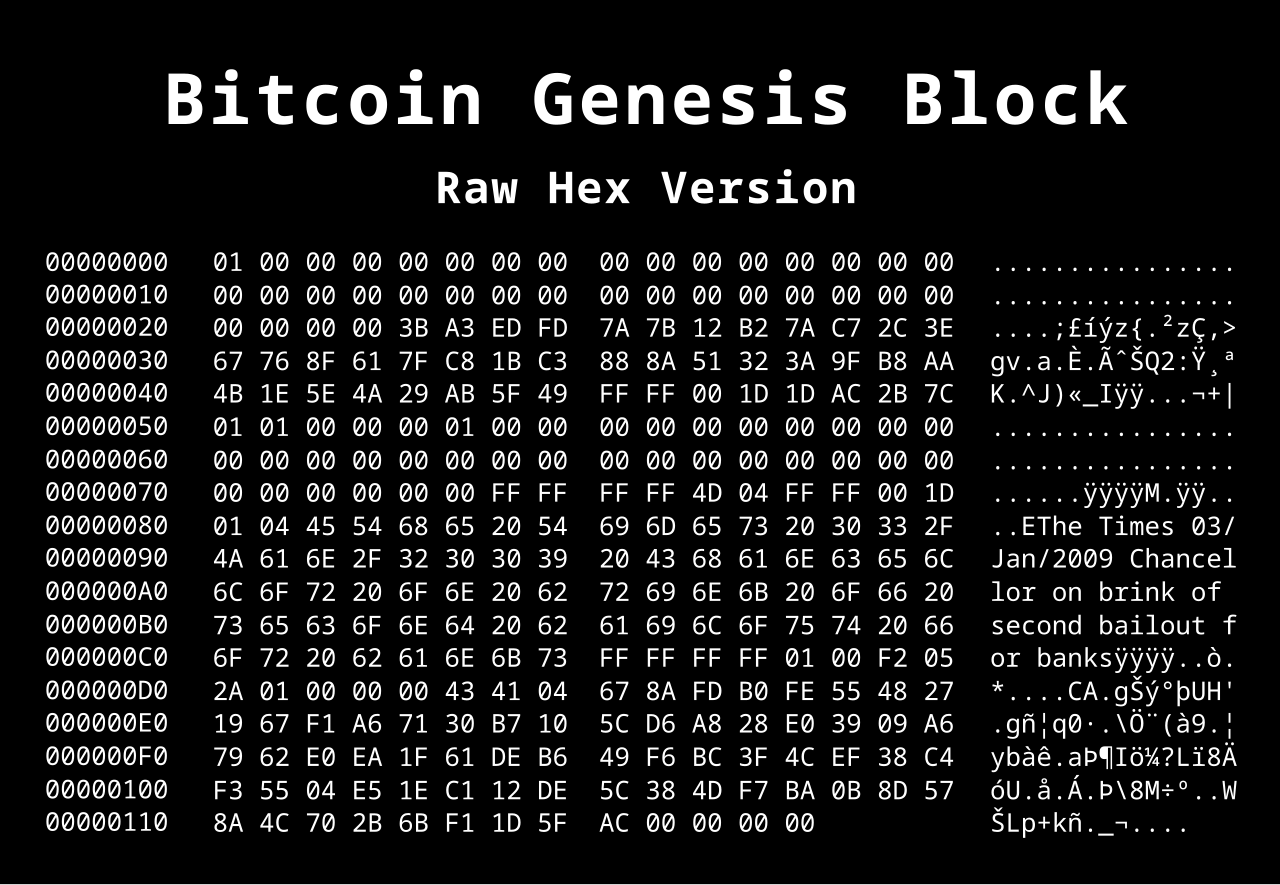
Via Wikimedia Commons: Bitcoin-Genesis-block by Vectorization: Alhadis, public domain.
Four halvings have taken place. The times below are the timestamps recorded in the first block of each new era, as reported by mempool.space.[6]
| Halving | Block | Timestamp (UTC) | Subsidy afterwards |
|---|---|---|---|
| First | 210,000 | 28 November 2012 | 25 |
| Second | 420,000 | 9 July 2016 | 12.5 |
| Third | 630,000 | 11 May 2020 | 6.25 |
| Fourth | 840,000 | 20 April 2024 | 3.125 |
Block 210,000 carries the timestamp 15:24 on 28 November 2012, block 420,000 the timestamp 16:46 on 9 July 2016, block 630,000 the timestamp 19:23 on 11 May 2020, and block 840,000 the timestamp 00:09 on 20 April 2024.[6] The genesis block, the first block of the chain, is timestamped 18:15 on 3 January 2009.[6] Counting from there, the four eras to date lasted about 3 years 10 months, 3 years 7 months, 3 years 10 months and 3 years 11 months, measured from timestamp to timestamp, so each came out a little under four years.[6]
src/validation.cpp, function GetBlockSubsidy, master branch, read 26 November 2026. raw.githubusercontent.com/bitcoin/bitcoin/master/src/validation.cppsrc/kernel/chainparams.cpp, setting nSubsidyHalvingInterval, master branch, read 26 November 2026. raw.githubusercontent.com/bitcoin/bitcoin/master/src/kernel/chainpa… Get Micwyn on your home screenIts own icon, full screen, and notifications.