Black Friday is the Friday after Thanksgiving Day in the United States, traditionally treated as the start of the holiday shopping season and known for widespread retail discounts and large crowds of shoppers.[1]
Place in the shopping year
The holiday it follows, including its fourth-Thursday date, is described in the Thanksgiving entry. Encyclopaedia Britannica describes Black Friday as routinely the busiest US shopping day of the year by number of shoppers, though not necessarily by value of sales.[1]
For much of the 20th century, department stores kept a custom of not advertising goods for Christmas until after Thanksgiving, so the end of the holiday opened the season.[1] According to Britannica, retailers lobbied successfully in 1939 for Thanksgiving to be moved a week earlier to give them a longer selling season, and Congress fixed the holiday's date by law in 1941.[1] After the Second World War, new retailers and shopping malls weakened the department stores' hold, and competition pushed holiday promotions ever earlier.[1]
Origin of the name
Several explanations of the name circulate; historians, lexicographers and fact-checkers accept some and reject others.
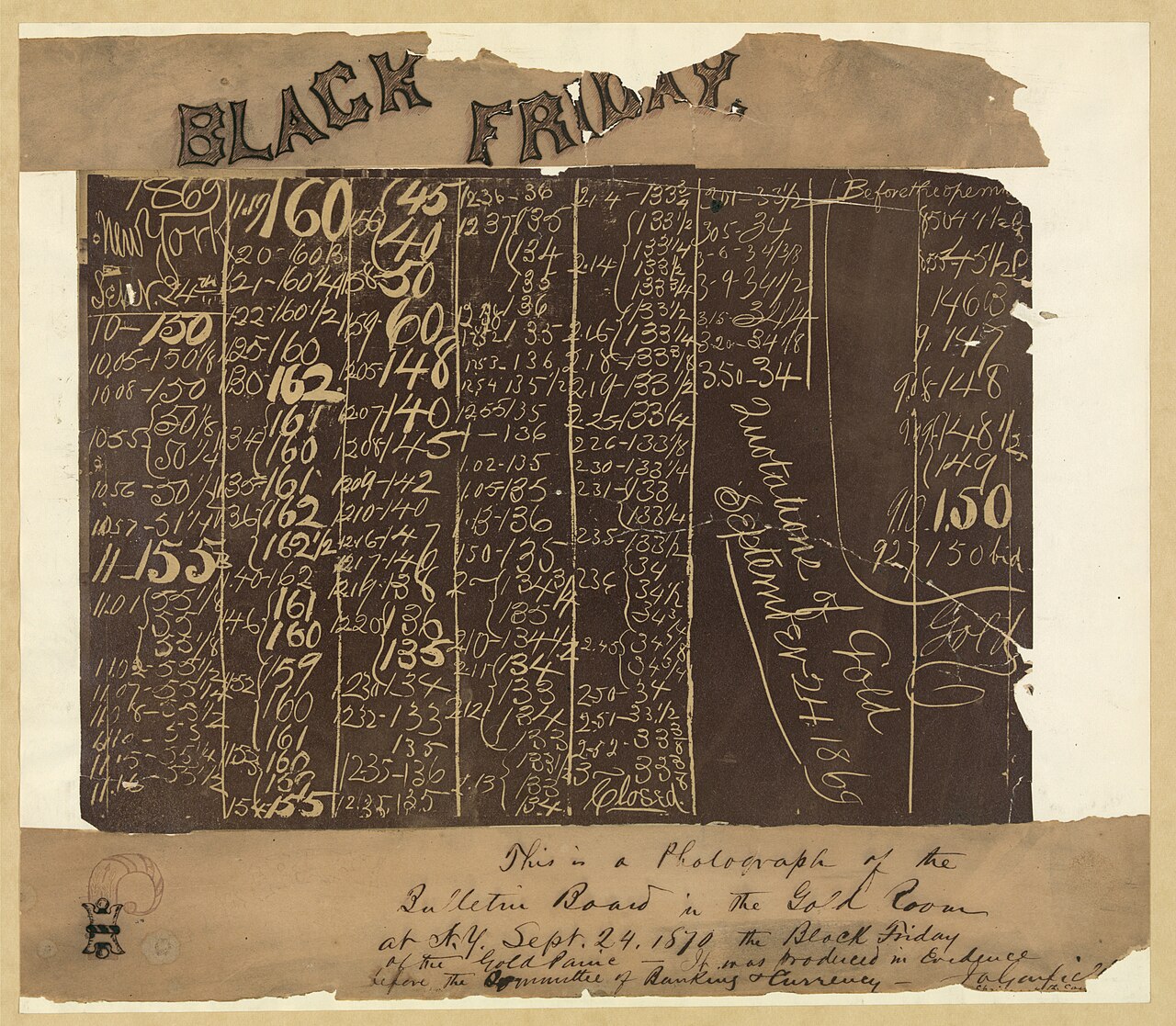
History.com reports that the earliest recorded use of "Black Friday" had nothing to do with shopping: it referred to the crash of the US gold market on Friday 24 September 1869, after the financiers Jay Gould and Jim Fisk tried to buy up as much of the nation's gold as they could to drive its price sharply higher.[2] When their scheme collapsed that day, the stock market fell steeply.[2]
The bulletin board of the New York Gold Room on 24 September 1869, the original "Black Friday", recording the collapse in the price of gold; photograph, 1869.
The linguist Ben Zimmer, writing for Vocabulary.com, reports that the earliest known use of the phrase for the day after Thanksgiving is a 1951 article titled "Friday After Thanksgiving" in the trade journal Factory Management and Maintenance.[4] That article was about workers staying away from their jobs on the day, not about shoppers.[4]
Philadelphia police and traffic
Sources agree that the shopping sense of the name grew up in Philadelphia, but date it differently. History.com says that in the 1950s Philadelphia police used the term for the disorder when suburban shoppers and tourists filled the city ahead of the annual Army–Navy football game, forcing officers onto long shifts while shoplifters exploited the crush.[2] Britannica places the police usage in the 1960s.[1]
Zimmer cites an item in the newsletter Public Relations News of 18 December 1961 reporting that Philadelphia police had come to call the days after Thanksgiving "Black Friday" and "Black Saturday" because of the traffic jams.[4] According to the same item, merchants disliked the label and were advised to promote "Big Friday" and "Big Saturday" instead.[4] History.com reports that the attempt to rename the day failed.[2]
The term spread slowly: Zimmer says it reached other cities in the 1970s and 1980s,[4] History.com says it was not in common national use in 1985,[2] and Britannica dates its national use to the 1980s.[1]
"Back in the black"
A widely repeated explanation holds that the name marks the day when retailers' accounts move from loss to profit, from "in the red" to "in the black" (after the bookkeeping practice of writing losses in red ink and profits in black). Britannica describes this as a more acceptable meaning that retailers offered later.[1] History.com calls it the officially sanctioned but inaccurate story, dating it to the late 1980s,[2] and Zimmer reports that it does not appear in print until the 1980s.[4]
The slave-sale claim
A claim shared widely on social media says the name comes from a day when enslaved people were sold at a discount after Thanksgiving. PolitiFact, in a fact-check published on 1 December 2021, rated false a post saying that Black Friday "originated in 1904" with such sales, and found no evidence linking the day to the sale of enslaved people.[3] It reported that a photograph often shared with the claim in fact shows Aboriginal prisoners in neck chains in Wyndham, Western Australia, and was first published in February 1905.[3] History.com also states that the claim has no basis in fact.[2]
Growth and changing form
Stores gradually opened earlier on the day,[2] and in the 2000s, Britannica notes, some chains began opening at midnight and then on Thanksgiving evening itself.[1] PBS NewsHour, in a report of 22 November 2012 headlined as Black Friday turning into "Gray Thursday", said Walmart would open at 8 p.m. on Thanksgiving Day and that Target, Toys "R" Us, Sears and Gap were among the chains also opening that night.[5] The programme reported that the move had drawn protests and online petitions, and a Financial Times correspondent interviewed on it said labour organisations complained that it spoiled employees' holiday.[5]
Britannica notes that Thanksgiving-night openings largely ended during the COVID-19 pandemic.[1] Target closed its stores on Thanksgiving Day in 2020 and 2021 to limit crowding, and on 22 November 2021 announced that they would stay closed on future Thanksgivings as well.[6]
History.com notes that Cyber Monday, a separate online sales day after the Thanksgiving weekend, emerged as internet shopping grew.[2] Britannica says the steady growth of online sales has reduced Black Friday's standing as the retail industry's single most important day, although it remains a strong marketing occasion.[1]
Recent figures
The National Retail Federation (NRF), a US retail trade association, reported on 2 December 2025 that a record 202.9 million people shopped in stores or online over the five days from Thanksgiving Day to Cyber Monday 2025, up from 197 million in 2024.[7] Black Friday remained the busiest day of that weekend, with 80.3 million in-store and 85.7 million online shoppers, slightly fewer than the 81.7 million and 87.3 million recorded in 2024.[7] The figures come from a survey of 3,099 adults conducted with Prosper Insights & Analytics.[7] Reuters reported on 29 November 2025 that Adobe Analytics, which tracks online retail transactions, put US online spending on Black Friday 2025 at a record 11.8 billion US dollars, up 9.1% on the year before.[8]
Spread beyond the United States
Britannica notes that Black Friday is used as a marketing occasion even in some countries that do not celebrate Thanksgiving.[1]
In the United Kingdom, the American public radio programme Marketplace reported on 24 November 2017 that Amazon's British site offered its first Black Friday discounts in 2010, and that the supermarket chain Asda, which Walmart owned at the time, held its first Black Friday sale in 2013, when fights broke out at several of its stores.[9] Citing earlier reports, Marketplace said police were called to at least seven Tesco stores during Black Friday sales in 2014.[9] Asda stepped away from the event in 2015; its chief executive said that customers did not want to be held hostage to a day or two of sales.[9]
In Canada, The Globe and Mail reported in an undated article that Black Friday bargains began to spread north of the border during the recession, as Canadian retailers used the day to discourage shoppers from crossing into the United States to buy.[10]
Disputes and criticism
Crowds and injuries
Britannica notes that the scramble for scarce goods on Black Friday has sometimes turned violent.[1] On 28 November 2008, a worker at a Walmart store in Valley Stream, New York, died of asphyxiation after being knocked down and trampled by a crowd of about 2,000 shoppers.[11] The federal workplace-safety regulator, the Occupational Safety and Health Administration (OSHA), cited Walmart on 26 May 2009 for a serious violation, proposing the maximum fine then allowed, 7,000 US dollars, and saying effective crowd management could have prevented the death.[11] Walmart contested the citation; an administrative law judge (a judge who hears cases within the agency system) of the Occupational Safety and Health Review Commission upheld it, but after Walmart withdrew its contest the Commission vacated that decision on 18 March 2015.[12]
Labour protests
The Associated Press reported on 23 November 2012 that a union-backed group of current and former Walmart employees, OUR Walmart, protested at stores on Thanksgiving Day and Black Friday over the company's wages, benefits and treatment of workers.[13] The group said hundreds of employees took part nationwide; Walmart said fewer than 50 did and called the group's count of about 1,000 protests "grossly exaggerated".[13]
Bloomberg reported on 25 November 2022 that workers in about 30 countries joined protests and walkouts against Amazon on Black Friday under the banner "Make Amazon Pay", a campaign coordinated by an international coalition of trade unions including UNI Global Union, demanding better pay and conditions; Amazon said it offered competitive wages and benefits.[14]
Criticism of consumerism
Buy Nothing Day, an annual protest against consumerism conceived in 1992 by a Canadian artist and promoted chiefly by the magazine Adbusters, is usually held in North America on the Friday after US Thanksgiving, according to Britannica; similar campaigns have appeared in Asia, Europe, South America and Australia.[15]
False discounts
Spain's Ministry of Social Rights, Consumer Affairs and Agenda 2030 announced on 4 July 2025 that it had fined seven online retailers a total of about 348,000 euros for false discounts during Black Friday 2023.[16] The companies had raised some prices a few days before Black Friday and then lowered them to the original level, advertising the result as a reduction; Spanish law requires a discount's reference price to be the lowest charged in the previous 30 days.[16] The ministry said an investigation into Black Friday 2024 was still open at that date.[16]
Black Friday 2026
Black Friday 2026 falls on 27 November. Before the day, Adobe forecast on 28 September 2026 that US online spending on Black Friday 2026 would reach 12.9 billion US dollars, 9.2% more than in 2025, which would make it the second-largest online shopping day of the season after Cyber Monday.[17] Adobe forecast 275.1 billion US dollars of online spending for the whole November–December 2026 season.[17] These figures are forecasts; no results for Black Friday 2026 had been published when this entry was written on 26 November 2026.
"U.S. Labor Department's OSHA cites Wal-Mart Stores Inc. following crushing death of worker at Long Island, N.Y., store" (news release). US Department of Labor, Occupational Safety and Health Administration. 26 May 2009. dol.gov/newsroom/releases/osha/osha20090526
"Secretary of Labor v. Wal-Mart Stores, Inc., OSHRC Docket No. 09-1013" (Final Order and Decision and Order). Occupational Safety and Health Review Commission. Final Order dated 18 March 2015. oshrc.gov/wp-content/uploads/09-1013.htm