New Year's Day, 1 January, is the first day of the year in the Gregorian calendar, the calendar introduced by Pope Gregory XIII in 1582.[1]
Why the year starts on 1 January
The choice of 1 January goes back to Rome. Roman tradition credited the early king Numa Pompilius with revising the calendar so that January, rather than March, became the first month.[1] The month took its name from Janus, the Roman god of beginnings, who was shown with two faces, one looking back and one looking forward.[2] Britannica notes that the evidence points to 1 January becoming the official start of the Roman year only in 153 BCE.[1][2] When Julius Caesar reformed the calendar in 46 BCE, the resulting Julian calendar kept 1 January as the opening day.[1]
Medieval and early modern year-starts
After the fall of the Western Roman Empire, many Christian countries started the year on a religious feast instead. According to Britannica, 25 March, the Feast of the Annunciation (the angel's announcement to Mary), and 25 December, Christmas, both became common New Year's Days.[1] Britannica's article on New Year festivals adds that most of Christian Europe treated 25 March as the start of the year, while New Year's Day was kept on 25 December in Anglo-Saxon England.[2] The Christmas date itself is covered in the Christmas entry.
In 1582 Pope Gregory XIII introduced a revised calendar, now called the Gregorian calendar, which corrected the Julian leap-year error and restored 1 January as New Year's Day.[1] European countries took up the change at different times: Britannica gives about 1700 for Germany and Denmark, 1752 for England and 1918 for Russia.[2] China adopted the Gregorian calendar in 1912 but continued to celebrate its traditional new year by the lunar calendar.[1]
Moving the start of the year and adopting the Gregorian calendar were separate steps. In Scotland, King James VI proclaimed that the year should begin on 1 January from 1600, according to the National Records of Scotland.[3] England did not follow, even after James also became king of England in 1603, so for more than 150 years a date between 1 January and 24 March could fall in different years on either side of the border; some documents of the period carry double dates such as "1 February 1699/1700".[3] Scotland, together with England, Wales and Ireland, adopted the Gregorian calendar itself only in 1752.[3]
The change in England came with the Calendar (New Style) Act 1750. Its preamble records that the legal year in England began on 25 March, a practice that differed from the reckoning used in Scotland and by almost all other nations of Europe.[4] The Act provided that after the last day of December 1751, the next day would be 1 January 1752, the first day of the new year.[4] It also corrected the calendar by omitting eleven days: the day after 2 September 1752 was to be called 14 September.[4] Britain's American colonies made the same change in 1752.[1]
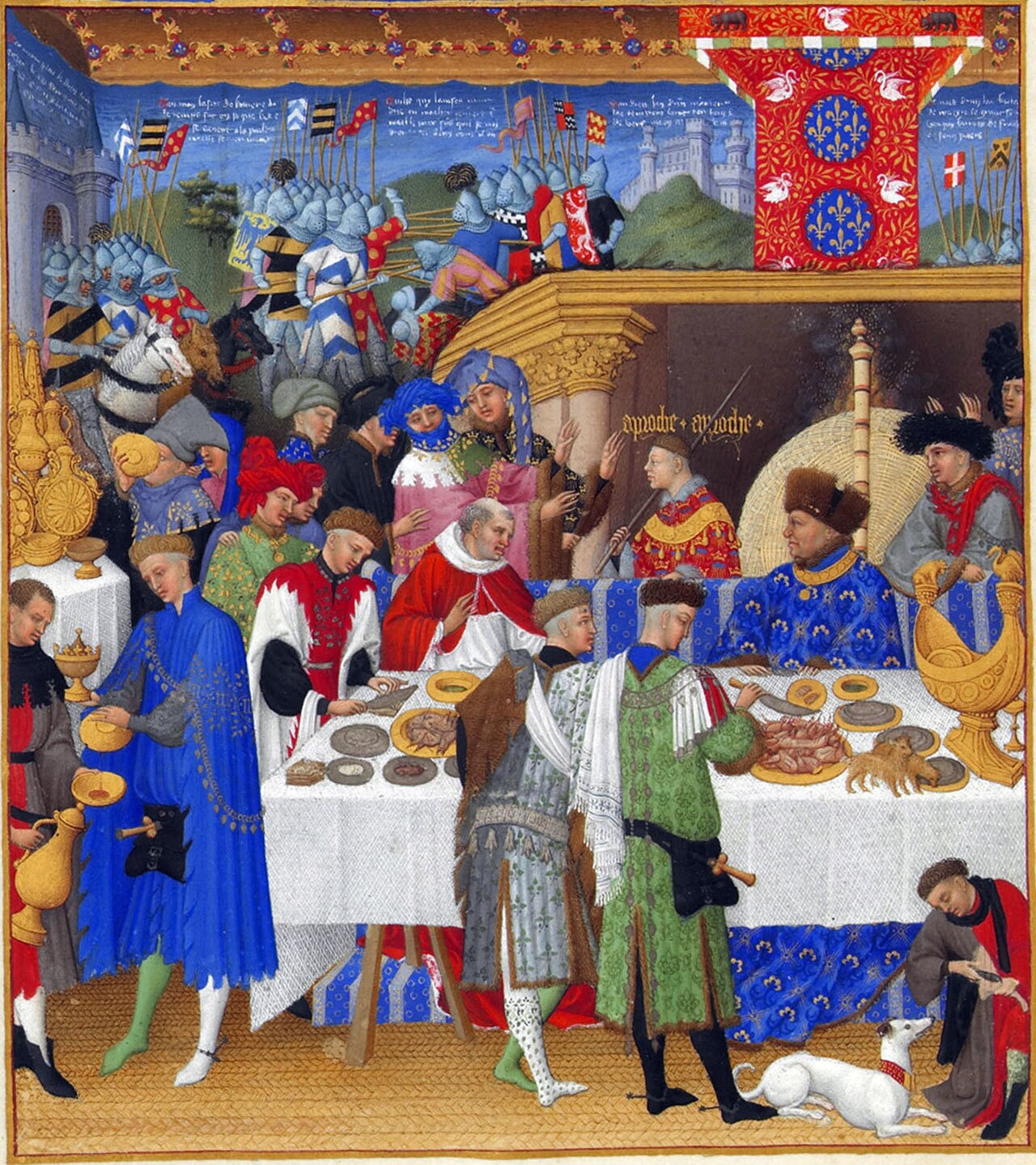
The January page of the Très Riches Heures du duc de Berry, a book of hours painted by the Limbourg brothers between about 1412 and 1416, showing the Duke of Be
The Roman Catholic Church celebrates 1 January as the Solemnity of Mary, the Holy Mother of God, which closes the octave (the eight-day celebration) of Christmas, according to the United States Conference of Catholic Bishops.[5] The same page notes that 1 January is also the World Day of Peace, with prayers for peace suggested for the day.[5]
In the Church of England, 1 January is kept as the Naming and Circumcision of Jesus in its Common Worship calendar.[6]
In the Orthodox Church in America's calendar for Friday 1 January 2027, the day commemorates the Circumcision of Jesus Christ and St Basil the Great, archbishop of Caesarea in Cappadocia, who died in 379.[7]
New Year's Day as a public holiday in 2027
In 2027, New Year's Day falls on Friday 1 January. The US Office of Personnel Management lists Friday 1 January 2027 as a federal holiday.[8] Because 1 January 2028 falls on a Saturday, the same schedule lists Friday 31 December 2027 as the day treated as the New Year's Day holiday for 2028 for federal pay and leave purposes.[8]
In the United Kingdom, a royal proclamation of 8 July 2026, made under the Banking and Financial Dealings Act 1971, appointed Friday 1 January 2027 as a bank holiday in England, Wales and Northern Ireland.[9]
In Japan, the new year holiday, Shōgatsu, is a three-day celebration from 1 to 3 January, according to Britannica.[2]
New Year's Eve customs
Times Square and the ball drop
By 1904, New York's Times Square, named after the newly built New York Times building, was already a gathering place on New Year's Eve, with fireworks set off from the building at midnight.[10] After fireworks were banned in 1907, a ball decorated with electric lights was lowered instead; The New York Times announced on 31 December 1907 that the building would be lit in honour of the birth of 1908.[10] The first ball, built of iron and wood and weighing about 700 pounds (317 kg), was designed by Jacob Starr, an electric sign designer.[10] According to Britannica, a ball has been lowered every year since, except during the wartime "dimouts" of 1942 and 1943.[10] Britannica links the idea to "time balls", which were dropped at a set hour so that ships' captains could check their clocks; one was installed at the Royal Observatory in Greenwich in 1833.[10]
"Auld Lang Syne" and Hogmanay
The song most associated with New Year's Eve in many countries is "Auld Lang Syne", whose words are by the Scottish poet Robert Burns.[11] The Library of Congress holds a manuscript of the song that was once part of a letter Burns wrote to his correspondent Frances Anna Dunlop; authorities date it to 1788.[11] Burns called it an old song and wrote that he had taken it down from an old man's singing, but, as the Library's folklorist notes, most scholars believe Burns wrote at least two of its verses himself.[11] The words were first printed in the fifth volume of James Johnson's Scots Musical Museum, issued in 1796, the year Burns died; the tune now sung became standard through a later edition published by George Thomson.[11]
In Scotland, New Year is called Hogmanay, a festival also kept in parts of northern England.[12] Britannica states that singing "Auld Lang Syne" at New Year began at Hogmanay and has since spread worldwide.[12] Another Hogmanay custom is "first footing": the first visitor to cross the threshold after midnight is held to bring luck, traditionally a tall, dark-haired man carrying a gift such as coal or salt.[12][2] The name Hogmanay was also used for the bread, cake or sweets given to children, and the festivities can last until 2 January.[12]
Japan: the temple bells
At temples throughout Japan, worshippers take turns striking the temple bell as midnight approaches on New Year's Eve, in a ceremony called Joya no Kane.[13] The bell is struck 108 times, a number explained as ridding people of 108 earthly temptations or vices.[13]
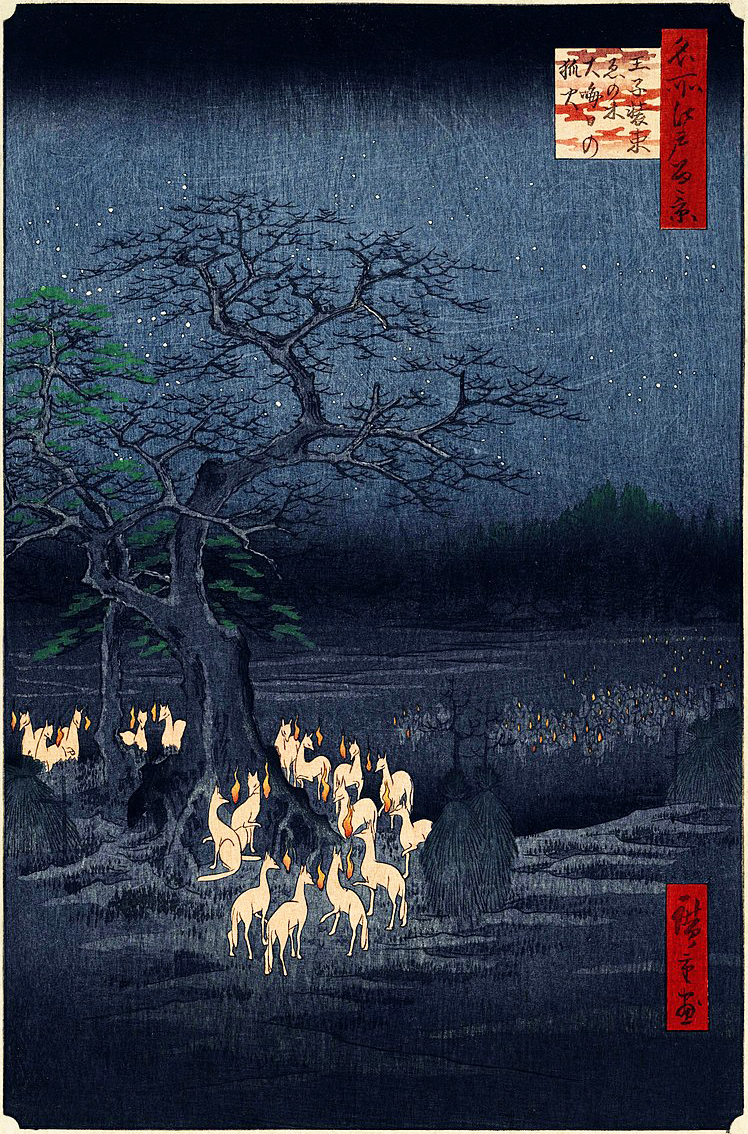
"New Year's Eve Foxfires at the Changing Tree, Ōji", a woodblock print by Utagawa Hiroshige from One Hundred Famous Views of Edo, 1857, showing foxes gathered a
In Spain, people eat twelve grapes, one at each of the twelve midnight chimes; in Madrid the chimes are those of the clock on the Real Casa de Correos in the Puerta del Sol, where a ball is lowered from the top of the tower a few seconds before midnight.[14] Madrid's official tourism site gives, as the most popular of the explanations for the custom, that in 1909 wine growers from the Levante region had a surplus of grapes, gave them away, and claimed that eating them on New Year's Eve brought good luck.[14] The site presents this as a popular account rather than a documented origin.
Other customs
Britannica lists eating symbolic foods among common New Year customs, giving the example of Europeans who eat cabbage or other greens for prosperity in the coming year.[2] It describes the making of resolutions, promises to give up bad habits and take up better ones, as a practice that dates to ancient times.[2]
Other new year dates
Many calendars begin the year on a date other than 1 January.[2] Dates for 2027, from the sources named:
Lunar (Chinese) New Year: Saturday 6 February 2027, according to the Hong Kong Labour Department's list of statutory holidays for 2027.[15] Britannica notes that the Chinese New Year is celebrated officially for a month beginning in late January or early February.[2]
Nowruz: described by Britannica as an ancient Zoroastrian festival celebrated as a cultural new year in Iran, which notes that for the ancient Persians the year began at the vernal (spring) equinox.[2] A United Nations General Assembly resolution adopted on 23 February 2010 recognised 21 March as the International Day of Nowruz, stating that the festival is celebrated on 21 March each year by more than 300 million people.[16]
Rosh Hashanah (Jewish New Year), 5788: begins at sundown on Friday 1 October 2027 and ends at nightfall on Sunday 3 October 2027, according to the Hebcal Jewish calendar.[17] Rosh Hashanah falls on the first day of the month of Tishri, which Britannica places between 6 September and 5 October.[2]
Islamic New Year, 1 Muharram 1449: the Islamic calendar is lunar, with years of normally 354 days, and its year begins with the month of Muharram.[2] Published calendars differ on the 2027 date. University College London's diversity calendar for 2026–27 lists 8–9 June 2027, noting that such holy days usually begin at sundown the day before.[18] The calendar site Islamic.app gives Saturday 5 June 2027 and states that its dates follow the tabular (calculated) Hijri calendar and may shift by a day depending on local moon sighting.[19]
Other examples: Ethiopia celebrates its New Year, Enkutatash, in September.[1] Tibetans observe Losar in February, and in Thailand the new year festival, Songkran, falls in mid-April.[2]
The Editors of Encyclopaedia Britannica. "New Year festival." Encyclopaedia Britannica. No date shown; accessed 26 November 2026. britannica.com/topic/New-Year-festival
The Church of England. "The Naming and Circumcision of Jesus, 1 January" (Common Worship: Services and Prayers for the Church of England, printable page). The Church of England. No date shown; accessed 26 November 2026. churchofengland.org/node/3913/printable/print
Orthodox Church in America. "Scripture Readings: Friday, January 1, 2027." OCA. No date shown; accessed 26 November 2026. oca.org/readings/daily/2027/01/01
King Charles III. "Proclamation appointing Friday 1st January 2027, Monday 3rd May 2027 and Tuesday 28th December 2027 as bank holidays" (England, Wales and Northern Ireland). Privy Council Office. 8 July 2026; accessed 26 November 2026. privycouncil.independent.gov.uk/wp-content/uploads/2026/07/2026-07-…
The Editors of Encyclopaedia Britannica (revised by Amy Tikkanen). "Hogmanay." Encyclopaedia Britannica. No date shown; accessed 26 November 2026. britannica.com/topic/Hogmanay
Japan Ministry of Land, Infrastructure, Transport and Tourism, multilingual explanation text on a temple bell tower and the Joya no Kane ceremony (PDF). mlit.go.jp. No date shown; accessed 26 November 2026. mlit.go.jp/tagengo-db/common/001565710.pdf
Tourism Madrid (esMadrid, Madrid Destino). "Twelve grapes / New Year's Eve in Puerta del Sol." esmadrid.com. Last updated 01/06/2026; accessed 26 November 2026. esmadrid.com/en/node/76740
Labour Department, Government of the Hong Kong Special Administrative Region. "Statutory Holidays for 2027." No date shown; accessed 26 November 2026. labour.gov.hk/eng/news/latest_holidays2027.htm