Kwanzaa is an annual week-long holiday, celebrated mainly in the United States from 26 December to 1 January, that Maulana Karenga created in 1966 to affirm African and African American family, community and cultural values.[1][2]
Dates
Kwanzaa has fixed dates. It begins on 26 December and ends on 1 January, which the official Kwanzaa website describes as both the last day of Kwanzaa and the first day of the new year.[1][2] In 2026 it runs from Saturday 26 December 2026 to Friday 1 January 2027.[3] Each of the seven days is given to one of seven principles, and Encyclopaedia Britannica describes a community feast, the karamu, held on 31 December.[2]
Creation in 1966
The official Kwanzaa website, run by the Organization Us (usually written US), says Kwanzaa "was established in 1966 in the midst of the Black Freedom Movement".[1] Britannica says Karenga created it that year to introduce his seven principles on a national level.[4] The historian Elizabeth Pleck, in a 2001 article in the Journal of American Ethnic History summarised by JSTOR Daily, described Karenga founding a Black nationalist organisation after the 1965 Watts riots in Los Angeles and the holiday growing out of an Africa-themed feast for about 50 people held in Karenga's apartment.[5]
The name comes from the Swahili phrase matunda ya kwanza, "first fruits", and Britannica notes that "Kwanzaa" is not itself a Swahili word.[1][2] The official website and Britannica both explain the extra final "a" as giving the name seven letters, one for each of seven children at an early celebration.[1][2]
According to the official website, Kwanzaa is modelled on continental African first-fruits (first-harvest) festivals. Among them it lists the Zulu Umkhosi, the Swazi Incwala, the Ashanti Odwira and the Yoruba new-yam festivals, and it says these were chosen because they were widespread across Africa, giving the holiday a Pan-African rather than an ethnically specific character.[1] Britannica says the concept draws on Southern African first-fruits celebrations.[2] These statements describe what the founder drew on; the holiday itself is a modern creation, which Pleck compared with other relatively recent holidays tied to national identity, such as Bastille Day and St Patrick's Day.[5]
The official website says Kwanzaa "is not a religious holiday, but a cultural one with an inherent spiritual quality". It says the holiday was not created as an alternative to anyone's religion or as a substitute for Christmas, and that people of many faiths, among them Christians, Muslims, Jews, Buddhists, Hindus and Bahá'ís, can take part.[1] Britannica likewise says the holiday was conceived as nonreligious and is not considered a substitute for Christmas.[2]
Principles
The core of the holiday is the Nguzo Saba ("seven principles"), part of a body of thought Karenga named Kawaida, a Swahili word that Britannica glosses as custom or tradition.[1][4] In the order of the seven days they are:
Umoja (unity)
Kujichagulia (self-determination)
Ujima (collective work and responsibility)
Ujamaa (cooperative economics)
Nia (purpose)
Kuumba (creativity)
Imani (faith)[1][2]
The official website gives the customary greeting during the week as the Swahili question "Habari gani?", answered with the principle of the day: "Umoja" on the first day, "Kujichagulia" on the second, and so on.[1]
Symbols
The official website lists seven basic symbols and two supplemental ones.[1] The basic symbols and what the website says they stand for are:
mazao (the crops): African harvest celebrations and the rewards of collective work;
mkeka (the mat): tradition and history, the foundation on which the community builds;
kinara (the candle holder): roots in continental African peoples;
muhindi (the corn): children and the future they embody;
kikombe cha umoja (the unity cup): unity;
mishumaa saba (the seven candles): the seven principles;
zawadi (the gifts): the labour and love of parents and the commitments children make and keep.[1]
The supplemental symbols are the bendera (flag), in black, red and green, which the website identifies as the colours of US and traces to the flag associated with Marcus Garvey, and a poster or other written copy of the Nguzo Saba.[1] The website gives the colours' meanings as black for the people, red for their struggle, and green for the future and hope that come from that struggle.[1]
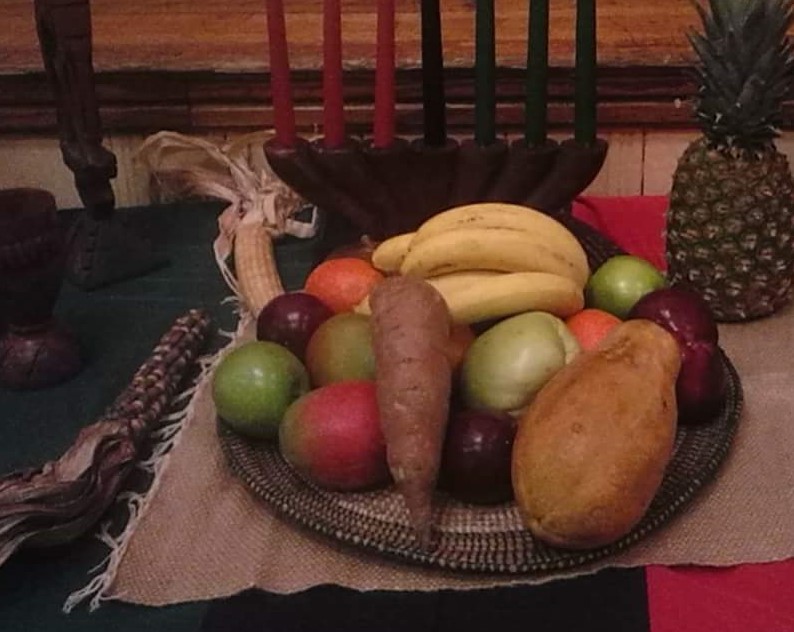
A Kwanzaa table with a kinara holding red, black and green candles, a basket of fruit, ears of corn, a sweet potato and a cup, photographed on 26 December 2018.
The official website describes laying African cloth and the mkeka in a central place in the home, placing the other symbols on or beside the mat, and setting the seven candles in the kinara: one black candle in the centre for Umoja, three red candles to its left and three green candles to its right.[1] The black candle is lit on the first day and the others on the following days from left to right, which the website says shows that the people come first, then the struggle, then the hope that comes from the struggle.[1] Britannica describes families gathering each day to light a candle and discuss that day's principle, and some participants wearing traditional African clothing.[2] The website says gifts are mainly for children and should always include a book and a heritage symbol.[1] The last day, 1 January, is the Day of Meditation (Siku ya Taamuli), which the website presents as a time of reflection and recommitment.[1]
Britannica says that, although Kwanzaa is primarily an African American holiday, it is also observed in the Caribbean and in other countries with large populations of African descent.[2] Pleck found that, as Kwanzaa spread, it came to be accepted as a supplement to Christmas rather than an alternative to it, took in Christian songs, and became associated with Black middle-class identity.[5]
Founder
Maulana Karenga was born Ronald McKinley Everett on 14 July 1941 in Parsonsburg, Maryland, according to Britannica.[4] Britannica says he adopted the title Maulana, which he used to mean "master teacher", in the 1960s, and took the surname Karenga from a Kikuyu word he interpreted as "keeper of tradition".[4] He co-founded US on 7 September 1965.[4] He earned a bachelor's degree (1963) and a master's degree (1964) in political science at the University of California, Los Angeles (UCLA), a PhD in political science from United States International University in San Diego (1976) and a PhD in social ethics from the University of Southern California (1994).[4] In 1989 he became professor and chair of the Black (later Africana) Studies Department at California State University, Long Beach (CSULB); his books include Introduction to Black Studies (1982) and The African American Holiday of Kwanzaa (1988).[4]
As of 5 November 2025, CSULB described him as professor and chair of its Department of Africana Studies, executive director of the African American Cultural Center and chair of the National Association of Kawaida Organizations, and announced that he would retire after more than six decades of scholarship and activism.[6] He issues an annual founder's message for the holiday; as of November 2026 the official website gave the 2026 theme as "Embracing the Principles and Culture of Kwanzaa: Creating, Celebrating and Sharing Good in the World".[1]
Public record
Britannica says US came into conflict with other groups in the Black Power movement, including the Black Panther Party, over ideology, methods and primacy.[4] On 17 January 1969 two Black Panther Party members, Alprentice "Bunchy" Carter and John Huggins, were killed on the UCLA campus; the 1976 final report of the US Senate's Select Committee to Study Governmental Operations with Respect to Intelligence Activities (the Church Committee) records that they were killed by US members after a meeting involving the two organisations and university students.[7]
The same report found that the Federal Bureau of Investigation (FBI), through COINTELPRO, its covert counterintelligence programme against political groups, worked to aggravate the hostility between the Panthers and US, for example by mailing cartoons ridiculing the Panthers that were falsely attributed to US.[7] The committee wrote that it could not establish a direct link between any specific FBI effort to promote violence and particular acts of violence, but that it had established "beyond doubt" that high FBI officials wanted to promote violent confrontations between the groups.[7]
Britannica reports that Karenga was charged in 1970 with torturing two female members of US and was convicted of assault and false imprisonment in 1971.[4] The Los Angeles Times reported on 18 September 1971 that Superior Court Judge Arthur L. Alarcon had sentenced him the previous day to one to ten years in state prison for feloniously assaulting a young woman in May 1970, an offence of which he and three of his followers had been convicted about four months earlier.[8] According to Britannica, Karenga denied the charges and said they were politically motivated, and he was released on parole in 1975.[4]
Criticism and debate
Criticism of Kwanzaa dates from its first years. According to Pleck, as summarised by JSTOR Daily, some Black Muslims objected to the holiday on religious grounds and some other Black Americans saw it as divisive; the same summary cites a 1997 article by Scot Ngozi-Brown in the Journal of Black Studies for the Black Panther Party's opposition to both Karenga and Kwanzaa.[5]
Some critics reject the holiday outright. The Associated Press (AP) reported in December 2009 that the Rev. Jesse Lee Peterson called it racist.[9] Others point to its founder's criminal record: in April 2022 The Dispatch, a US news site, examined social-media posts by the group Turning Point USA saying that the founder of Kwanzaa was a convicted felon, and rated that claim true.[10]
Others raise commercialisation and the holiday's changing meaning. Keith Mayes, a University of Minnesota historian and author of Kwanzaa: Black Power and the Making of the African-American Holiday Tradition, told the AP in 2009 that the Black Power movement had been the holiday's "engine", that Kwanzaa faded as that movement receded, and that mainstream institutions had repackaged it as a celebration of inclusion, diversity and multiculturalism.[9] Pleck noted that it had taken on consumer elements similar to those of Christmas.[5] The official website, for its part, distinguishes cooperative vendors and artists, which it links to the principle of Ujamaa, from corporate marketing that seeks to dominate the Kwanzaa market.[1]
How many observe it
Estimates of how many people celebrate Kwanzaa differ widely.[9][11] In 2009 Mayes estimated that between 500,000 and 2 million people in the United States celebrated it and said participation had levelled off after a boom in its first two decades, while the African American Cultural Center, of which Karenga was then executive director, put worldwide observance at 30 million.[9] An AP-NORC poll of 1,053 US adults, taken from 5 to 9 December 2019 with a margin of error of plus or minus 4.0 percentage points, found that 3% planned to celebrate Kwanzaa that season, against 92% for Christmas and 5% for Hanukkah.[11]
Official recognition
The United States Postal Service issued its first Kwanzaa stamp in 1997, designed by the artist Synthia Saint James and highlighting Kuumba; new designs followed in 2004, 2009, 2011 and 2013, and a sixth design, also by Saint James, was dedicated in Charleston, South Carolina, on 1 October 2016, the holiday's 50th anniversary year.[12] President George W. Bush issued a presidential message for Kwanzaa in December 2006 that spoke of families honouring "their rich African heritage" and reflecting on the seven principles.[13]
The Editors of Encyclopaedia Britannica (most recent revision by Alicja Zelazko). "Kwanzaa". Encyclopaedia Britannica. No date shown; accessed 26 November 2026. britannica.com/topic/Kwanzaa
Melissa Mayntz. "When Is Kwanzaa 2026? Dates, Meaning, and the Seven Principles". Farmers' Almanac. Updated 20 August 2026; accessed 26 November 2026. farmersalmanac.com/when-is-kwanzaa
Laura Payne and the Editors of Encyclopaedia Britannica. "Maulana Karenga". Encyclopaedia Britannica. No date shown; accessed 26 November 2026. britannica.com/biography/Maulana-Karenga
Erin Blakemore. "What is Kwanzaa?" JSTOR Daily. 28 December 2015, modified 4 December 2021; accessed 26 November 2026. daily.jstor.org/what-is-kwanzaa (summarises Elizabeth Pleck, "Kwanzaa: The Making of a Black Nationalist Tradition, 1966-1990", Journal of American Ethnic History 20, no. 4 (2001), and Scot Ngozi-Brown, Journal of Black Studies 28, no. 2 (1997)).
California State University, Long Beach, College of Liberal Arts. "Dr. Maulana Karenga, Kwanzaa Creator and Africana Studies Pioneer, to Retire". 5 November 2025; accessed 26 November 2026. csulb.edu/node/622171
United States Senate, Select Committee to Study Governmental Operations with Respect to Intelligence Activities (Church Committee). "The FBI's Covert Action Program to Destroy the Black Panther Party", Final Report, Book III. 1976. Copy hosted by the Assassination Archives and Research Center; accessed 26 November 2026. aarclibrary.org/publib/church/reports/book3/pdf/ChurchB3_3_BlackPan…
Alec Dent. "Fact Check: Was the Founder of Kwanzaa Convicted of Kidnapping and Torture?" The Dispatch. 18 April 2022; accessed 26 November 2026. thedispatch.com/?p=16177
AP-NORC Center for Public Affairs Research. "Happy Holidays: Festive or Stressful?" 20 December 2019; accessed 26 November 2026. apnorc.org/?p=1146