Hanukkah (also spelled Chanukah) is an eight-day Jewish festival, beginning on the 25th of the Hebrew month of Kislev, that marks the rededication of the Second Temple in Jerusalem after the Maccabean revolt and is observed by lighting lamps or candles each night.[8][1]
Name and dates
The Hebrew word hanukkah means "dedication", and the festival is also known in English as the Festival of Lights, the Feast of Dedication and the Feast of the Maccabees.[6][8] It begins on 25 Kislev and lasts eight days.[8] Because its date is fixed on the Hebrew calendar, it falls on a different Gregorian date each year, usually in December.[8][1]
In 2026, according to the Jewish calendar site Hebcal, Hanukkah begins at sundown on Friday 4 December 2026 (25 Kislev 5787) and ends at nightfall on Saturday 12 December 2026 (2 Tevet 5787).[1] Hebcal's schedule for 2026 lists the first candle, on Friday 4 December, as lit before sundown and the second, on Saturday 5 December, as lit at nightfall, rather than at dusk as on the other weekday nights.[1] The same page lists Hanukkah in 2025 as running from 14 to 22 December, and in 2027 as beginning on 24 December.[1]
The events and the sources that record them
Background and revolt
In the 2nd century BCE Judea was under the Seleucid Empire, whose rulers My Jewish Learning calls the Syrian Greeks.[1][6] According to My Jewish Learning, the Seleucid king Antiochus IV Epiphanes, who reigned from 175 to 164 BCE, sought to impose Hellenistic (Greek) culture and, by 167 BCE, had defiled the Temple in Jerusalem and banned Jewish practice.[8][6] A revolt followed, led by the sons of the priest Mattathias, especially Judah, known as Judas Maccabeus; after a three-year campaign the rebels recovered Jerusalem and cleansed and rededicated the Temple.[6] My Jewish Learning dates the rededication to 25 Kislev in 164 BCE.[6] The family is also called the Hasmoneans.[8]
The books of Maccabees
The story is told in the First and Second Books of Maccabees.[6] The First Book of Maccabees describes Judas and his brothers finding the sanctuary desolate, its altar profaned and its gates burned; they pulled down the defiled altar, built a new one of unhewn stones, made new holy vessels and restored the lampstand.[2] It says that on the 25th day of the month of Chislev (Kislev), in the 148th year by the book's count, they offered sacrifice on the new altar with songs and instruments, celebrated the dedication for eight days, and decreed that it be kept every year for eight days from that date.[2] The Second Book of Maccabees gives a shorter account: the sanctuary was purified on the same day of the year on which it had been profaned, the 25th of Chislev, and the people celebrated for eight days "in the manner of" the Festival of Booths (Sukkot, an autumn festival), and decreed by public vote that the whole nation should keep these days every year.[3][6]
Neither book is part of the Jewish Bible.[6] The Catholic Church, by its own account, has always accepted both as inspired scripture and calls them "deuterocanonical", while Jews and Protestants regard them as apocryphal; the introduction to 1 Maccabees published by the United States Conference of Catholic Bishops says the book was written in Hebrew around 100 BCE, survives in an early Greek translation, and that its account of the rededication "is the origin of the Jewish feast of Hanukkah".[9] Britannica notes that the festival is not mentioned in the Hebrew Scriptures.[8]
Josephus
The historian Flavius Josephus, writing about 250 years after the events, retold the rededication in his Antiquities of the Jews (book 12, sections 316 to 326).[6][4] He describes Judas purifying the Temple, building a new altar and celebrating an eight-day festival with sacrifices, hymns and psalms on the 25th of Casleu (Kislev), three years after the Temple's profanation.[4] Josephus says the annual festival was called "Lights", and suggests the name came from the people's unexpected new freedom, which "appeared" to them.[4]
The Talmud and the jar of oil
The story most widely told about Hanukkah first appears in the Babylonian Talmud, which My Jewish Learning describes as completed roughly 600 years after the Maccabean events.[6] In the tractate Shabbat (page 21b), the Talmud asks what Hanukkah is and answers with an earlier rabbinic teaching: when the Greeks entered the sanctuary they defiled its oils, and when the Hasmoneans prevailed they searched and "found only one cruse of oil" sealed by the High Priest; it held enough to burn for a single night, but "a miracle occurred and they lit the candelabrum from it eight days", and the following year the days were made a festival with Hallel (psalms of praise) and thanksgiving.[5][7] The books of Maccabees and Josephus, as read for this entry, do not tell this story.[2][3][4] Louis Jacobs, writing in the Encyclopedia of Religion in 1987, calls it the "Talmudic legend" and observes that the earliest sources do not present Hanukkah as a festival of lights; he reads 2 Maccabees as explaining the eight days by the Jews' inability to keep the eight-day festival of Sukkot during the war.[7] My Jewish Learning suggests that the rabbis who retold the oil story may have been passing on an older oral legend.[6]
Later accounts also circulated, among them the Scroll of Antiochus, described by Britannica as an early medieval account of Hanukkah that some communities read in synagogue or at home.[8]
The lamp
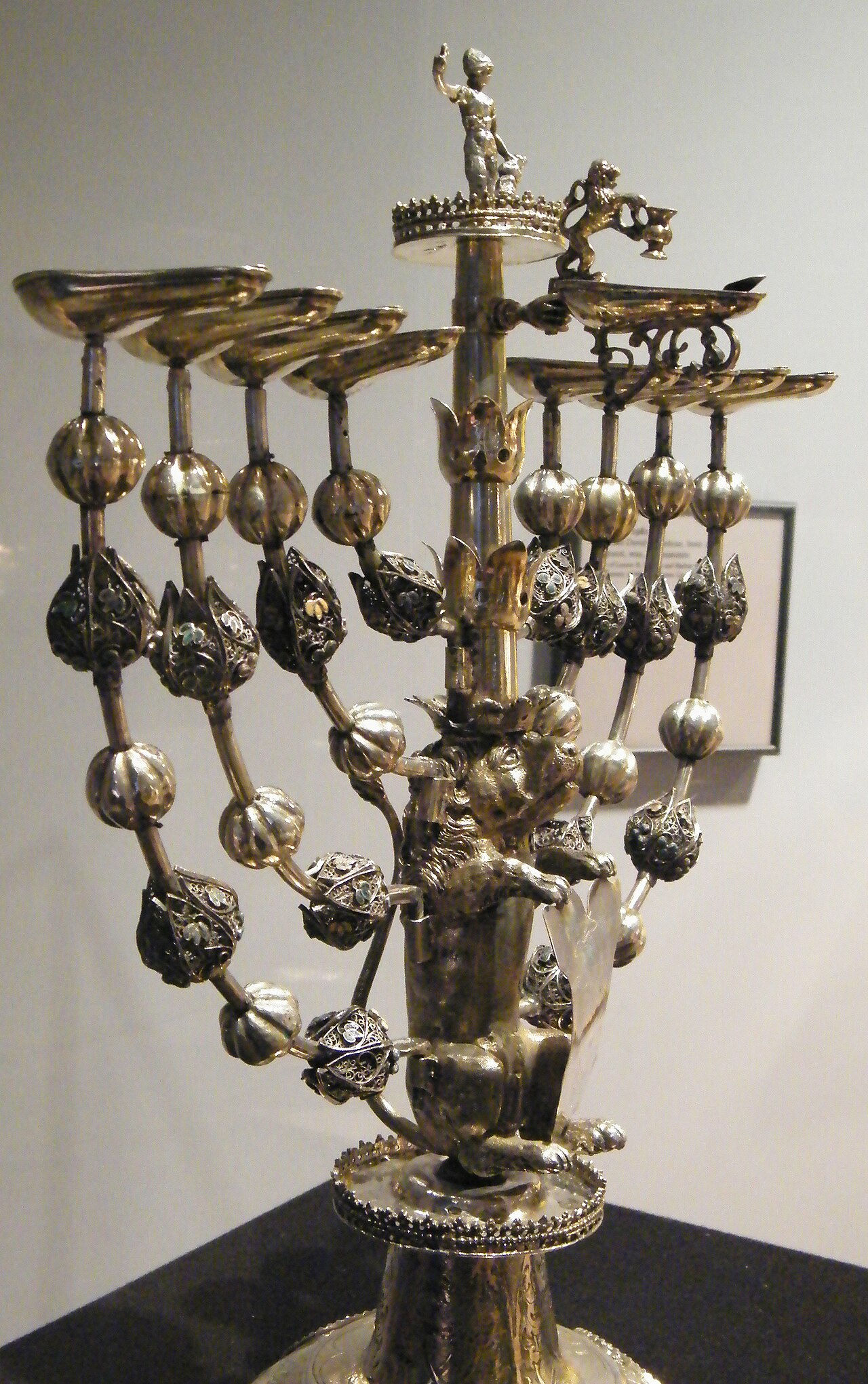
A silver Hanukkah lamp made by Johann Adam Boller in Frankfurt am Main between 1706 and 1732, in the Jewish Museum, New York, photographed in 2009.
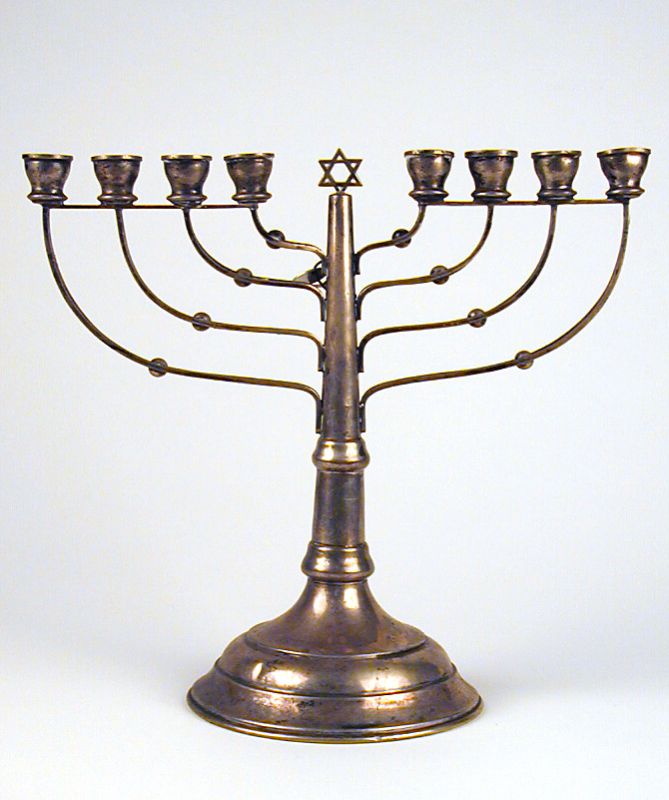
The central custom is the lighting of a lamp each evening.[8] The lamp is called a menorah or hanukkiah (the Hebrew name for the nine-branched Hanukkah lamp); it has eight lights in a row plus a ninth, the shamash ("servant"), used to light the others.[1][8][7] Chabad.org teaches that the shamash should stand at a different height from the eight lights, that the eight should be in a straight, even line, and that their light is not to be used for ordinary purposes, while the shamash's light may be.[10]
The Talmud records three levels of the practice: at a minimum, one light each night for the whole household; a more careful custom of one light for each member of the household; and the most careful practice of varying the number each night.[5] On that last point it records a dispute between two schools of sages, which Jacobs places at the beginning of the Common Era: Beit Shammai (the school of Shammai) held that one lights eight lights on the first night and one fewer each night after, while Beit Hillel (the school of Hillel) held that one lights one light on the first night and one more each night after.[5][7] The Talmud gives explanations for both: Shammai's count matches the days still to come, or the descending number of bull offerings on Sukkot, and Hillel's matches the days already passed, or the principle that holiness should increase rather than decrease.[5] Common practice follows Beit Hillel: one light on the first night, rising to eight on the last.[7][8] Candles are placed from right to left and lit from left to right, so that the newest is lit first.[10][8]
Before lighting, two blessings are said each night, thanking God for the commandment to kindle the Hanukkah lights and for the miracles done for the ancestors; on the first night a third, the Shehecheyanu, thanks God for granting life.[10] Chabad.org says the whole household should gather for the lighting in order to publicise the miracle, called pirsum ha-nes, which it calls an essential part of the festival.[10]
A 19th-century Hanukkah lamp from Austria-Hungary, with eight cups on curved arms and a Star of David at the top, in the Musée d'Art et d'Histoire du Judaïsme,
That aim shapes where the lamp is put. The Talmud says the lamp should be placed at the entrance of the house on the outside; a person living upstairs places it in a window facing the public street; and in a time of danger it may be placed on a table indoors.[5] According to Jacobs, later authorities discouraged lighting outside the door, and the usual practice became lighting near the door but inside the home.[7]
Prayers and other customs
The full Hallel is recited with a blessing on all eight days, and a passage called Al ha-Nissim ("For the miracles") is added to the thanksgiving blessing of the Amida, the central standing prayer of each service, and to the grace after meals.[12] As Jacobs describes it, the added prayer thanks God for delivering the strong and the many into the hands of the weak and the few.[7] A special Torah reading each day describes the offerings brought by the leaders of the tribes at the dedication of the Tabernacle.[12] Britannica notes that Hanukkah lacks the work restrictions of the major festivals such as Rosh Hashana and Yom Kippur.[8]
A game of chance is played with the dreidel, a four-sided spinning top, sometimes for coins.[8] The Union for Reform Judaism describes it as adapted from an older German game, noting that Hanukkah was one of the few times of year when rabbis allowed games of chance.[11] Its four Hebrew letters, nun, gimel, hei and shin, are read as standing for the phrase nes gadol hayah sham, "a great miracle happened there"; in Israel the shin is replaced by a pe, for "a great miracle happened here".[11][8]
Foods fried in oil, such as latkes and sufganiyot (a kind of doughnut), are traditional, and are explained as a reminder of the miracle of the oil.[8] Children also receive Hanukkah gelt, sometimes in the form of chocolate coins wrapped in gold foil.[8]
Modern observance
Judaism classes Hanukkah as a minor festival, below the Sabbath, Passover and the High Holidays, as the historian Dianne Ashton of Rowan University said in a 2013 NPR interview about her book Hanukkah in America: A History.[13] In that interview Ashton traced the festival's rise in the United States to mid-19th-century debates over who should lead American Judaism, in which each side presented itself as the Maccabees of the modern era, and to the late 19th century, when rabbis, religious leaders and women's organisations urged parents to give children gifts on each night of Hanukkah so that they would feel happy about being Jewish at the season when Christian children were celebrating Christmas.[13] She described Hanukkah as a "boundary holiday" that grew because it falls when American culture is most visibly Christian, and noted that some Jews worry that commercialism distorts its meaning.[13] Jacobs likewise describes children's presents as customary and links the practice to Christmas gift-giving.[7]
In Israel, Britannica describes Hanukkah as a national holiday during which schools close, menorahs are displayed on the Knesset (parliament) and a torch relay runs from Modiin to the Western Wall in Jerusalem.[8] Jacobs, writing in 1987, noted that large Hanukkah lamps on public buildings were a common sight in Israel.[7]
Chabad.org reported in 2020 that the Lubavitcher Rebbe, Rabbi Menachem M. Schneerson, began a campaign in 1974 to raise awareness of the holiday and hold public menorah lightings.[14] As part of that campaign, a lighting began in 1979 in Lafayette Park in Washington, D.C., where President Jimmy Carter lit the shamash; President Ronald Reagan publicly called it the "National Menorah" in 1982.[14] By Chabad's 2020 account, the movement's National Menorah Council advises public lighting ceremonies around the world, which it numbered in the thousands.[14]
On 14 December 2025, the first day of Hanukkah that year, gunmen attacked a public Hanukkah event, "Chanukah by the Sea", at Bondi Beach in Sydney, Australia.[15][1] An Associated Press report, last updated on 14 December 2025 US Eastern time, gave the death toll as 16, citing officials, and Prime Minister Anthony Albanese called the attack an act of antisemitic terrorism.[15]
"2 Maccabees 10" (New Revised Standard Version, Catholic Edition). Bible Hub. No date shown; accessed 26 November 2026. biblehub.com/nrsvce/2_maccabees/10.htm
My Jewish Learning. "The History of Hanukkah." My Jewish Learning. No date shown (page metadata: last modified 21 November 2023); accessed 26 November 2026. myjewishlearning.com/article/hanukkah-history/
United States Conference of Catholic Bishops. "1 Maccabees" (introduction, New American Bible, Revised Edition). USCCB. No date shown; accessed 26 November 2026. bible.usccb.org/bible/1maccabees/0
Eliezer Melamed. "Al Ha-nisim, Hallel, and Torah Reading." Peninei Halakha, Zemanim, chapter 11 (Hanuka), section 8. No date shown; accessed 26 November 2026. ph.yhb.org.il/en/05-11-08/
Michel Martin and Dianne Ashton. "How Hanukkah Got Americanized" (transcript). Tell Me More, NPR. November 2013 (no exact date shown on the transcript page); accessed 26 November 2026. npr.org/transcripts/247516340
Aharon Loschak. "Washington, D.C. Menorah Brightens a Nation Darkened by Pandemic." Chabad.org. 14 December 2020; accessed 26 November 2026. chabad.org/article.asp?aid=4977259
Associated Press. "Gunmen kill at least 16 people during a Jewish celebration on Sydney's Bondi Beach." PBS NewsHour. 14 December 2025 (updated 14 December 2025, 3:16 p.m. EST); accessed 27 November 2026. pbs.org/newshour/world/gunmen-kill-at-least-11-people-during-a-jewi…