The Gospel of Thomas is an early Christian collection of 114 sayings attributed to Jesus, preserved complete in a Coptic copy found in Egypt in 1945 and in part in older Greek fragments.
It is a different work from the Infancy Gospel of Thomas, which tells stories of Jesus as a child. It is not part of the New Testament, and is counted among the writings described in the entry on New Testament apocrypha.
What it is
The work consists entirely of sayings, with no narrative.[1] It does not tell the story of the life and death of Jesus.[3] Its opening lines present the contents as hidden or secret words spoken by "the living Jesus" and written down by Didymos Judas Thomas.[2][3] Both "Thomas", from a Semitic word, and "Didymos", from Greek, mean "twin".[3] The usual numbering divides the text into 114 sayings.[2] Some resemble sayings in the New Testament gospels, such as the parable of the sower, and others do not.[2][1]
The Greek fragments
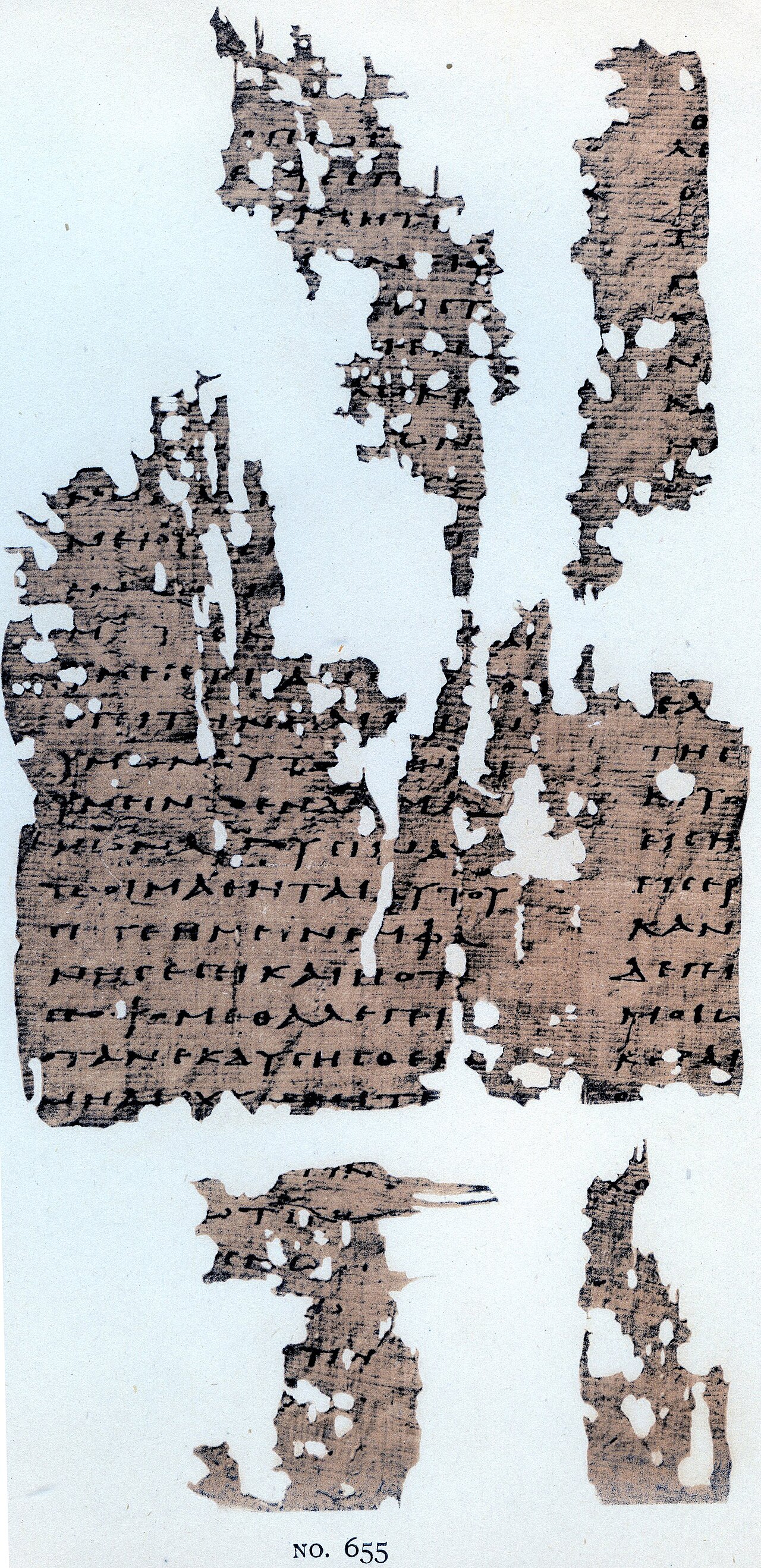
In 1896–97 excavators working in the ancient rubbish heaps of Oxyrhynchus, a town south of Cairo, recovered a leaf of papyrus with sayings that each begin "Jesus says".[1] Its discoverers, the Oxford scholars B. P. Grenfell and A. S. Hunt, published it in 1897 as Sayings of Our Lord, dating its handwriting to not much later than the year 200.[1] Catalogued as P.Oxy. 1, it is held by the Bodleian Library in Oxford, which describes it as a third-century copy.[1] The leaf comes from a codex, a book with pages, and not from a scroll.[1] Two more Greek fragments from Oxyrhynchus, P.Oxy. 654 and 655, were later published.[4]
A page of an ancient copy of the Gospel of Thomas.
Via Wikimedia Commons: P. Oxy. 655 by Unknown author Unknown author, public domain.
None of these could then be identified with a particular work. That became possible after the Coptic text was found.[1][4]
Nag Hammadi
In 1945 a group of papyrus books was discovered near Nag Hammadi in Upper Egypt.[1] One of them, a codex of the later fourth century now in the Coptic Museum in Cairo and known as Nag Hammadi Codex II, contains a complete Coptic version of the Gospel of Thomas among other works.[1] Coptic is a late form of the Egyptian language. Comparison showed that the Greek fragments belong to the same work, in a version close to the Coptic but not identical.[1]
A fragment published in 2023
On 31 August 2023 the Egypt Exploration Society's series The Oxyrhynchus Papyri published a further fragment, P.Oxy. 5575, in volume 87.[4] It combines material paralleling Matthew, Luke and saying 27 of Thomas, so it is not a plain copy of either a New Testament book or Thomas.[4] Daniel B. Wallace, one of its editors, writes that he and his colleagues dated it to the late second or perhaps early third century, which would make it the oldest known witness to any text of Thomas.[4]
Date of composition
The age of the surviving copies is not the age of the work, and its date is debated. The Smithsonian's National Museum of Asian Art, in an account of P.Oxy. 1, suggests the Greek version was first composed perhaps in the mid-second century, or earlier.[1] The Princeton historian Elaine Pagels has said that the text cannot be reconstructed with certainty as it stood around the year 100, but that it very likely existed then and that much of its material goes back to the first century.[3]
Early references
Ancient Christian writers mention a gospel under Thomas's name, though not always clearly the same one. Hippolytus of Rome, describing a group he calls the Naassenes, says they quoted a passage from a "Gospel inscribed according to Thomas".[5] The passage he quotes does not match the Coptic text word for word.[5][2] The church historian Eusebius named the gospels of Peter and of Thomas among books put forward by heretics under the names of apostles.[6] Cyril of Jerusalem told his hearers not to read a Gospel according to Thomas, saying it was the work of a disciple of Mani, founder of Manichaeism, and not of one of the twelve apostles.[7] Because the infancy gospel also circulated under Thomas's name, a bare mention does not always show which work a writer meant.
Read it
Marvin Meyer's English translation, The Gospel of Thomas (HarperOne, 1992), includes an introduction, notes and the Coptic text. Micwyn does not host its text: the book's page shows where to borrow or buy it.