New Zealand is an island country in the south-western Pacific Ocean, made up of the North Island, the South Island and many smaller islands, with Wellington as its capital.[1]
Geography
New Zealand lies in the South Pacific and is counted as part of Polynesia, one of the main island regions of the Pacific.[1] Britannica places it more than 1,000 miles (1,600 km) south-east of Australia, which it calls the country's nearest neighbour.[1] The two main islands, the North Island and the South Island, are accompanied by numerous smaller islands.[1] Britannica gives a total area of 265,700 square kilometres (102,587 square miles), slightly less than the US state of Colorado.[1] Wellington is the capital and Auckland is the largest urban area.[1]
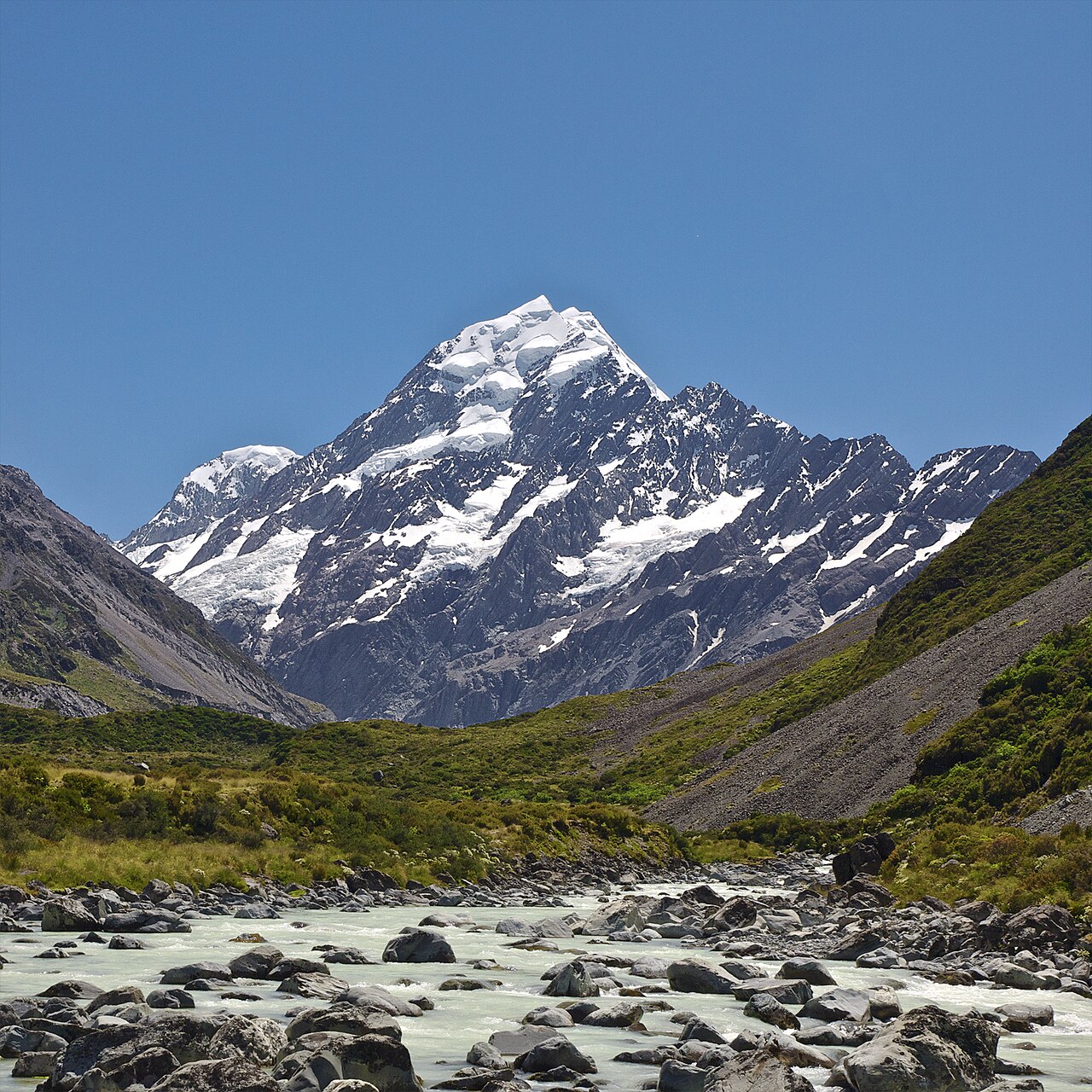
Britannica lists active volcanoes, caves, glacial lakes, fjords (long, narrow sea inlets between steep cliffs), beaches and the mountain chain of the Southern Alps.[1] Long isolation meant that much of the native wildlife evolved in its own way; the flightless kiwi is the best-known example.[1] Large birds called moa also lived in New Zealand until people arrived; Te Ara, the Encyclopedia of New Zealand, says they were hunted to extinction within roughly 100 to 200 years of human settlement.[2]
Beyond its two main islands, New Zealand administers the island group of Tokelau, claims a sector of Antarctica, and is in free association with the self-governing Cook Islands and Niue, according to Britannica.[1]
People and languages
Stats NZ, the national statistics office, estimated the provisional resident population of Aotearoa New Zealand at 5,357,300 at 30 June 2026.[3]
Stats NZ's national summary of the 2023 Census gives these shares of the total population by ethnic group: European 67.8 per cent, Māori 17.8 per cent, Asian 17.3 per cent, Pacific peoples 8.9 per cent, and MELAA (Stats NZ's grouping for Middle Eastern, Latin American and African peoples) 1.9 per cent (the shares add up to more than 100 per cent).[4] Britannica says that the gap between Māori and the descendants of British settlers has narrowed since the 1970s, while educational and economic differences between the two groups remain.[1]
New Zealand has three official languages: English, Māori (te reo Māori) and New Zealand Sign Language, the last of which became official on 10 August 2006.[1] Te reo Māori was made an official language when the Maori Language Act came into force on 1 August 1987.[5] NZHistory, the history website of the Ministry for Culture and Heritage, explains that by the mid-20th century there were fears the language was dying out, and that the Waitangi Tribunal heard the Te Reo Māori claim in 1985, two years before the Act.[5] The Act set up the Maori Language Commission, renamed Te Taura Whiri i te Reo Māori in 1991.[5]
Māori history
Settlement
The first settlers of New Zealand were Polynesian voyagers.[2] In Te Ara's entry on the question, Geoff Irwin and Carl Walrond conclude that the various methods of dating agree that permanent Polynesian settlement was established by around 1300 CE.[2] Radiocarbon dates that are considered reliable all fall after 1250, and early settlement sites lie above a layer of volcanic ash from the Kaharoa eruption, dated to 1314.[2] Māori genealogies (whakapapa), counted back at 25 years per generation, point to arrival between about 1325 and 1400, although the authors describe this method as imprecise.[2] A much earlier date of 50 to 150 CE, based on the dating of rat bones, has been put forward but is disputed, and other evidence such as rat-gnawed seeds supports arrival around 1250 to 1300.[2]
The Treaty of Waitangi
The Treaty of Waitangi (te Tiriti o Waitangi) is an agreement made in 1840 between the British Crown and Māori chiefs (rangatira).[6][7] NZHistory states that about 40 chiefs signed it at Waitangi on 6 February 1840; the Waitangi Tribunal gives the number who signed there as between 43 and 46 rangatira, alongside Captain William Hobson and several English residents.[6][7] By the end of 1840, according to NZHistory, about 500 more Māori, including 13 women, had added their names or moko (tattoo designs used as signatures), and all but 39 of them signed the Māori-language text.[6]
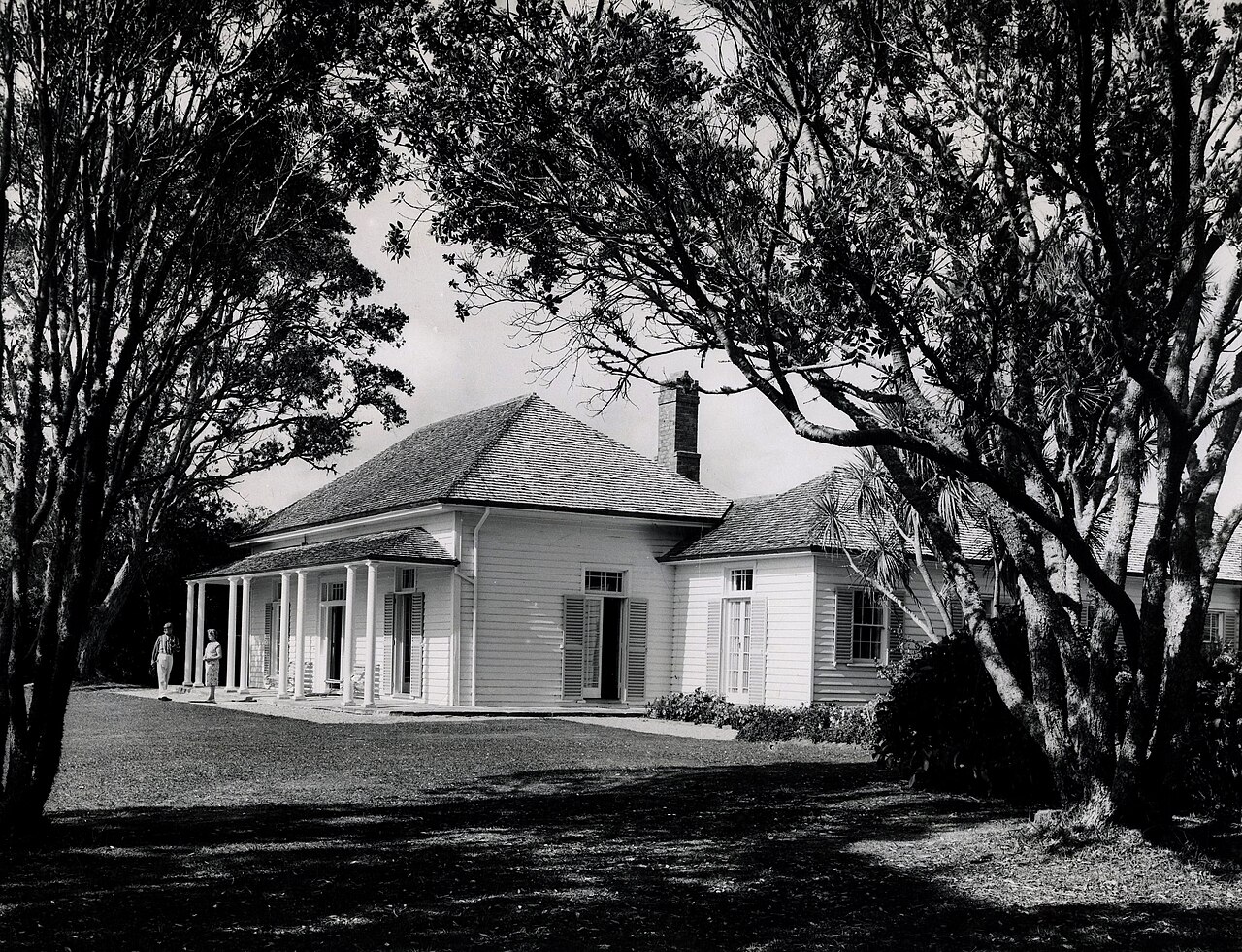
The Treaty House at Waitangi, once the residence of James Busby, in a black-and-white photograph from Archives New Zealand.
The Treaty exists in two texts, one in te reo Māori and one in English, and the Waitangi Tribunal states that the Māori text is not an exact translation of the English.[7] The Tribunal sets out the main differences as follows:
In Article 1 of the Māori text, Māori gave the British "kawanatanga", the right of governance, whereas the English text says Māori ceded "sovereignty"; the Tribunal notes that sovereignty had no direct equivalent in Māori society.[7]
In Article 2, the Māori text uses "rangatiratanga" in promising to uphold the authority that tribes had always held over their lands and taonga (treasured things), while the English text emphasises undisturbed possession of property.[7]
On the Crown's right of pre-emption (the sole right to buy Māori land), the Tribunal says that scholars and the Tribunal itself have concluded that Māori and the Crown held different understandings of the provision.[7]
The Waitangi Tribunal, which inquires into Māori claims against the Crown under the Treaty, was set up by the Treaty of Waitangi Act 1975.[8] In 1985 Parliament allowed it to investigate events going back to 1840.[8] As of November 2026, the Tribunal's website states that it has registered 2501 claims, fully or partly reported on 1028 claims and issued 123 final reports.[8]
The meaning of the 1840 agreement remains contested. On 14 November 2014 the Tribunal released its report on stage 1 of the Te Paparahi o Te Raki inquiry, concluding that the rangatira who signed in February 1840 did not cede their sovereignty to Britain; it found that they agreed to share power and authority with Britain and to the Governor having authority to control British subjects in New Zealand, and that Britain, although it went into the negotiation intending to acquire sovereignty, did not explain this clearly.[9] The Tribunal stated that the report said nothing about how and when the Crown acquired the sovereignty it exercises today.[9] Responding to the report, Treaty Negotiations Minister Chris Finlayson was quoted by the New Zealand Herald as saying there was no question that the Crown has sovereignty in New Zealand and that the report did not change that fact.[10] The same article quoted the historian Paul Moon of Auckland University of Technology as saying the report distorted New Zealand history and undermined the Tribunal's credibility.[10]
The Treaty Principles Bill
Disagreement about the Treaty came before Parliament again with the Treaty Principles Bill, a measure of the ACT party that aimed to redefine the principles of the Treaty.[11] RNZ reported on 11 April 2025 that the bill had been voted down at its second reading by 112 votes to 11, with every party except ACT opposing it.[11] More than 300,000 submissions were made on the bill, a record, and Parliament's Justice Committee reported that 90 per cent of them opposed it.[11] Te Pāti Māori co-leader Rawiri Waititi said the bill had divided the nation, while ACT's David Seymour said the debate over the Treaty's principles would continue and that he hoped to revive the bill after the following year's election.[11]
Later history
Colony to independent state
Great Britain annexed New Zealand in 1840.[1] Britannica traces its constitutional path to a self-governing colony in 1856 and a dominion in 1907; it did not become fully independent until 1947, when it adopted the Statute of Westminster.[1] A parliament was first set up in 1854.[12]
The New Zealand Wars
Conflict over sovereignty and land led to fighting between government forces and some Māori tribes (iwi) in the 1840s and 1860s, a series of campaigns now known as the New Zealand Wars.[13] In Te Ara's account by Danny Keenan, the two main periods of conflict were the mid-1840s and the 1860s, and the largest campaign was the clash between the Kīngitanga (the Māori King movement) and the Crown.[13] From 1864 to 1872 the fighting was carried on largely by colonial troops and their Māori allies.[13] After the wars the government confiscated significant areas of Māori land in the North Island.[13] Government forces occupied the settlement of Parihaka on 5 November 1881 and partly destroyed it.[13]
Votes, wars and the twentieth century
From 1867 Māori men aged 21 and over could vote for four Māori members of Parliament.[12] In 1893, Te Ara states, New Zealand became the first country to give women the vote.[12]
New Zealand fought in both world wars.[1] NZHistory states that just over 100,000 New Zealanders served overseas in World War I, more than 18,000 died as a result of the war and over 40,000 more were wounded.[14] In 1953 the New Zealander Edmund Hillary and the Sherpa Tenzing Norgay climbed Mount Everest, an event Britannica highlights in its account of the country.[1]
The economy long depended on exporting farm products, especially to Great Britain, before a broader industrial sector developed.[1] Parliament's upper house, the Legislative Council, was abolished in 1951, and since 1996 elections have been held under the mixed-member proportional (MMP) system, which combines local electorate seats with seats allocated by party vote.[12]
Government
New Zealand is a constitutional monarchy: the monarch is head of state and is represented in New Zealand by a governor-general, while an elected prime minister heads the government.[1] As of November 2026, Britannica lists King Charles III as head of state and Christopher Luxon as prime minister.[1] It is a member of the Commonwealth.[1]
The 2026 election
Prime Minister Christopher Luxon announced on 21 January 2026 that the general election would be held on Saturday 7 November 2026.[15] The Electoral Commission's timetable set the dissolution of Parliament for 1 October, election day for 7 November, the declaration of official results for 27 November and the last day for the return of the writ (the formal document confirming the result) for 3 December.[15]
ABC News reported on 27 November 2026 that the official results, which included roughly 400,000 special votes, gave Luxon's three-party governing coalition 65 seats, one short of a majority.[16] The final seat totals it reported were National 40, Labour 36, Green 17, ACT 13, New Zealand First 12, Opportunity 7 and Te Pāti Māori 5.[16] Labour leader Chris Hipkins said his party had won the popular vote, while accepting that this did not guarantee a path to government.[16] ABC reported that if no coalition or confidence-and-supply agreement (a deal to support a government in key votes without joining it) could be reached, New Zealand would have to hold fresh elections.[16]
Economy
New Zealand has historically relied on exports of agricultural products, and tourism has played an increasingly important part in the economy.[1]
1News reported on 17 September 2026, citing Stats NZ, that the economy grew 0.2 per cent in the June 2026 quarter and that gross domestic product (GDP, the total value of goods and services produced) rose 1.7 per cent in the 12 months to June.[17] The same report said GDP per person rose 0.1 per cent in the quarter, and that construction rose 2.7 per cent while transport, postal and warehousing fell 1.7 per cent.[17] Finance Minister Nicola Willis noted that the Reserve Bank had forecast flat growth for the quarter, while Labour's finance spokesperson Barbara Edmonds said real GDP per person was lower than when Labour left office.[17]
For trade in goods, Stats NZ reported that goods exports rose by $509 million (7.9 per cent) to $7.0 billion in October 2026, compared with October 2025.[18] The currency is the New Zealand dollar.[1]
Culture
Britannica notes that immigration has helped shape New Zealand's culture.[1] Te reo Māori has been an official language since 1987, and the body set up to look after it, the Maori Language Commission, has been known since 1991 as Te Taura Whiri i te Reo Māori.[5]
In rugby union, New Zealand Rugby's All Blacks website states that haka (Māori posture dances, often performed as a challenge) have been part of New Zealand rugby for more than 130 years, and that the All Blacks perform two haka, Ka Mate and Kapa O Pango.[19]
New Zealand Sign Language has been the country's third official language since 2006.[1]
"Story summary" (Te Ara story on Parliament). Te Ara – the Encyclopedia of New Zealand. No date shown; accessed 28 November 2026. teara.govt.nz/node/211106
Danny Keenan. "New Zealand wars". Te Ara – the Encyclopedia of New Zealand. No date shown in the text read; accessed 28 November 2026. teara.govt.nz/en/new-zealand-wars/print
"New Zealand and the First World War". NZHistory, Manatū Taonga Ministry for Culture and Heritage. No date shown; accessed 28 November 2026. nzhistory.govt.nz/war/first-world-war