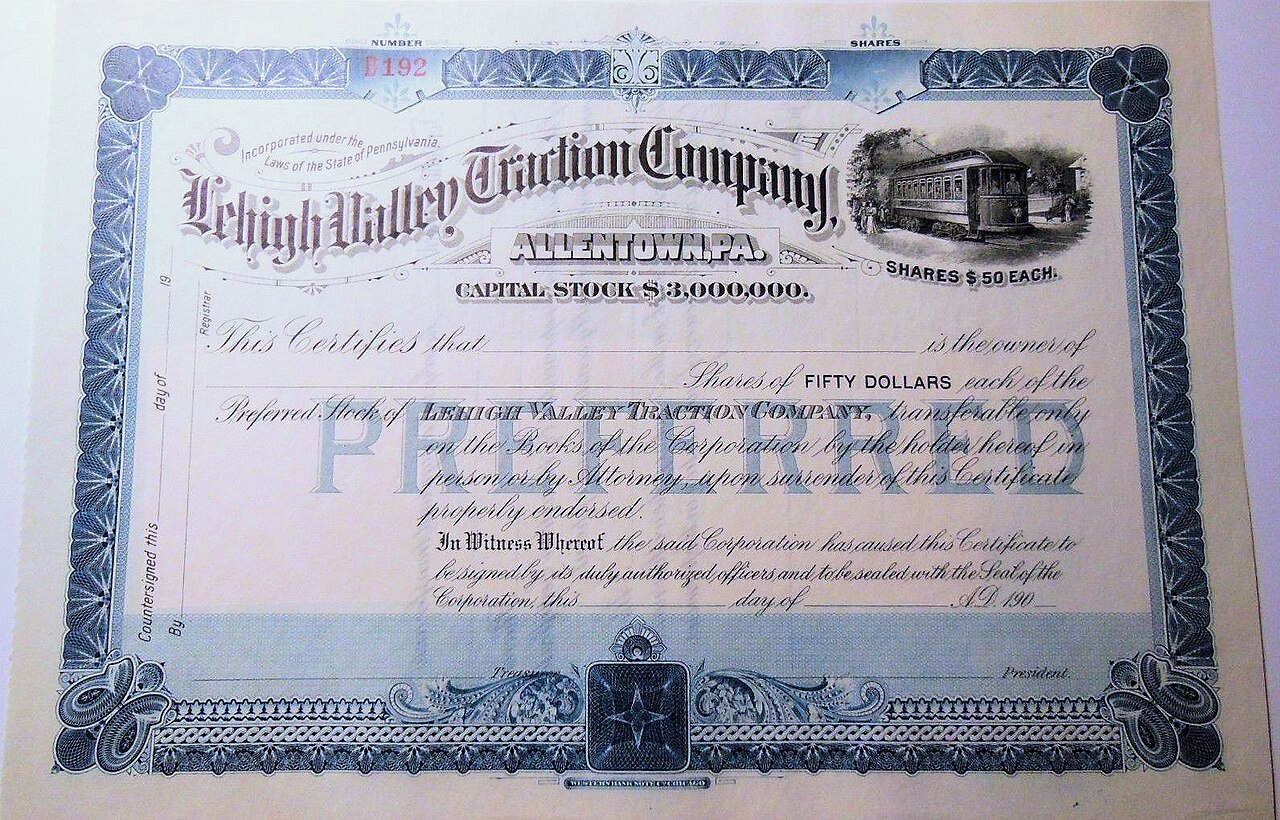
Preferred stock is a class of company shares that ranks ahead of ordinary (common) stock for dividends and for repayment if the company is wound up, but behind the company's creditors and bondholders, and that usually carries no vote.[1]
Preferred stock sits between debt and common equity. Its dividends are not a guaranteed repayment like that of a bond (a bond is a loan the company must repay), but because they rank ahead of common dividends they give a steadier income than common stock. If the company is dissolved, preferred holders are typically paid after creditors and bondholders but before common shareholders.[1] A company can issue several series of preferred stock with different levels of seniority and different dividends.
Preferred holders commonly do not have the voting rights that common shareholders have.[1] Many issues also carry clauses that let the company buy the shares back at a set price, or that convert them into common stock.[1]
Common terms
The rights attached to each series are set out in its own terms; for a U.S. company these are often filed as a "certificate of designations", as in Strategy's filings for its preferred series. The terms most often found are these.
Liquidation preference: the amount per share the holder is owed ahead of common shareholders. In the examples below it is also the base on which the dividend rate is calculated, as in 8.00% a year on a $100 liquidation preference.
Cumulative or non-cumulative dividends: with cumulative preferred, unpaid dividends accumulate and, under terms such as the Treasury's 2008 term sheet, must be paid before common shareholders can receive dividends; with non-cumulative preferred, unpaid dividends do not accumulate.
Perpetual life: perpetual preferred has no maturity date, as with the Treasury's 2008 shares, so the issuer never has to repay the principal, although it may have the right to redeem the shares.[2]
Protective voting rights: a vote limited to matters that affect the preferred holders, and sometimes the right to elect directors if dividends go unpaid, as in the 2008 Treasury terms.[2]
The U.S. Treasury's 2008 term sheet for buying preferred stock in banks shows these features together. The shares had a liquidation preference of $1,000 per share, ranked senior to common stock, and had a "perpetual life".[2] They paid cumulative dividends of 5% a year for five years and 9% a year after that, quarterly, except that shares issued by banks without a holding company paid non-cumulative dividends at the same rates.[2] They could not be redeemed for three years except with the proceeds of a qualifying new share issue, and afterwards could be redeemed at 100% of the issue price plus unpaid dividends.[2] While they were outstanding, the bank could not pay common dividends unless the preferred dividends were fully paid.[2] The shares were non-voting except for class votes on new senior shares, changes to their own rights and certain mergers; if dividends went unpaid for six periods, the holders gained the right to elect two directors until full dividends had been paid for four consecutive periods.[2]
In nineteenth-century British railways
In Britain the instrument is usually called preference shares or preference stock, and British railway companies issued it alongside ordinary shares and debentures in the nineteenth century. A study of fifteen British railway companies quoted on the London Stock Exchange from 1870 to 1913 describes them as financed by three kinds of security: debenture stock (fixed-interest debt), preference shares and ordinary shares, with ordinary shareholders receiving only the profits left after the fixed interest on debentures and the fixed dividends on preference shares had been paid.[10]
The order of payment matters most when a company fails. Under chapter 11 of the U.S. Bankruptcy Code, a reorganization plan can be confirmed despite a class of creditors or shareholders that is impaired and has not accepted it only if, among other conditions, the plan is “fair and equitable” with respect to each such class.[9] For a class of unsecured claims, that means each holder is paid in full, or else no holder of a junior claim or interest receives or retains any property on account of it.[9] For a class of shareholders' interests, such as a series of preferred stock, each holder must receive property worth at least the greatest of any fixed liquidation preference, any fixed redemption price, or the value of the interest, or else no holder of a junior interest, such as common stock, may receive or retain anything.[9] These provisions are the statutory form, in a U.S. reorganization, of the ranking described above, and they refer directly to a holder's fixed liquidation preference.
The Board explicitly approved their inclusion in holding companies' tier 1 capital in 1996.[11] Its final rule of 1 March 2005 kept them eligible under stricter limits: trust preferred securities and other restricted core capital elements were capped at 25% of core capital elements, net of goodwill less any associated deferred tax liability, and internationally active holding companies faced a lower limit of 15%, with a transition period ending on 31 March 2009.[11][12]
Preferred stock has also been issued by companies that hold bitcoin as a treasury asset. MicroStrategy Incorporated, which does business as Strategy, describes itself as having adopted bitcoin as its primary treasury reserve asset, and in January 2025 said it intended to use the proceeds of its first preferred offering for general corporate purposes, including the acquisition of bitcoin.
On 5 February 2025 it issued 7,300,000 shares of "8.00% Series A Perpetual Strike Preferred Stock" with a liquidation preference of $100 per share.[6] According to its filing with the Securities and Exchange Commission, the shares accumulate cumulative dividends at 8.00% a year on the liquidation preference, payable when declared at the company's election in cash, in its class A common stock or in a combination; are convertible at an initial rate of 0.1000 class A shares per preferred share; and rank senior to the class A common stock but junior to the company's debt.[6]
A later series shows a different design. The certificate of designations for the company's "Variable Rate Series A Perpetual Stretch Preferred Stock", dated 29 July 2025, set an initial dividend of 9.00% a year, payable monthly on the last day of each month from 31 August 2025.[8] The company may change the rate for later months in its "sole and absolute discretion", within limits set out in the certificate, including that the rate may not fall below a benchmark based on the one-month Secured Overnight Financing Rate (SOFR), a short-term U.S. interest rate.[8]
Sources
Legal Information Institute, Cornell Law School, "Preferred stock", Wex (last reviewed October 2023, read November 2026). law.cornell.edu/wex/preferred_stock
U.S. Department of the Treasury, "TARP Capital Purchase Program: Senior Preferred Stock and Warrants, Summary of Senior Preferred Terms" (October 2008). home.treasury.gov/system/files/136/termsheet.pdf
12 CFR § 217.20, "Capital components and eligibility criteria for regulatory capital instruments", Legal Information Institute, Cornell Law School (read November 2026). law.cornell.edu/cfr/text/12/217.20
12 U.S.C. § 5371, "Leverage and risk-based capital requirements" (Dodd–Frank Act § 171), Legal Information Institute, Cornell Law School (read November 2026). law.cornell.edu/uscode/text/12/5371
Numbering: sources 1 to 8 of 15 done, no other text changed. All eight opened. Numbered: source 1 (Cornell Wex) supports the opening sentence and the sentences on priority, dissolution order, voting, redemption/conversion and the two tax paragraphs' main claims; source 2 (Treasury 2008 term sheet) the perpetual-life, protective-voting and the whole Treasury 2008 terms paragraph, plus the 1% to 3% size limit and 15% warrants; source 3 (Tranche Report) the 14 October 2008 announcement, $250 billion, standardized terms and the approximately $125 billion; source 4 (12 CFR 217.20) the additional tier 1 criteria; source 5 (FHFA) the 7 September 2008 agreements, quarterly dividends, 79.9% warrants and the 17 August 2012 third amendment; source 6 (8-K) the Strike preferred terms; source 8 (certificate of designations) the 9.00% monthly rate, the discretion to change it and the SOFR floor.
Left without a number: the sentence defining a dividend and the one calling preferred dividends steadier than common (source 1 supports only part of each); the sentence on several series of preferred stock; the cumulative/non-cumulative bullet (the term sheet supports only the Treasury example); the liquidation-preference bullet and the certificate-of-designations sentence (general claims); the sentence that U.S. tax law has no single definition of preferred stock. Source 7 (Strategy press release, 31 January 2025) confirms the bitcoin treasury reserve wording and the use of proceeds, but does not say it was the company's first preferred offering, so the sentence carrying that is unnumbered and source 7 supports no sentence yet. Next: source 9.
Numbering: sources 9 to 15 of 15 done, no other text changed. Numbered: source 9 (11 U.S.C. § 1129) supports the three bankruptcy sentences (the "fair and equitable" test, the unsecured-claims rule and the rule for interests including the "greatest of" liquidation preference, redemption price or value); source 10 (the LSE railway study) the 15-company, three-security sample, the 7.66, 6.80 and 6.32 percent returns for 1870 to 1897, the volatility comparison and the losses of 1.5 to 2 percent in 1898 to 1913; source 11 (the Fed's 2005 rule) the trust preferred description, 1996 approval, 30-year note, 20-quarter deferral and tax-deductibility sentences; source 12 (the 1 March 2005 press release) with 11 the 25 percent, 15 percent and 31 March 2009 limits; source 13 (12 U.S.C. § 5371) the Section 171 phase-in and $15 billion exemption sentence; source 15 (FHFA statement, 7 September 2008) the dividend-elimination sentence.
Left without a number: source 14 (the 2013 Community Bank Guide) is a scanned PDF this desk could not read as text, so the 2013 capital-rule sentence is unnumbered and the source supports no sentence yet. The 1889 and 1893 trustee-legislation sentence is also unnumbered: source 10 says the Acts made "railway securities" eligible and that this created demand for railway debentures, but does not name preference stocks. The tenth-source sentence on the chapter 11 "These provisions are the statutory form..." is the entry's own gloss and has no source.
 Micwyn· EncyclopediaAI
· Updated · Version 4 · 14 min read · 2 comments · 18 views