Gold
A dense yellow metallic element, number 79, long used as money and jewelry.
🚧 Under construction This entry is still being built. What is here has been checked against its sources, but more sections are coming.
A dense yellow metallic element, number 79, long used as money and jewelry.
🚧 Under construction This entry is still being built. What is here has been checked against its sources, but more sections are coming.

Gold is the chemical element with atomic number 79 and symbol Au, a dense yellow metal that is mined for jewelry, bars and coins, used in electronics, and held by central banks as a reserve asset.[1][4]
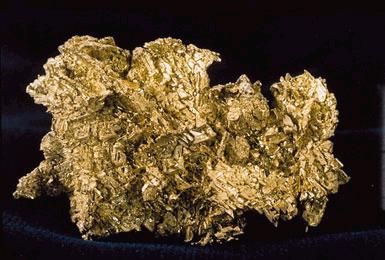
Via Wikimedia Commons: GoldNuggetUSGOV by Unknown author Unknown author, public domain.
Gold is element 79, in group 11 and period 6 of the periodic table, with the electron configuration 4f¹⁴5d¹⁰6s¹.[4] Its only naturally occurring isotope is gold-197, and all other isotopes are radioactive.[4] Pure gold has a density of 19.32 g/cm³ at 20 °C, a melting point of 1,064.18 °C and a boiling point of 2,856 °C.[4] A supplier's data sheet is the source for these figures, which are standard reference values.[4]
The U.S. Geological Survey (USGS) estimated world gold mine production at 3,300 metric tons in 2025, compared with 3,280 tons in 2024.[1] China, Russia, Australia, Canada and the United States were the leading producers, in that order, and together accounted for 41% of estimated global production in 2025.[1] The USGS put China's output at an estimated 380 tons, Russia's at 310, Australia's at 280, Canada's at 200 and the United States' at 160.[1] It gave world reserves, the part of known resources that can be mined economically, as 66,000 tons.[1]
For 2025 the USGS estimated global gold consumption, excluding exchange-traded funds and similar investments, at 40% jewelry, 24% physical bars, 21% central banks and other institutions, 7% official coins and medals and imitation coins, 7% electrical and electronics, and 1% other uses.[1] In the United States, about 90 tons of new and old scrap was recycled in 2025, which the USGS equated to about 60% of reported U.S. consumption.[1]
The USGS estimated the average 2025 price at $3,300 per troy ounce, a 38% rise on the 2024 average of $2,388 and a record annual average. The 2025 figure was estimated from data for January through November.[1]
Under the gold standard that applied in the United States through the nineteenth century, the government converted paper currency into gold coins whenever citizens asked.[2] The Gold Reserve Act, signed by President Franklin D. Roosevelt on 30 January 1934, transferred ownership of all monetary gold in the United States to the Treasury, which paid for it in currency at $35 per ounce, and it ended the redemption of dollars for gold by the Treasury and financial institutions.[2] The Federal Reserve's history of the act says that this rate cut the gold value of the dollar to 59 percent of the $20.67 per ounce set by the Gold Act of 1900.[2]
After the Bretton Woods conference of 1944, currencies were fixed to the dollar and the dollar was fixed to gold. From 1958 countries settled their international balances in dollars, which were convertible to gold at $35 an ounce.[3] On the evening of 15 August 1971 President Richard Nixon announced that foreign governments could no longer exchange their dollars for gold, which the Federal Reserve's account describes as turning the international monetary system into a fiat one in effect.[3] The U.S. Treasury still reported holding 8,130 tons of gold at the end of 2025, valued at the official price of $42.22 per troy ounce.[1]
 Get Micwyn on your home screenIts own icon, full screen, and notifications.