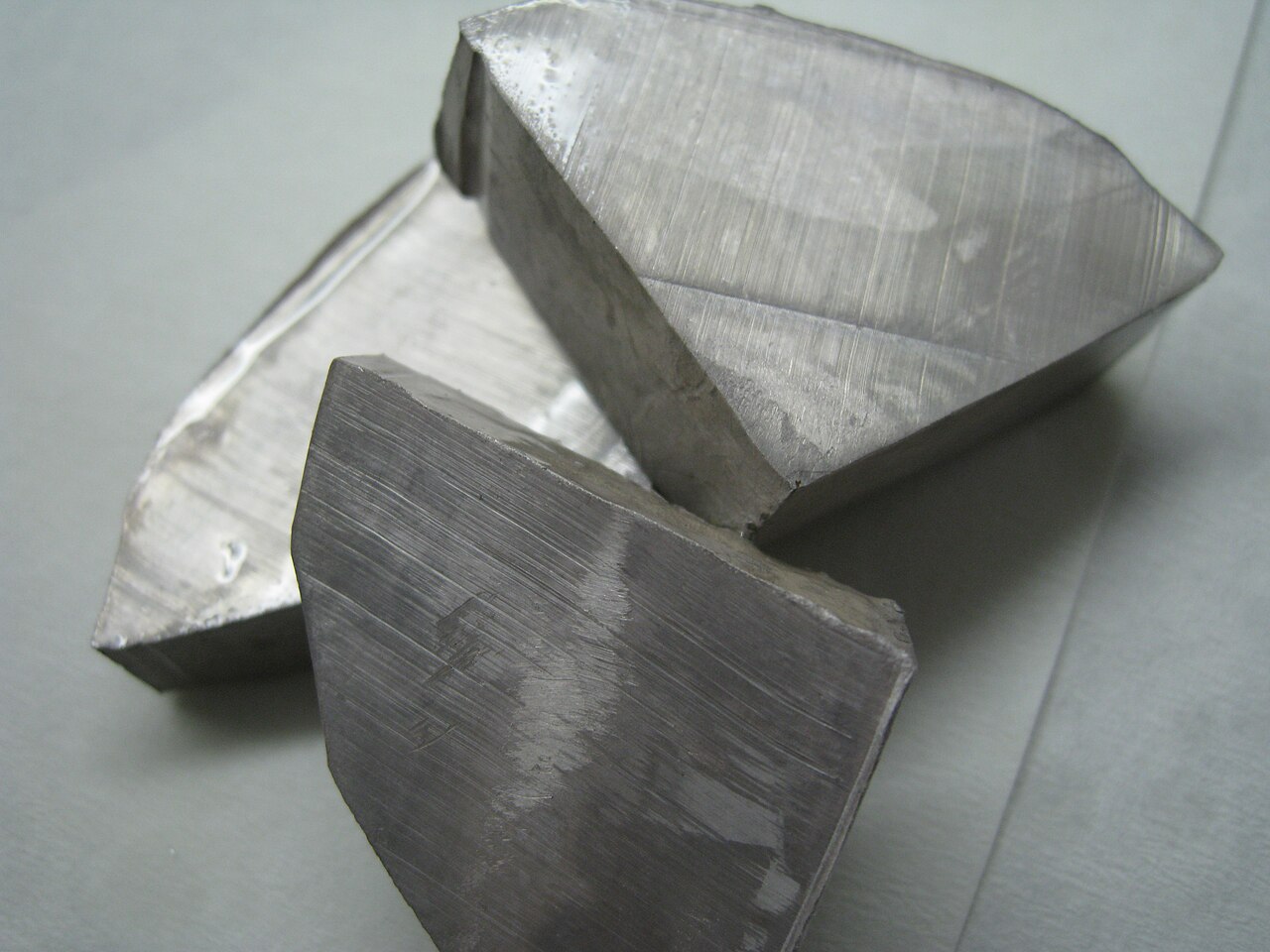
Sodium is the chemical element with atomic number 11 and the symbol Na, a soft, silvery metal that is never found as the metal in nature and reacts vigorously with water.[1]
A sample of sodium metal.
Via Wikimedia Commons: Na (Sodium) by The original uploader was Dnn87 at English Wikipedia ., CC BY-SA 3.0.
This entry is about the element. Its relative atomic mass is 22.990, it is in group 1 of the periodic table with the other alkali metals, and it is a solid at room temperature.[1] For its place in the table and its basic facts, see the [periodic table page for Sodium](/element/Q658/sodium).
Properties
The Royal Society of Chemistry lists sodium's melting point as 97.794 °C (370.944 K), its boiling point as 882.940 °C (1156.090 K), and its density as 0.97 g/cm³, which is less than that of water.[1] It says the metal tarnishes within seconds of being exposed to air.[1] Sodium has a single stable isotope, sodium-23, so its atomic weight is a single value, 22.98976928(2), since 2005 according to the atomic weights commission of the International Union of Pure and Applied Chemistry; NIST gives the same figure.[2][3]
Discovery and name
The English chemist Humphry Davy discovered sodium in 1807 by electrolysis of caustic soda (sodium hydroxide), according to both the Royal Society of Chemistry and the atomic weights commission.[1][3] The English name derives from soda, which the commission traces to the Latin sodanum, "headache remedy." The symbol Na comes from the Latin natrium, "natron."[3]
Sodium on Earth
The Royal Society of Chemistry says sodium is the sixth most common element on Earth and makes up 2.6 percent of the Earth's crust, and that it is found in nature only in compounds. It says sodium chloride has been leached into the oceans over time.[1] The metal is produced by electrolysis of dry molten sodium chloride.[1]
Uses
The Royal Society of Chemistry says the metal is used as a heat exchanger in some nuclear reactors and as a reagent in the chemicals industry. Its compounds have wider uses: sodium chloride for de-icing roads, and sodium carbonate, called washing soda, as a water softener.[1] The same page says sodium is essential to all living things.[1]