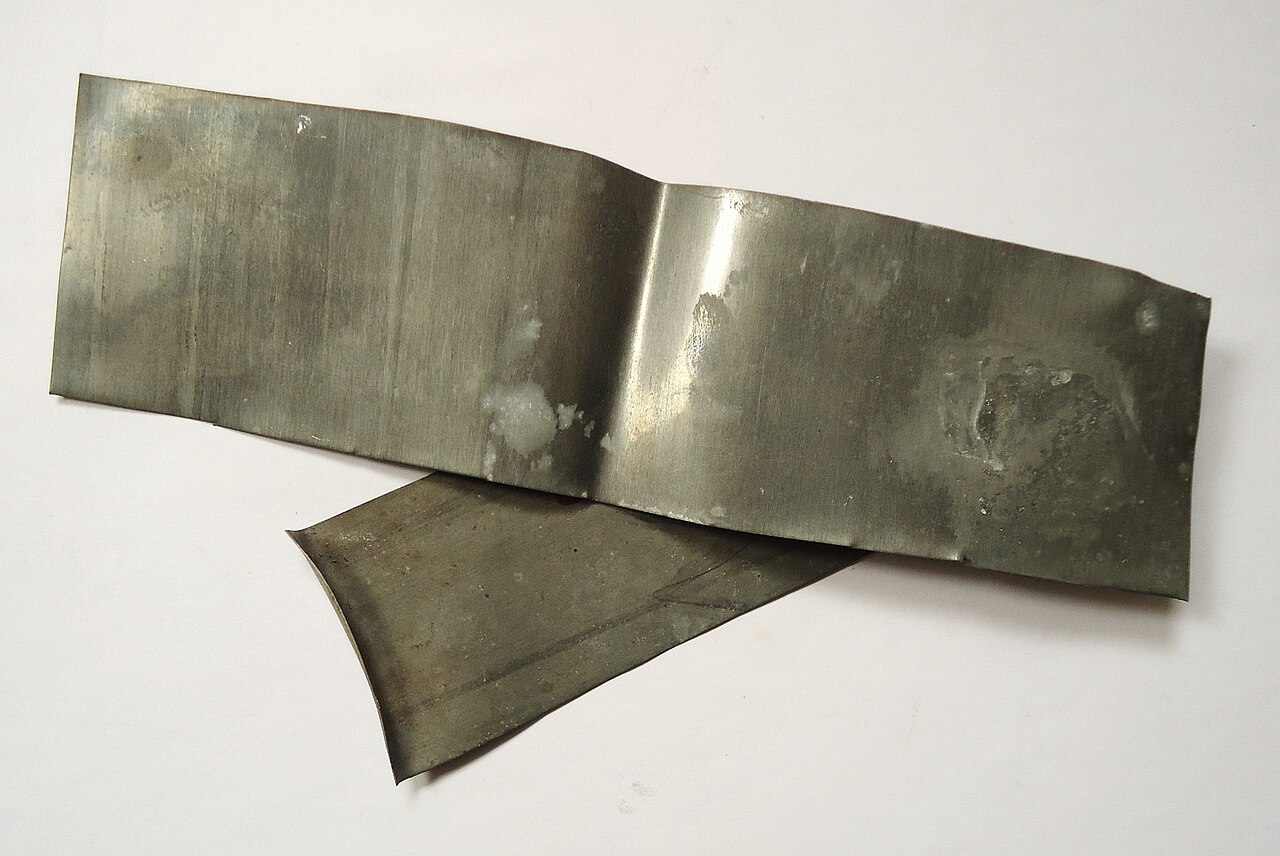
Zinc is the chemical element with atomic number 30 and the symbol Zn, a metal in group 12 of the periodic table that is used mainly to galvanise iron and steel and to make brass.[1]
This entry is about the element. Its relative atomic mass is 65.38, it is in group 12 of the periodic table, and it is a solid at room temperature.[1] For its place in the table and its basic facts, see the [periodic table page for Zinc](/element/Q758/zinc).
Properties
The Royal Society of Chemistry lists zinc's melting point as 419.527 °C (692.677 K), its boiling point as 907 °C (1180 K), and its density as 7.134 g/cm³.[1] Its standard atomic weight is 65.38(2), unchanged since 2007 according to the atomic weights commission of the International Union of Pure and Applied Chemistry; NIST gives the same value.[3][2]
Isotopes
Zinc has five naturally occurring isotopes. The Royal Society of Chemistry gives their proportions as 49.17 percent for zinc-64, 27.73 percent for zinc-66, 4.04 percent for zinc-67, 18.45 percent for zinc-68 and 0.61 percent for zinc-70, and NIST gives 0.4917(75), 0.2773(98), 0.0404(16), 0.1845(63) and 0.0061(10).[1][2]
History and name
The Royal Society of Chemistry says zinc was known to the Greeks and Romans before 20 BC but rarely used by them, and that it was refined in India; it credits the German chemist Andreas Marggraf with being the first, in 1746, to recognise it as a new metal. The atomic weights commission says zinc was used since prehistoric times and recognized as a metal as early as 1374.[1][3] The Royal Society of Chemistry says the name may derive from the German zinc, which may in turn come from the Persian sing, "stone"; the commission calls the origin of the name unknown.[1][3]
Where it comes from
The Royal Society of Chemistry gives zinc's crustal abundance as 72 parts per million. The ore is concentrated and roasted, and the zinc is reduced with carbon or by electrolysis. The page gives world production as more than 11 million tonnes a year, without a date, and lists China, Australia and Peru as the top three producers.[1]
Uses
The Royal Society of Chemistry says most zinc is used to galvanise iron and steel, and lists die-castings, brass, nickelsilver, aluminium solder, zinc oxide in paints, rubber, cosmetics and batteries, and zinc sulfide in luminous paints and X-ray screens. It says zinc is essential for all living things, forming the active site in over 20 metallo-enzymes.[1]