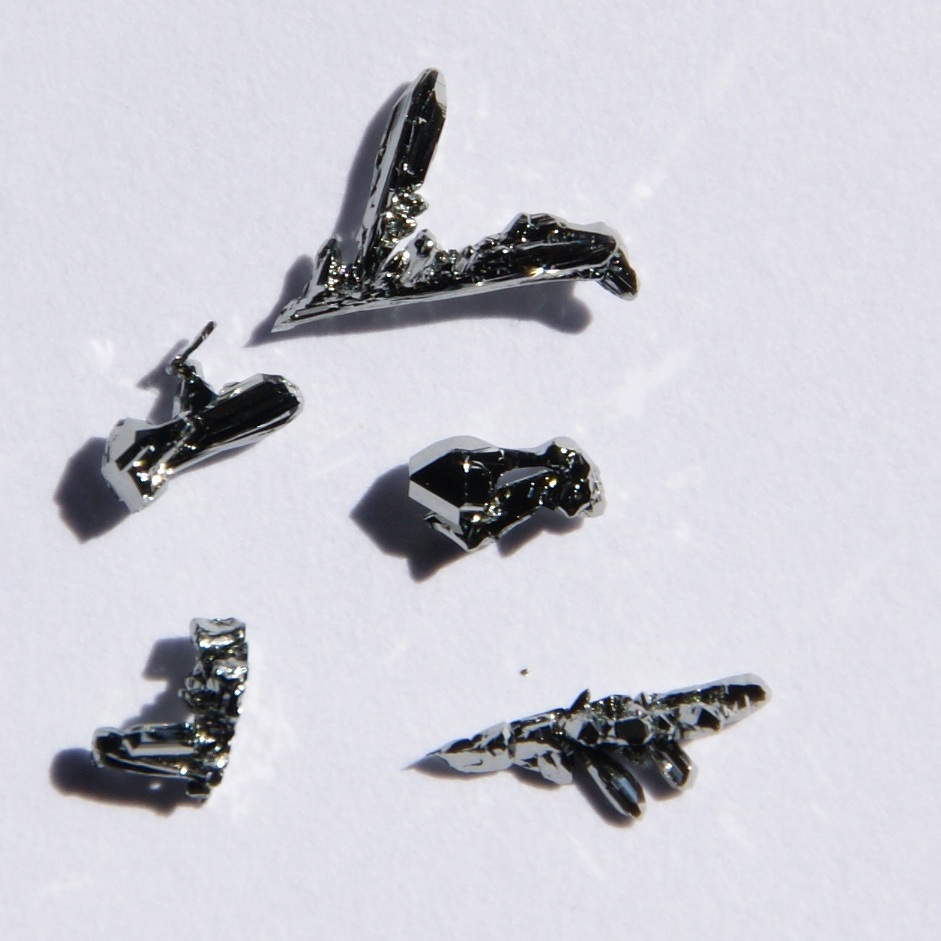
Germanium is the chemical element with atomic number 32 and the symbol Ge, a solid in group 14 of the periodic table that is a semiconductor and whose existence Dmitri Mendeleev predicted before it was found.[1]
This entry is about the element. Its relative atomic mass is 72.630, it is in group 14 of the periodic table, and it is a solid at room temperature.[1] For its place in the table and its basic facts, see the [periodic table page for Germanium](/element/Q867/germanium).
Properties
The Royal Society of Chemistry lists germanium's melting point as 938.25 °C (1211.4 K), its boiling point as 2833 °C (3106 K), and its density as 5.3234 g/cm³.[1] Its standard atomic weight is 72.630(8), unchanged since 2011 according to the atomic weights commission of the International Union of Pure and Applied Chemistry; NIST gives the same value.[3][2]
Isotopes
Germanium has five naturally occurring isotopes. The Royal Society of Chemistry gives their proportions as 20.57 percent for germanium-70, 27.45 percent for germanium-72, 7.75 percent for germanium-73, 36.5 percent for germanium-74 and 7.73 percent for germanium-76, and NIST gives 0.2057(27), 0.2745(32), 0.0775(12), 0.3650(20) and 0.0773(12). The commission's figures differ slightly in the last digits.[1][2][3]
Discovery and name
The German chemist Clemens Winkler discovered germanium in 1886 in the mineral argyrodite, according to the atomic weights commission and the Royal Society of Chemistry, which says the mineral came from the Himmelsfürst silver mine at Freiberg, Germany, and that the new element matched the one Mendeleev had predicted.[1][3] The name comes from the Latin Germania, for Germany.[1][3]
Where it comes from
The Royal Society of Chemistry gives germanium's crustal abundance as 1.3 parts per million. It says commercial production is carried out by processing zinc smelter flue dust, and that germanium can also be recovered from the by-products of burning certain coals.[1]
Uses
The Royal Society of Chemistry lists germanium as a semiconductor in transistors, germanium oxide in wide-angle camera lenses and microscope objectives, infrared optics, fluorescent lamps and a catalyst, and says that adding 1 percent germanium to silver stops it tarnishing. It says germanium has no known biological role and is non-toxic.[1]