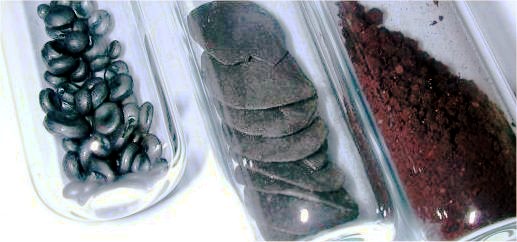
Selenium is the chemical element with atomic number 34 and the symbol Se, a solid in group 16 of the periodic table that is used in glass, pigments and solar cells.[1]
Samples of selenium.
Via Wikimedia Commons: Selen 1 by de:User:Tomihahndorf, public domain.
This entry is about the element. Its relative atomic mass is 78.971, it is in group 16 of the periodic table, and it is a solid at room temperature.[1] For its place in the table and its basic facts, see the [periodic table page for Selenium](/element/Q876/selenium).
Properties
The Royal Society of Chemistry lists selenium's melting point as 220.8 °C (494 K), its boiling point as 685 °C (958 K), and its density as 4.809 g/cm³.[1] Its standard atomic weight is 78.971(8), unchanged since 2013 according to the atomic weights commission of the International Union of Pure and Applied Chemistry; NIST gives the same value.[3][2]
Isotopes
Selenium has six naturally occurring isotopes. NIST gives their proportions as 0.0089(4) for selenium-74, 0.0937(29) for selenium-76, 0.0763(16) for selenium-77, 0.2377(28) for selenium-78, 0.4961(41) for selenium-80 and 0.0873(22) for selenium-82, which the Royal Society of Chemistry's table matches; the commission's figures differ slightly.[1][2][3]
Discovery and name
The Swedish chemist Jöns Jacob Berzelius discovered selenium in 1817, according to the atomic weights commission, while trying to isolate tellurium in an impure sample. The Royal Society of Chemistry says he found a red-brown sediment in a sulfuric acid works in which he had shares, first thought it was tellurium because it smelled of radishes when heated, and then realised it was a new element.[1][3] The name comes from Selene, the Greek goddess of the Moon.[1][3]
Where it comes from
The Royal Society of Chemistry gives selenium's crustal abundance as 0.13 parts per million. It is obtained from the anode muds of copper electrolytic refining, and the top three producers listed are Japan, Germany and Belgium, without a date.[1]
Uses
The Royal Society of Chemistry lists decolourising or red-colouring glass, a bronze tint in architectural glass, ceramic and paint pigments, photocells, solar cells, photocopiers, rectifiers, anti-dandruff shampoo and an additive to stainless steel. It says selenium is an essential trace element for some species, including humans, and is carcinogenic and teratogenic in excess.[1]
This entry explains; it is not medical advice. Ask a doctor or pharmacist about your own health.