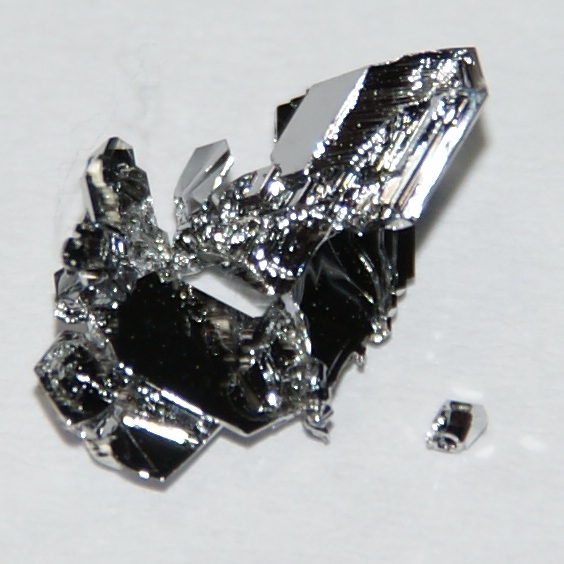
Ruthenium is the chemical element with atomic number 44 and the symbol Ru, a rare metal in group 8 of the periodic table that is used in electrical contacts and as a catalyst.[1]
This entry is about the element. Its relative atomic mass is 101.07, it is in group 8 of the periodic table, and it is a solid at room temperature.[1] For its place in the table and its basic facts, see the [periodic table page for Ruthenium](/element/Q1086/ruthenium).
Properties
The Royal Society of Chemistry lists ruthenium's melting point as 2333 °C (2606 K), its boiling point as 4147 °C (4420 K), and its density as 12.1 g/cm³.[1] Its standard atomic weight is 101.07(2), unchanged since 1983 according to the atomic weights commission of the International Union of Pure and Applied Chemistry; NIST gives the same value, with a note about fission products at the Oklo natural nuclear reactor in Gabon.[3][2]
Isotopes
Ruthenium has seven naturally occurring isotopes. The Royal Society of Chemistry gives their proportions as 5.54 percent for ruthenium-96, 1.87 percent for ruthenium-98, 12.76 percent for ruthenium-99, 12.6 percent for ruthenium-100, 17.06 percent for ruthenium-101, 31.55 percent for ruthenium-102 and 18.62 percent for ruthenium-104, and NIST gives the same figures as fractions.[1][2]
Discovery and name
The Russian chemist Gottfried Wilhelm Osann discovered ruthenium in a crude platinum ore, which the commission dates to 1828 and the Royal Society of Chemistry to 1825. Karl Karlovich Klaus of the University of Kazan showed in 1844 that Osann's result came from an impure sample, extracted the metal and kept Osann's name.[1][3] The name comes from Ruthenia, the Latin name for Russia.[1][3]
Where it comes from
The Royal Society of Chemistry gives ruthenium's crustal abundance as 0.000037 parts per million and says it is obtained commercially from the wastes of nickel refining. South Africa, Russia and Zimbabwe are listed as the top three producers, without a date.[1]
Uses
The Royal Society of Chemistry lists chip resistors and electrical contacts, ruthenium oxide coatings on anodes for making chlorine, catalysts for ammonia and acetic acid, solar cells, and a hardener for platinum and palladium. It says ruthenium has no known biological role and that ruthenium(IV) oxide is highly toxic.[1]