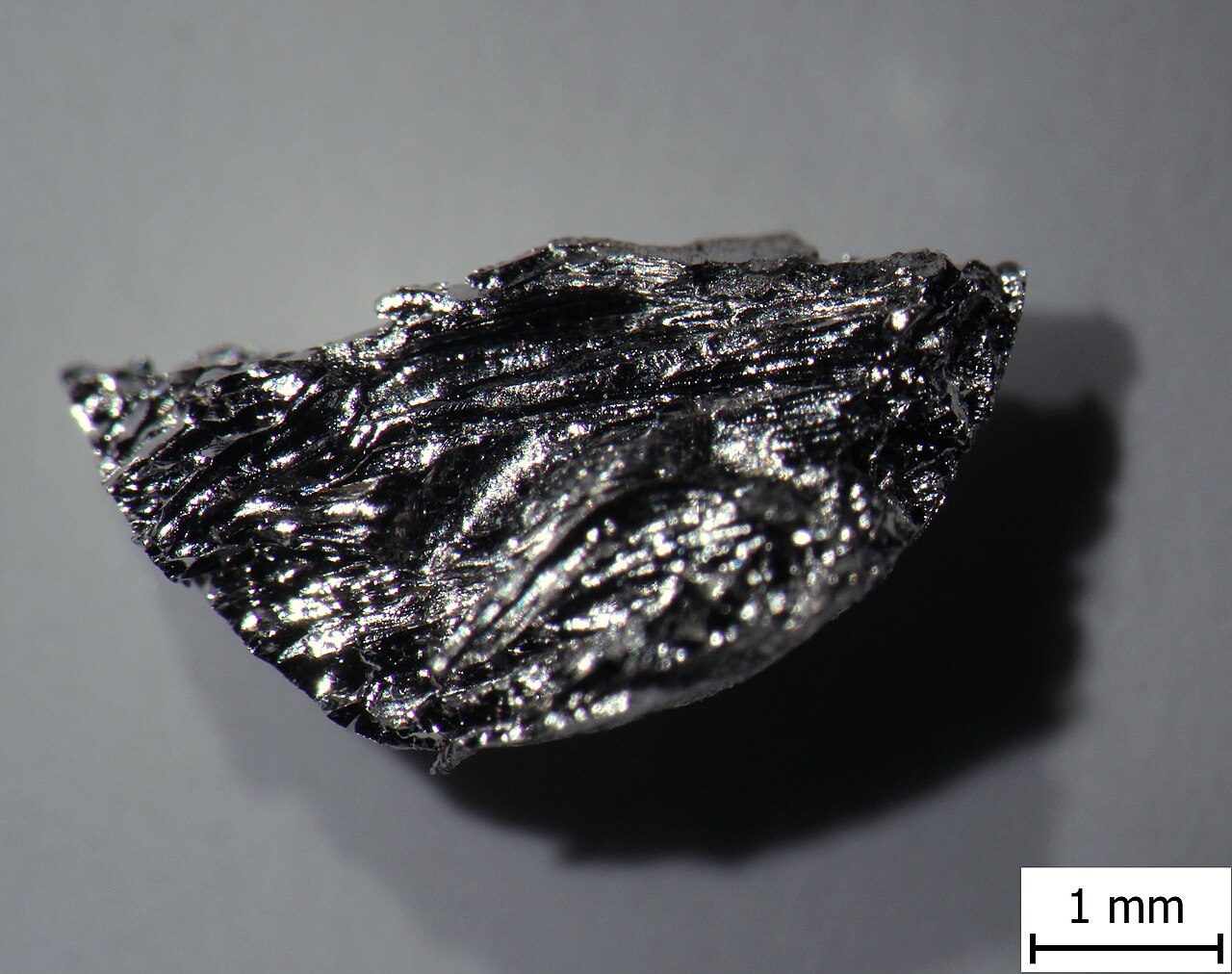
Rhodium is the chemical element with atomic number 45 and the symbol Rh, a metal in group 9 of the periodic table that the Royal Society of Chemistry calls the rarest of all non-radioactive metals and that is used mainly in car catalytic converters.[1]
This entry is about the element. Its relative atomic mass is 102.906, it is in group 9 of the periodic table, and it is a solid at room temperature.[1] For its place in the table and its basic facts, see the [periodic table page for Rhodium](/element/Q1087/rhodium).
Properties
The Royal Society of Chemistry lists rhodium's melting point as 1963 °C (2236 K), its boiling point as 3695 °C (3968 K), and its density as 12.4 g/cm³.[1] It has a single stable isotope, rhodium-103, so its atomic weight is a single value, 102.90549(2) since 2017 according to the atomic weights commission of the International Union of Pure and Applied Chemistry; NIST gives 102.90550(2).[3][2]
Discovery and name
The English chemist and physicist William Hyde Wollaston discovered rhodium in 1803 in a crude platinum ore, according to the atomic weights commission. The Royal Society of Chemistry says he worked with Smithson Tennant on platinum and obtained rose-red salts from the residue of dissolved platinum, and from them the metal.[1][3] The name comes from the Greek rhodon, "rose."[1][3]
Where it comes from
The Royal Society of Chemistry gives rhodium's crustal abundance as 0.000037 parts per million. It is obtained commercially as a by-product of copper and nickel refining, world production is about 30 tonnes a year according to the page, and South Africa, Russia and Zimbabwe are listed as the top three producers, all without a date.[1]
Uses
The Royal Society of Chemistry says 80 percent of rhodium is used in car catalytic converters, and lists catalysts for nitric acid, acetic acid and hydrogenation, optical-fibre and mirror coatings, crucibles, thermocouples, headlight reflectors and electrical contacts. It says rhodium has no known biological role and is a suspected carcinogen.[1]