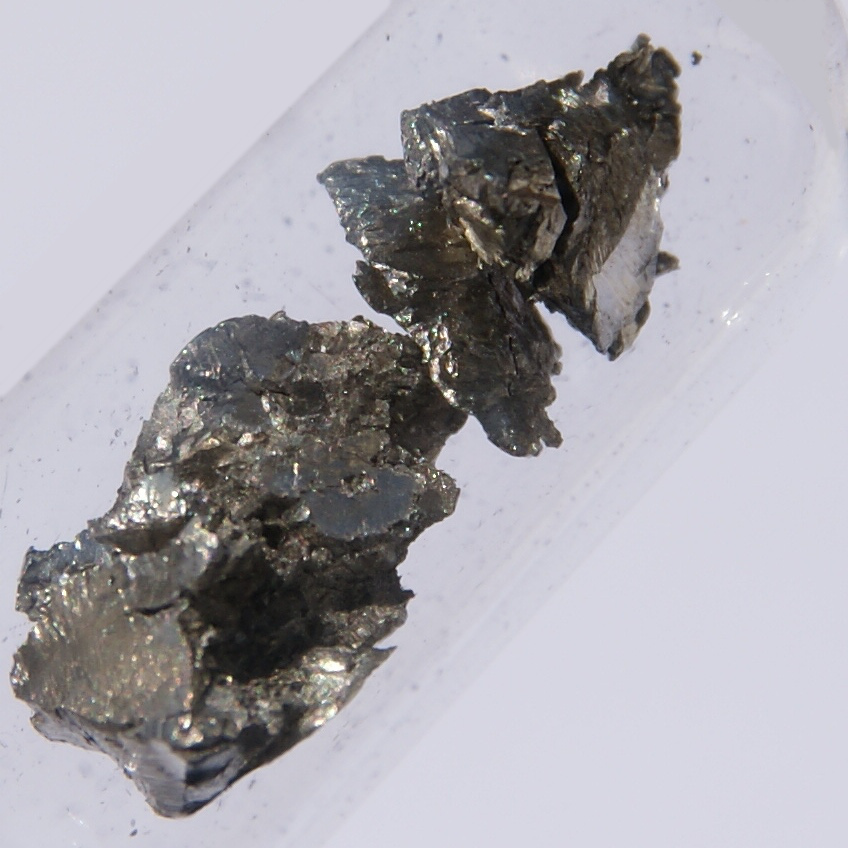
This entry is about the element. Its relative atomic mass is 140.908, it is one of the lanthanides in the periodic table, and it is a solid at room temperature.[1] For its place in the table and its basic facts, see the [periodic table page for Praseodymium](/element/Q1386/praseodymium).
Properties
The Royal Society of Chemistry lists praseodymium's melting point as 931 °C (1204 K), its boiling point as 3520 °C (3793 K), and its density as 6.77 g/cm³.[1] It has a single stable isotope, praseodymium-141, so its atomic weight is a single value, 140.90766(1) since 2017 according to the atomic weights commission of the International Union of Pure and Applied Chemistry; NIST gives 140.90766(2).[3][2]
Discovery and name
The Austrian chemist Carl Auer von Welsbach discovered praseodymium in 1885, according to the Royal Society of Chemistry and the atomic weights commission. The Royal Society of Chemistry says Carl Mosander had announced a substance called didymium in 1841, that Bohuslav Brauner showed in 1882 that it was not a single element, and that Auer split it into neodymium and praseodymium in June 1885. Pure praseodymium metal was first produced in 1931.[1][3] The name comes from the Greek prasios, "green," and didymos, "twin," because of the pale green salts it forms.[1][3]
Where it comes from
The Royal Society of Chemistry says praseodymium is extracted from the minerals monazite and bastnaesite by ion exchange and solvent extraction, and the metal is prepared by reducing the anhydrous chloride with calcium.[1]
Uses
The Royal Society of Chemistry lists an alloy with magnesium for aircraft engines, mischmetal in cigarette-lighter flints, permanent-magnet alloys, carbon-arc electrodes for studio lighting, colouring for glass, enamel and glaze, and didymium goggles for welding and glassblowing. It says praseodymium has no known biological role and low toxicity.[1]