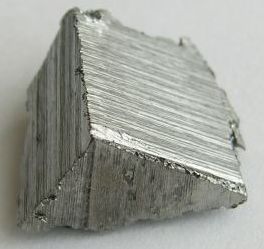
Erbium is the chemical element with atomic number 68 and the symbol Er, a metal in the lanthanide series that is named after the Swedish village of Ytterby and is used in fibre-optic amplifiers.[1][3]
A sample of erbium metal.
Via Wikimedia Commons: Erbium-crop by Erbium.jpg : Original uploader was Tomihahndorf at de.wikipe, CC BY-SA 3.0.
This entry is about the element. Its relative atomic mass is 167.259, it is one of the lanthanides in the periodic table, and it is a solid at room temperature.[1] For its place in the table and its basic facts, see the [periodic table page for Erbium](/element/Q1849/erbium).
Properties
The Royal Society of Chemistry lists erbium's melting point as 1529 °C, its boiling point as 2868 °C, and its density as 9.07 g/cm³.[1] Its standard atomic weight is 167.259(3), unchanged since 1999 according to the atomic weights commission of the International Union of Pure and Applied Chemistry, which notes that fission products at the Oklo natural nuclear reactor in Gabon explain the "g" annotation; NIST gives the same value.[3][2]
Isotopes
Erbium has six stable isotopes. The Royal Society of Chemistry gives their natural proportions as 0.139 percent for erbium-162, 1.601 percent for erbium-164, 33.503 percent for erbium-166, 22.869 percent for erbium-167, 26.978 percent for erbium-168 and 14.91 percent for erbium-170, and NIST gives the same figures as fractions.[1][2]
Discovery and name
The Swedish surgeon and chemist Carl Gustav Mosander discovered erbium in 1843 in a yttrium sample, according to the atomic weights commission. The Royal Society of Chemistry says he obtained two new oxides from yttrium that year, the erbium oxide being pink, and that pure erbium metal was not made until 1934, by Klemm and Bommer.[1][3] The name comes from Ytterby, where the ore gadolinite was first mined.[1][3]
Where it comes from
The Royal Society of Chemistry says erbium is obtained principally from the minerals monazite and bastnaesite by ion exchange and solvent extraction.[1]
Uses
The Royal Society of Chemistry says there is little use of the metal, which tarnishes in air, but lists an alloy with vanadium that lowers hardness and improves workability, erbium oxide in infrared-absorbing glass such as welders' safety glasses, a pink tinge in glass, sunglasses and imitation gems, and erbium in glass fibre to amplify fibre-optic signals. It says erbium has no known biological role and low toxicity.[1]