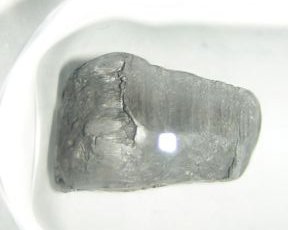
Thallium is the chemical element with atomic number 81 and the symbol Tl, a metal in group 13 of the periodic table that was found in 1861 by a green line in its spectrum and that the Royal Society of Chemistry describes as very toxic.[1]
A sample of thallium.
Via Wikimedia Commons: Thallium-croprotated by Thallium.jpg : Tomihahndorf at de.wikipedia derivative work:, public domain.
This entry is about the element. Its relative atomic mass is 204.38, it is in group 13 of the periodic table, and it is a solid at room temperature.[1] For its place in the table and its basic facts, see the [periodic table page for Thallium](/element/Q932/thallium).
Properties
The Royal Society of Chemistry lists thallium's melting point as 304 °C, its boiling point as 1473 °C, and its density as 11.8 g/cm³.[1] Its standard atomic weight is an interval, 204.382 to 204.385, since 2009 according to the atomic weights commission of the International Union of Pure and Applied Chemistry; NIST gives the same interval, and the Royal Society of Chemistry prints the rounded value 204.38.[3][2][1]
Isotopes
Thallium has two stable isotopes. The Royal Society of Chemistry gives their proportions as 29.52 percent for thallium-203 and 70.48 percent for thallium-205, and NIST gives 0.2952(1) and 0.7048(1).[1][2]
Discovery and name
The English physicist and chemist William Crookes discovered thallium in 1861, according to the atomic weights commission; the Royal Society of Chemistry says he announced it in March of that year after seeing a green spectral line. The commission says the French chemist Claude-Auguste Lamy first isolated the metal in 1862, and the Royal Society of Chemistry says the French Academy credited Lamy with the discovery, while both received medals at the 1862 London exhibition.[1][3] The name comes from the Greek thallos, "green twig" or "shoot."[1][3]
Where it comes from
The Royal Society of Chemistry says thallium is found in several ores, including pyrites, and is mostly obtained as a by-product of copper, zinc and lead refining; it also occurs in manganese nodules.[1]
Uses
The Royal Society of Chemistry lists photoelectric cells, thallium oxide for glass of high refractive index and low melting point, and an alloy with mercury for low-temperature thermometers and switches. It says thallium sulfate was once used as a rat poison, now banned for household use in most developed countries, and that thallium has no known biological role and is very toxic.[1]
This entry explains; it is not medical advice. Ask a doctor or pharmacist about your own health.