Europa is the fourth-largest moon of Jupiter and shows strong evidence of a saltwater ocean beneath its icy crust, which makes it one of the most promising places in the Solar System to look for environments where life could exist beyond Earth.[1][2]
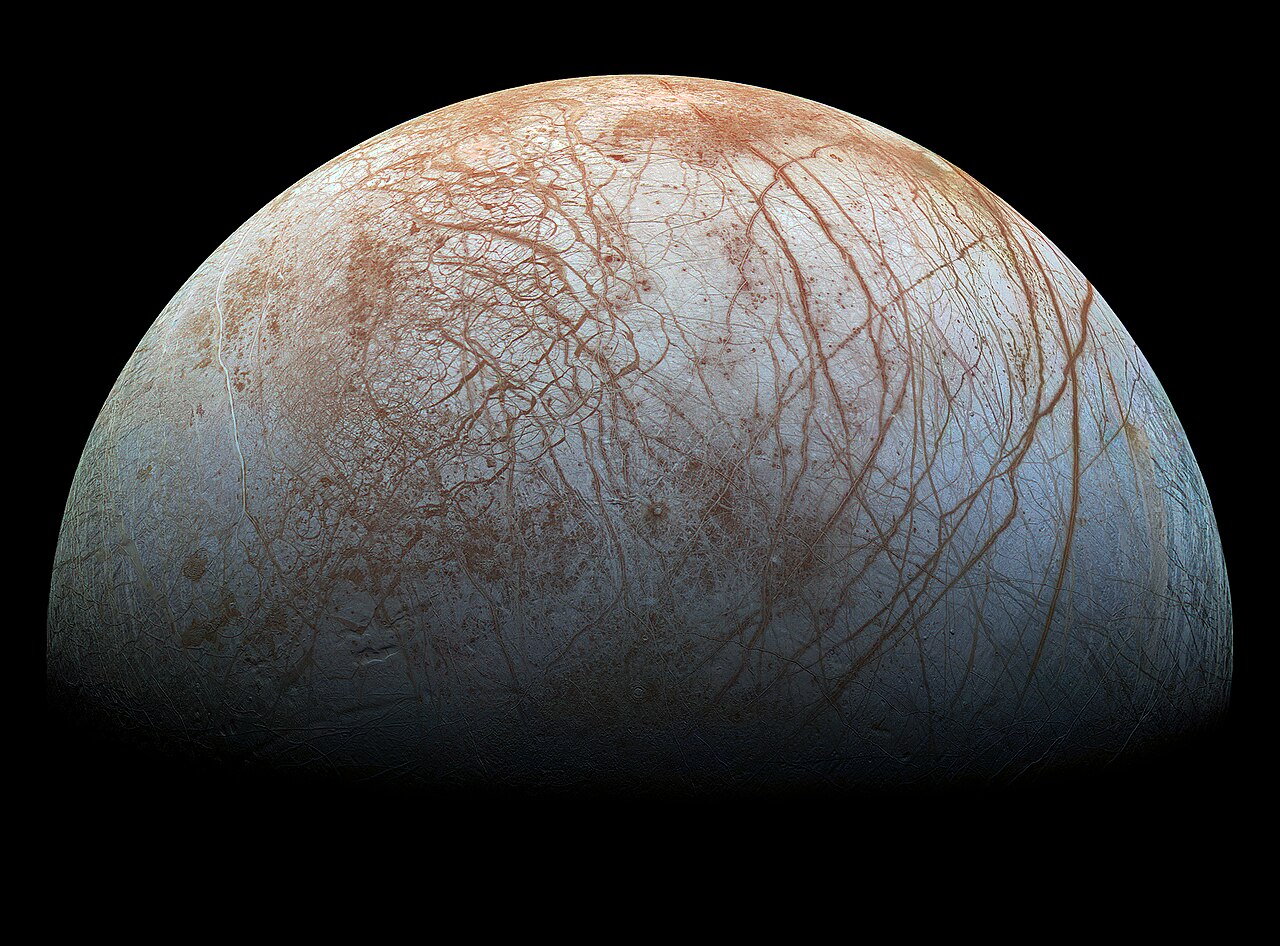
Europa, Jupiter's icy moon, with its cracked surface of water ice.
Europa has an equatorial diameter of about 3,100 kilometres, roughly 90% the size of Earth's Moon. NASA notes that, because its surface is water ice, it reflects 5.5 times as much sunlight as the Moon does.[1] It orbits Jupiter at about 671,000 kilometres every 3.5 days and is locked by gravity so that the same hemisphere always faces the planet.[1] It is the sixth-closest of Jupiter's moons to the planet.[2]
Europa, Io and Ganymede are in an orbital resonance: each time Ganymede orbits Jupiter once, Europa orbits twice and Io four times. NASA says this keeps Europa's orbit slightly elliptical, so its distance from Jupiter varies and tides stretch and relax its surface; the flexing likely creates the surface fractures and, if an ocean exists, could cause volcanic or hydrothermal activity on the seafloor.[1]
Surface
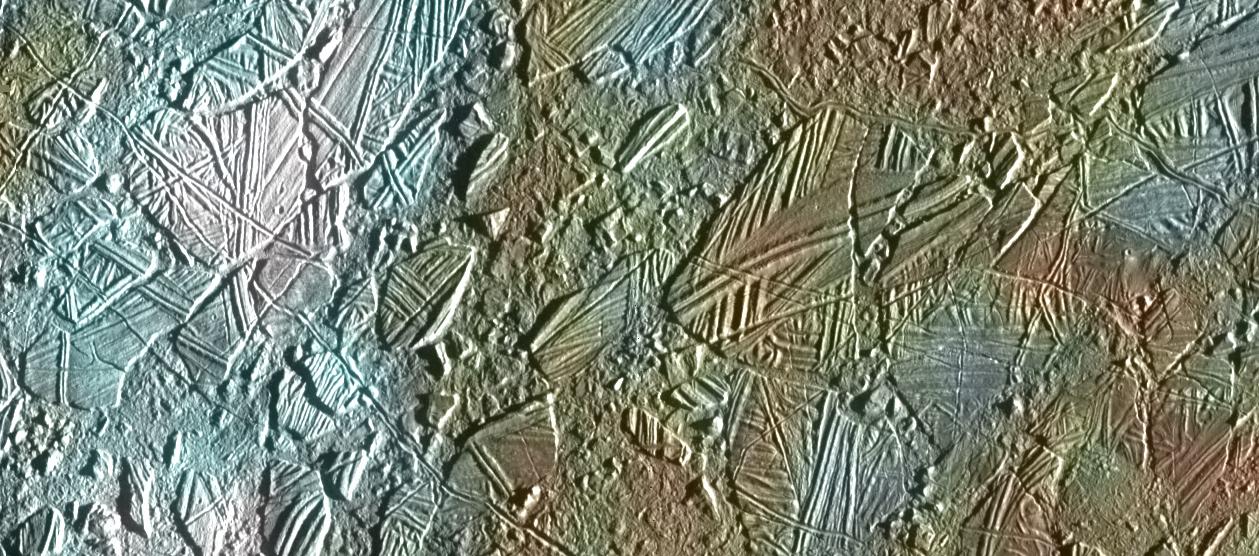
Europa's water-ice surface is crisscrossed by dark, reddish-brown cracks. NASA says the small number of impact craters suggests the surface is no more than 40 to 90 million years old, young in geologic terms, whereas Callisto's is a few billion years old.[1] The reddish-brown material along the fractures is not known for certain but likely contains salts and sulfur compounds mixed with the ice and modified by radiation.[1] Fractures are often only 1 to 2 kilometres wide but can run for thousands of kilometres, and some have built up ridges hundreds of metres tall. Galileo spacecraft images also showed pits and domes that suggest the ice layer may be slowly churning, and regions of broken "chaos terrain".[1]
A close view of Europa's cracked and broken ice surface.
Via Wikimedia Commons: Europa Chaos by NASA / JPL / University of Arizona, public domain.
The ocean
In 1972 spectroscopic observations from Kitt Peak National Observatory showed Europa's surface is mostly water ice, and thermal models since 1971 had suggested a layer of liquid water inside.[1] One of Galileo's most important discoveries was a disturbance of Jupiter's magnetic field near Europa, which strongly implied that a magnetic field is being induced by a deep layer of electrically conductive fluid. Given Europa's icy composition, NASA says a global ocean of salty water is the most likely explanation.[1]
NASA's Europa facts page gives an estimated ice shell thickness of 15 to 25 kilometres floating on an ocean 60 to 150 kilometres deep. It says Europa's ocean may hold twice as much water as Earth's ocean even though Europa is one-fourth Earth's diameter, and that although the evidence is strong, the ocean's existence awaits confirmation by a future mission.[1] In a result published on 17 December 2025 in Nature Astronomy, NASA's Juno spacecraft, using its microwave radiometer on a 29 September 2022 flyby, found the shell averages about 29 kilometres thick in the region it observed. NASA says this is the first measurement to discriminate between earlier thin-shell and thick-shell models, which ranged from under a kilometre to tens of kilometres.[3]
Plumes and surface chemistry
No plumes were seen while Galileo was at Jupiter in the 1990s. Later Hubble Space Telescope observations and a reanalysis of Galileo data suggest thin plumes of water may rise about 160 kilometres above the surface, and NASA says a research team announced in November 2019 that it had directly detected water vapor above Europa.[1] NASA's exploration history lists Hubble's December 2013 report of the byproducts of water vapor and its September 2016 images of possible plumes about 200 kilometres high.[7] If plumes exist and are linked to the ocean, a spacecraft could sample them.[1]
In January 2026 NASA reported the first detection of ammonia-bearing compounds on Europa's surface, found in a re-examination of data from Galileo's Near-Infrared Mapping Spectrometer. The signals appear near fractures and pits, suggesting that ammonia-bearing material has been placed there recently from the ocean or shallow subsurface.[4]
Potential for life
NASA lists three main requirements for life as we know it: liquid water, certain chemical elements and an energy source, and also time. It says Europa's ocean may have existed for roughly 4 billion years, and astrobiologists believe it has abundant water and elements including carbon, hydrogen, nitrogen, oxygen, phosphorus and sulfur.[1] Any life would likely be powered by chemical reactions rather than sunlight, because the ocean lies under the ice. Radiation from Jupiter would make the surface lethal to life but may produce fuel for life in the ocean.[1] No life has been found.
Exploration
Europa was first seen up close in the early 1970s as Pioneer 10 and 11 and then Voyager 1 and 2 passed Jupiter, and Voyager images in 1979 showed a bright, smooth surface with few large craters.[1][2] NASA's Galileo spacecraft, in orbit around Jupiter from 1995, made 12 close flybys of Europa and provides most of what is known about it.[1] NASA says six spacecraft had flown in Europa's vicinity as of the date its history page was written.[7] NASA's Juno flew past on 29 September 2022.[3] Hubble also observes the moon regularly.[2]
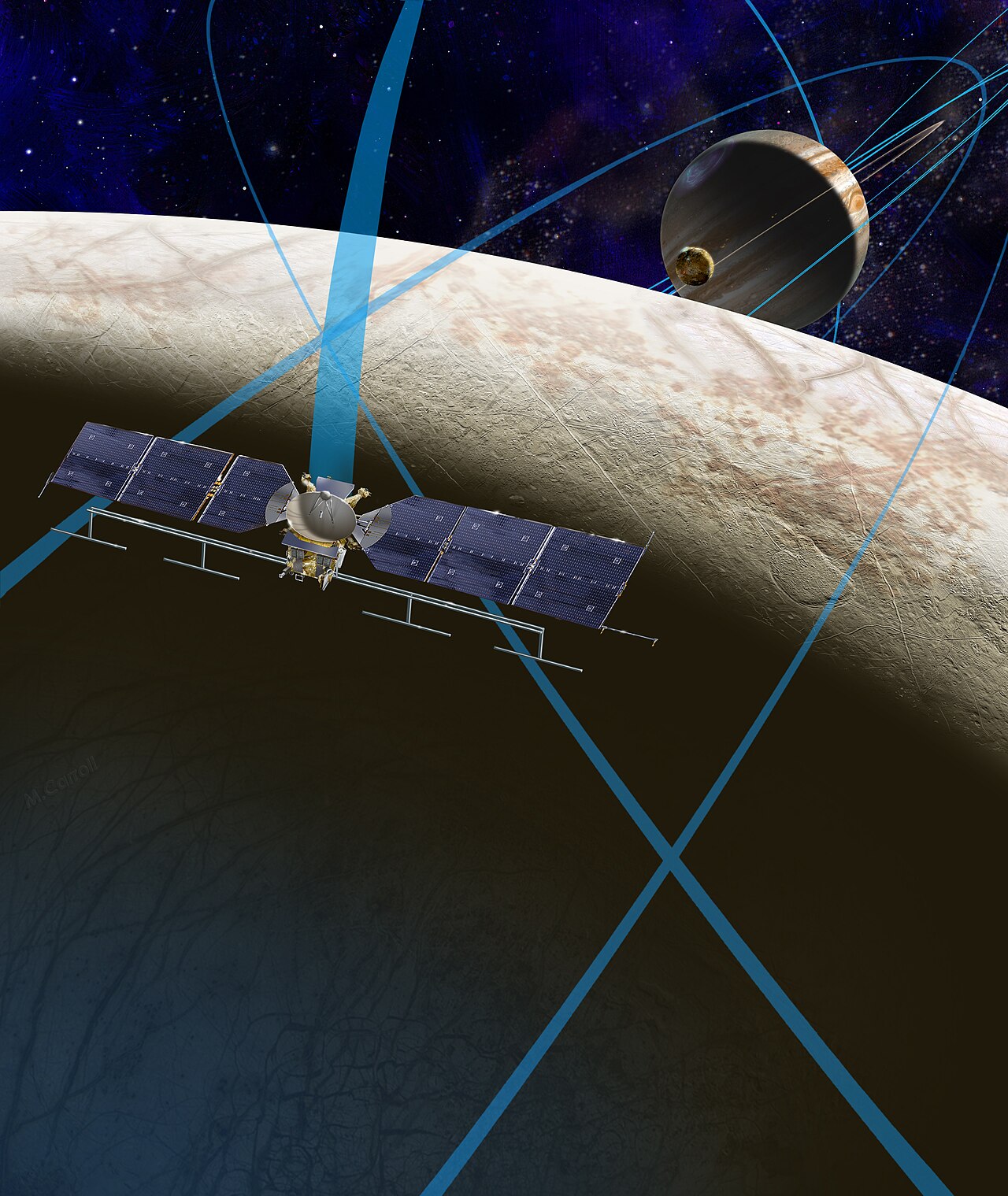
An artist's concept of NASA's Europa Clipper spacecraft.
NASA's Europa Clipper launched on 14 October 2024, the first mission to conduct a detailed science investigation of Europa.[2][5] It carries nine instruments. NASA says it is the largest spacecraft the agency has built for a planetary mission, and that it will make nearly 50 flybys of Europa from as low as 25 kilometres, inside a radiation-shielding vault. Its main goal is to determine whether there are places below the surface that could support life.[5] NASA's January 2026 article says the spacecraft arrives in the Jupiter system in April 2030, and its mission timeline says it will then conduct nearly 50 flybys of Europa.[4][6] The European Space Agency's Juice mission, launched in April 2023 and due at Jupiter in July 2031, will also fly by Europa.[8]
Name
Europa is named for a woman who, in Greek mythology, was abducted by the god Zeus, called Jupiter in Roman mythology.[1]