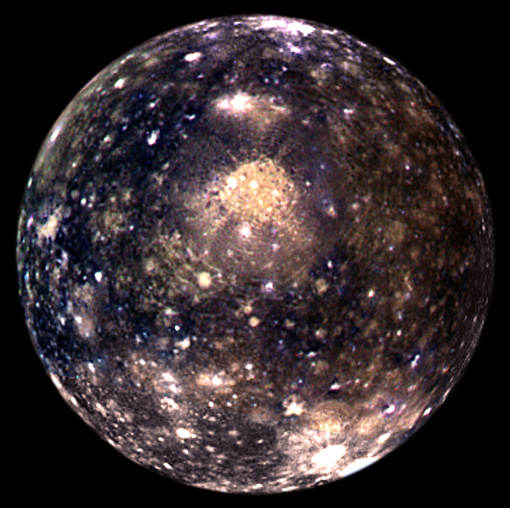
Callisto is Jupiter's second-largest moon and the third-largest in the Solar System, almost as big as the planet Mercury, with a surface that NASA calls the oldest and most heavily cratered in the Solar System.[1]
Callisto, Jupiter's heavily cratered moon, in an image from NASA's Galileo spacecraft.
NASA's Jovian satellite fact sheet lists Callisto's radius as 2,410.3 kilometres, its mean density as 1,830 kilograms per cubic metre and its orbit as 16.689 days at a distance of about 1.88 million kilometres from Jupiter.[3] NASA says it is about 1.8 times farther from Jupiter than Ganymede, 2.8 times farther than Europa and 4.5 times farther than Io. Callisto is tidally locked, so the same side always faces Jupiter.[1] Its density is the lowest of the four Galilean moons in the fact sheet's table.[3]
Surface
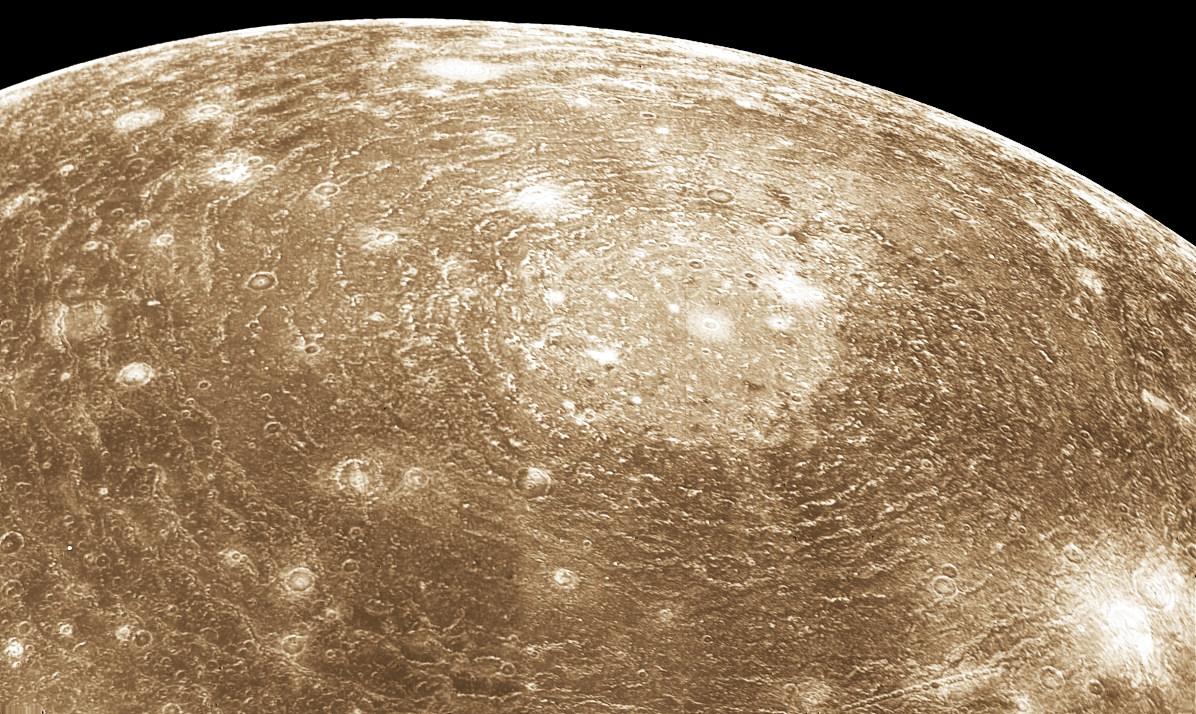
NASA says Callisto's rocky, icy surface is about 4 billion years old and has been pummeled, likely by comets and asteroids. Because the craters are still visible, scientists think the moon has little geologic activity: no active volcanoes and no tectonic shifting to erode the craters.[1] The craters include bowl-shaped ones and ones with multiple rings, and the bright white dots on its surface are thought to be crater peaks capped with water ice.[1]
Impact craters and rings on the surface of Callisto.
NASA says that scientists once regarded Callisto as a boring "ugly duckling moon" and a "hunk of rock and ice" because the crater-covered world seemed to have little going on.[1]
Interior and the possible ocean
NASA says data from the Galileo spacecraft in the 1990s suggest Callisto may have a salty subsurface ocean, which scientists estimate may lie about 250 kilometres below the surface, possibly in contact with a layer of rocks. It adds that more recent research indicates the ocean may be deeper than previously thought, or may not exist at all.[1] The interior may have layers of ice mixed with rock and metal, possibly extending to the center.[1]
Atmosphere
Scientists announced in 1999 that Galileo had detected a very thin carbon dioxide exosphere on Callisto in 1997 observations. NASA says more recent research indicates the exosphere also holds oxygen and hydrogen.[1]
Potential for life
NASA lists Callisto among possible places where life could exist beyond Earth, because Galileo data and models indicate that a salty ocean interacting with rock, if it exists, would provide key conditions for life, and oxygen has been detected in the exosphere.[1] No life has been found.
Discovery and name
Galileo Galilei discovered Callisto on 7 January 1610, along with Ganymede, Europa and Io. It is named for a woman turned into a bear by Zeus in Greek mythology; Zeus is the Roman god Jupiter.[1]
Exploration
NASA says that almost 400 years after Galileo's discovery, the Galileo orbiter began the first in-depth study of the Jovian system, including Callisto, and orbited Jupiter until its mission ended in 2003.[2] The Galileo spacecraft made eight encounters with Callisto.[4] Since then NASA's Cassini and New Horizons spacecraft have taken images of its surface, and NASA says its Juno spacecraft has also imaged Callisto.[2] NASA's Pioneer 10 and the Voyager probes passed earlier.[2]
The European Space Agency's Juice (Jupiter Icy Moons Explorer), launched on 14 April 2023 and due to reach Jupiter in July 2031, lists Callisto, with Ganymede and Europa, among the ocean-bearing icy moons it will characterize, and will make flybys of it during its orbital tour.[5]