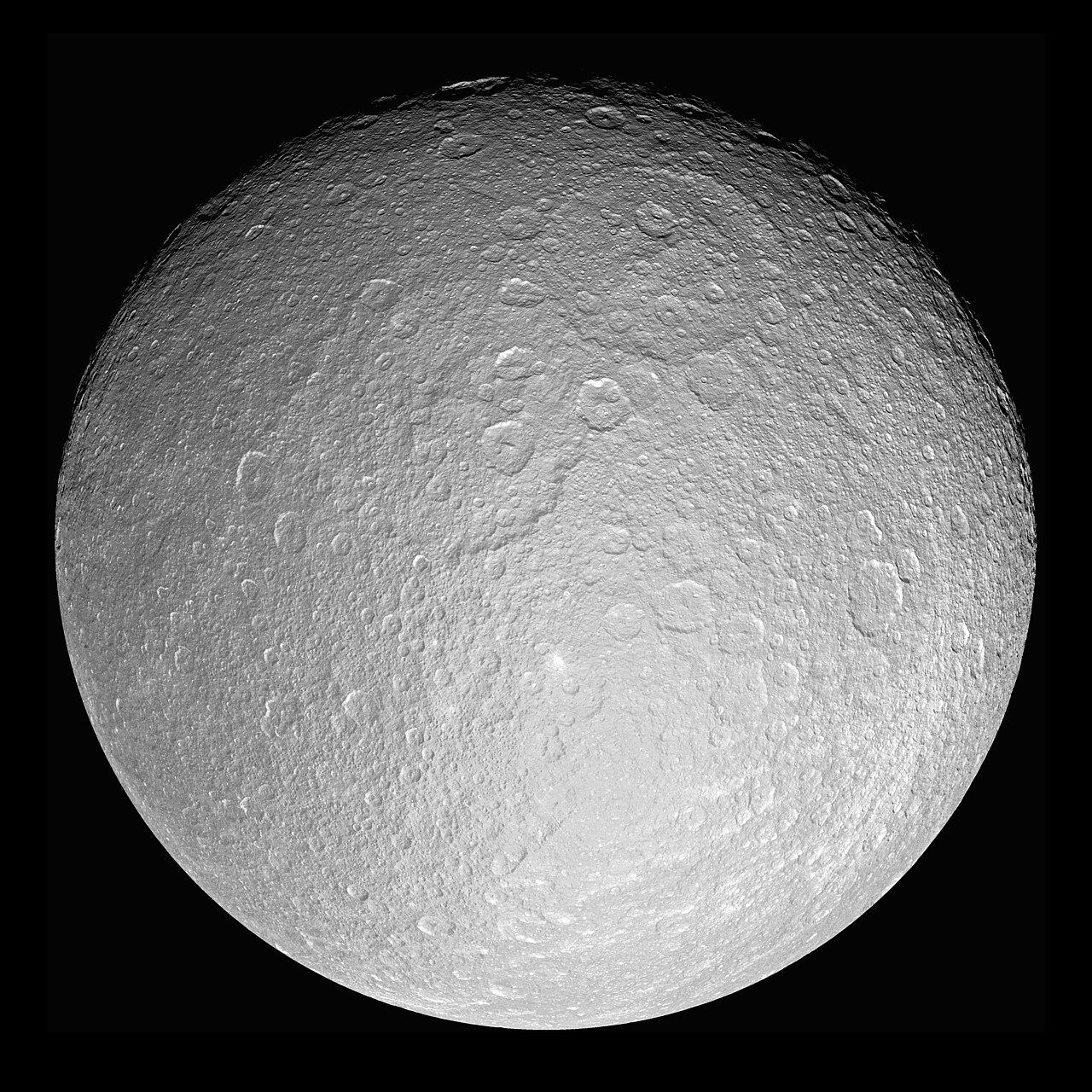
Rhea is the second largest moon of Saturn, a small, cold, airless world of ice and rock with a mean radius of about 764 kilometres.[1] It was discovered by Giovanni Cassini on 23 December 1672.[1]
Rhea in a black-and-white image from the Cassini spacecraft, showing its heavily cratered surface.
Via Wikimedia Commons: PIA07763 Rhea full globe5 by NASA / JPL / Space Science Institute, public domain.
Size, composition and orbit
NASA gives Rhea a mean radius of 764 kilometres (475 miles), less than a third the radius of Saturn's largest moon, Titan.[1] NASA's Saturnian Satellite Fact Sheet lists radii along three axes of 765 × 763 × 762 kilometres, a mass of 23.1 × 10²⁰ kilograms, a mean density of 1,240 kilograms per cubic metre and a geometric albedo of 0.7.[2] NASA's page gives the density as 1.233 times that of liquid water, which suggests to NASA that Rhea is about three quarters ice and one quarter rock.[1]
Rhea orbits Saturn at a distance of about 527,000 kilometres (327,500 miles) and takes about 4.5 Earth days to complete an orbit.[1] The fact sheet gives a semi-major axis of 527.04 thousand kilometres, a period of 4.5175 days, an inclination of 0.35 degrees and an eccentricity of 0.0010, with synchronous rotation.[2] Like its neighbours Dione and Tethys, Rhea is tidally locked, with one side always facing Saturn.[1]
Surface
Rhea's surface temperatures range from about −174 °C in sunlit areas to about −220 °C in shaded areas.[1] Its high reflectivity suggests a surface made largely of water ice, which behaves like rock at these temperatures.[1] Cassini measurements from a close encounter gave a moment of inertia higher than expected if Rhea had a rocky core, so NASA says Rhea is thought to be a homogeneous mixture of ice and rock, a "frozen dirty snowball".[1]
NASA explains that Rhea, being farther from Saturn than Dione and Tethys, receives less tidal variation and so less internal heating. Dione and Tethys have more smooth plains, which are probably places where liquid water reached the surface and refroze, erasing craters, while Rhea is more heavily cratered.[1] Voyager images in 1980 and 1981 showed two kinds of terrain: heavily cratered bright terrain with craters larger than 40 kilometres across, and parts of the polar and equatorial regions with only smaller craters, which may indicate a major resurfacing event long ago. NASA gives the average age of the plains as around 4 billion years.[1]
NASA reports that Voyager also revealed linear "wispy" lines tens to hundreds of miles long, and that in 2006 Cassini images showed them to be subsidence fractures forming canyons, some several hundred metres high, whose bright walls expose fresh water ice. NASA says these fracture cliffs suggest Rhea may have been tectonically active in the past, and that similar features occur on Dione and Tethys.[1]
A thin atmosphere
In 2010 the Cassini spacecraft detected a very thin atmosphere, an exosphere, containing oxygen and carbon dioxide around Rhea. NASA calls it the first time a spacecraft directly captured molecules of an oxygen atmosphere at a world other than Earth.[1] The oxygen appears to come from energetic particles trapped in Saturn's magnetic field striking the water-ice surface and decomposing it; the source of the carbon dioxide is less certain. Surface oxygen is estimated to be about 5 trillion times less dense than on Earth.[1]
The rings that were not found
NASA's Rhea page says that in 2008 Cassini found evidence of material orbiting Rhea, the first time rings had been found around a moon.[1] That claim was later contradicted. In 2010 a team led by Matthew Tiscareno of Cornell University took 65 images of Rhea between 2008 and 2009, looking at angles suited to detect both fine dust and larger objects, and found no orbiting material.[3][4] The 2008 inference had rested on a sharp, symmetrical drop in electrons that Cassini detected near the moon in a 2005 flyby.[3] The team concluded that the electron signal is not caused by solid material orbiting Rhea, leaving the cause of those electromagnetic effects unexplained.[3][4] The entry follows the 2010 results where they conflict with the older NASA page.
Via Wikimedia Commons: PIA07763 Rhea full globe5 by NASA / JPL / Space Science Institute, public domain.
Discovery and name
NASA says Giovanni Cassini discovered Rhea on 23 December 1672, and its moons list also gives 1672.[1][5] Rhea appeared as a tiny dot to astronomers until the Voyager encounters in 1980 and 1981.[1]
Rhea is named for the Greek goddess, or Titan, Rhea, daughter of Uranus and Gaea and wife of Kronos, the Roman Saturn, who was called the mother of the gods because she bore several of the gods of Mount Olympus, including Zeus.[1] Cassini referred to Rhea as one of the four Sidera Lodoicea, the Stars of Louis, after King Louis XIV, together with Tethys, Dione and Iapetus. Astronomers also call it Saturn V, for the fifth moon in distance from Saturn.[1]
Cornell University. "No rings around Saturn's Rhea, astronomers find." 29 July 2010. news.cornell.edu/node/272010 (read 22 November 2026)
Tiscareno, M. S., Burns, J. A., Cuzzi, J. N. and Hedman, M. M. "Cassini imaging search rules out rings around Rhea." arXiv:1008.1764, 2010. arxiv.org/abs/1008.1764 (abstract read 22 November 2026)