Epimetheus is a small, potato-shaped moon of Saturn, about 58 kilometres in mean radius, that shares almost the same orbit as its sister moon Janus and trades places with it about every four years.[1] NASA says this is the only such orbital arrangement known in the solar system.[1]
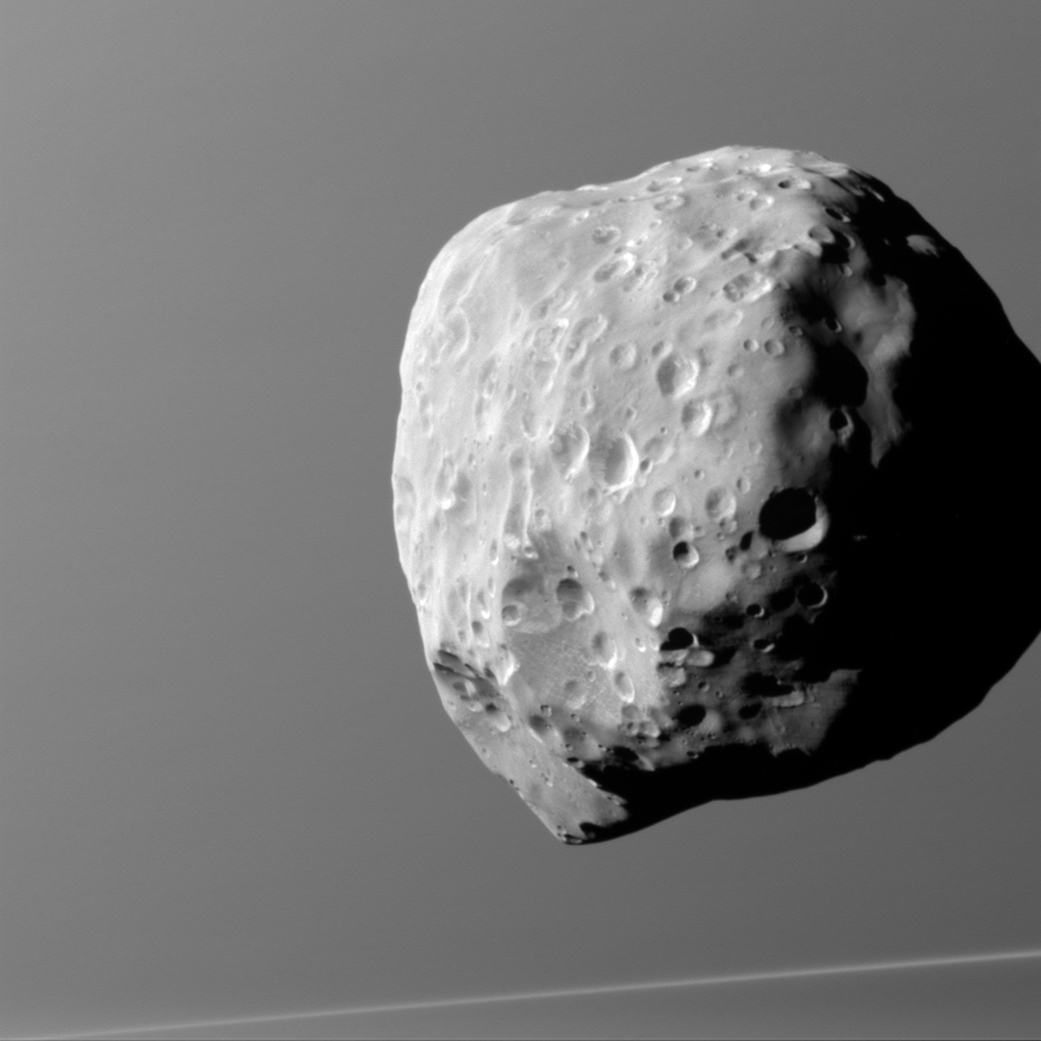
Via Wikimedia Commons: Epimetheus Mai2016 by Nasa, Cassini, public domain.
Size and shape
NASA gives Epimetheus a mean radius of 58 kilometres (36 miles) and dimensions of 135 × 108 × 105 kilometres, and says its shape reflects a pronounced flattening at the south pole associated with the remains of a large crater.[1] NASA's Saturnian Satellite Fact Sheet lists radii along three axes of 65 × 57 × 53 kilometres, a mass of 0.0053 × 10²⁰ kilograms, a mean density of 640 kilograms per cubic metre and an albedo of 0.8, which implies diameters of about 130 × 114 × 106 kilometres, not quite the same as the page, and the entry does not reconcile them.[1][2] An image caption on NASA's page gives the moon's extent as 116 kilometres (72 miles) across in a view from a flyby on 6 December 2015.[1]
NASA says Epimetheus has several craters larger than 30 kilometres, including Hilairea and Pollux.[1] Like Janus, it has a density below 0.7 times that of water, and NASA says both moons are thought to be largely water ice and are probably "rubble piles", with a temperature of about −195 °C and a visual albedo of 0.7 to 0.8 on NASA's page.[1] Each has dark, smoother areas alongside brighter terrain, and NASA's interpretation is that dark material moves down slopes, leaving shinier water ice on the walls of fractures.[1]
Orbit and the exchange with Janus
Epimetheus orbits Saturn about 151,000 kilometres (94,000 miles) from the planet, in the gap between the F and G rings, and circles it in about 17 hours.[1] The fact sheet gives a semi-major axis of 151.422 thousand kilometres, a period of 0.6942 days, an inclination of 0.34 degrees and an eccentricity of 0.009, with synchronous rotation.[2] NASA says it shares its orbit with Janus in a co-orbital condition, or 1:1 resonance.[1]
NASA explains that one of the two moons orbits about 50 kilometres farther from Saturn than the other and so takes longer to go around. The inner, faster moon catches up with the other about every four Earth years, and the gravitational interaction then makes them trade places between the inner and outer orbits. The closest they come is about 15,000 kilometres.[1] The fact sheet's semi-major axes, 151.422 thousand kilometres for Epimetheus and 151.472 thousand kilometres for Janus, show how close the two orbits are, though the fact sheet is a snapshot and does not say which moon is currently the inner one.[2]
Origin and the ring
NASA says the two moons may have formed by the break-up of one moon. If so, it happened early in the Saturn system's life, since both have ancient cratered surfaces, many with soft edges because of dust, and some grooves similar to those on Phobos that suggest glancing blows from other bodies.[1] They also share their orbits with a faint dust ring, now called the Janus/Epimetheus Ring, which NASA says may be made of particles blasted off their surfaces by meteoroid impacts.[1]
Discovery
NASA says Audouin Dollfus observed a moon on 15 December 1966, for which he proposed the name Janus, and that Richard Walker made a similar observation on 18 December 1966, now credited as the discovery of Epimetheus. Astronomers then believed there was only one moon in the orbit. In October 1978 Stephen M. Larson and John W. Fountain realised that the 1966 observations were better explained by two objects sharing very similar orbits, and Voyager 1 confirmed this in 1980, so Larson and Fountain officially share the discovery of Epimetheus with Walker.[1] NASA's list of Saturn's moons gives different credit lines for Epimetheus, naming Fountain and Larson for 1977 and another observer for 1980, so the sources differ on who is credited and when.[3] Cassini has made several close approaches since it reached orbit around Saturn in 2004.[1]
Name
John Herschel suggested naming Saturn's moons for the mythical brothers and sisters of Kronos, known to the Romans as Saturn.[1] Epimetheus was the Greek god, or Titan, whose name means "hindsight" and who was the brother of Prometheus, "foresight", and NASA says the two together represented humanity.[1] NASA adds that the crater Hilairea is named for a priestess of Artemis and Athena, and Pollux for a warrior in the Iliad who carried her off.[1] Astronomers also call the moon Saturn XI and S/1980 S3.[1]
Sources
- NASA Science. "Epimetheus." science.nasa.gov/saturn/moons/epimetheus/ (read 22 November 2026)
- NASA NSSDCA. "Saturnian Satellite Fact Sheet." nssdc.gsfc.nasa.gov/planetary/factsheet/saturniansatfact.html (read 22 November 2026)
- NASA Science. "Saturn Moons." science.nasa.gov/saturn/moons/ (read 22 November 2026)
