The ecliptic is the apparent path of the Sun across the sky over a year, as seen from Earth.[1] It is also the plane of Earth's orbit around the Sun, and the planets' orbits lie close to it.[1][3]
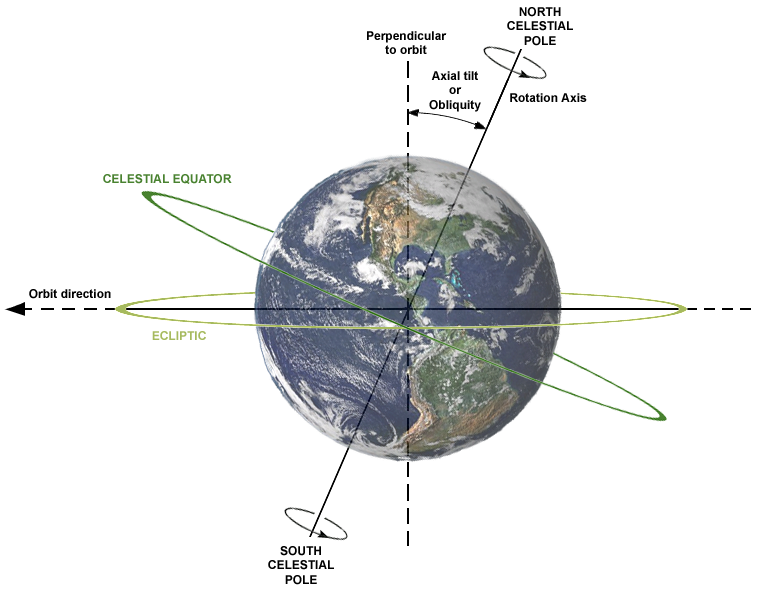
Via Wikimedia Commons: AxialTiltObliquity by Dna-webmaster, CC BY 3.0.
Two ways to describe it
Georgia State University's HyperPhysics pages explain that, from Earth's point of view, the Sun appears to move around Earth in a path called the ecliptic, and that the apparent path of the Sun on the celestial sphere is the ecliptic. The "ecliptic plane" is the plane of Earth's orbit, which that path traces on the sky.[1] The pages note that it is often more convenient to describe the sky as if Earth were fixed, and that the ecliptic is then the Sun's apparent path.[1]
The tilt
The ecliptic is tilted against the celestial equator, the projection of Earth's equator on the sky, because Earth's spin axis is tilted against its orbit. HyperPhysics gives the angle as 23.5 degrees, and NASA's Earth facts page gives the tilt of Earth's rotation axis to the plane of its orbit as 23.4 degrees.[1][2] The two figures round the same angle differently, and neither source says why they differ. NASA says the tilt causes the yearly cycle of seasons: for part of the year the northern hemisphere is tilted toward the Sun and has summer, and six months later the reverse.[2]
HyperPhysics says the two points where the ecliptic crosses the celestial equator are the equinoxes, when the day and the night each last 12 hours, and that the Sun's most northern excursion is the summer solstice, the longest daylight, with the winter solstice opposite.[1]
The planets lie near the ecliptic
HyperPhysics says observations show the other planets, with the exception of Pluto, also orbit the Sun in essentially the same plane, so the ecliptic plane holds most of the objects orbiting the Sun, which suggests the solar system formed from a disk of material.[1] It names Pluto's orbit as exceptional, at 17 degrees to Earth's, with Mercury the only other planet to move significantly away, by 7 degrees.[1] NASA's planetary fact sheet lists orbital inclinations of 7.0 degrees for Mercury, 3.4 for Venus, 0.0 for Earth, 1.8 for Mars, 1.3 for Jupiter, 2.5 for Saturn, 0.8 for Uranus, 1.8 for Neptune and 17.2 for Pluto, and 5.1 for the Moon.[3] I did not read that sheet's notes, so I have not checked which reference plane it uses, but the numbers agree with HyperPhysics. See Solar System, Mercury and Pluto.
Away from the ecliptic
Smaller bodies are less confined. NASA says many scattered disc objects have orbits tilted by tens of degrees, and that "hot" classical Kuiper belt objects are more tilted than "cold" ones.[4] See the Kuiper belt entry. A summary in Eos of Juno dust measurements says the particles responsible for zodiacal light orbit the Sun in discrete bands near the ecliptic plane.[5] These are descriptions of populations, not of the ecliptic itself.
See also
Solar System, Earth and Sun.
Sources
- HyperPhysics, Georgia State University. "Ecliptic Plane." hyperphysics.gsu.edu/hbase/eclip.html (read 23 November 2026)
- NASA Science. "Earth Facts." science.nasa.gov/earth/facts/ (read 23 November 2026)
- NASA Goddard Space Flight Center. "Planetary Fact Sheet — Metric." nssdc.gsfc.nasa.gov/planetary/factsheet/ (read 23 November 2026)
- NASA Science. "Kuiper Belt Facts." science.nasa.gov/solar-system/kuiper-belt/facts/ (read 23 November 2026)
- Stanley, S. "The space dust that causes zodiacal light might come from Mars." Eos 102, 12 March 2021. eos.org/research-spotlights/the-space-dust-that-causes-zodiacal-lig… (read 23 November 2026)
