Chitin is a horny, nitrogen-containing polysaccharide built from units of N-acetylglucosamine; it is the main structural material of the outer skeleton of insects and other arthropods and an important component of fungal cell walls.[1][2]
Chemical structure
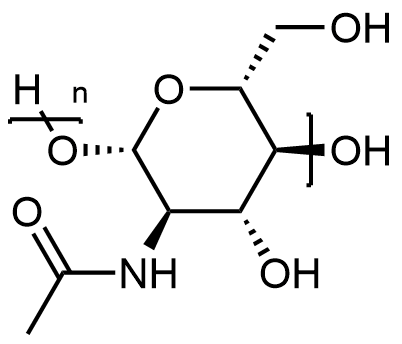
Chitin is a polysaccharide, meaning a long chain made of many sugar units joined together, and Britannica describes those units as the amino sugar glucosamine.[1] More precisely, the repeating unit is N-acetylglucosamine (often shortened to GlcNAc), and neighbouring units are joined by beta-1,4 glycosidic links, the type of sugar-to-sugar bond that connects carbon 1 of one unit to carbon 4 of the next.[2][3] Some natural chitin also contains units of plain glucosamine that lack the acetyl group, so it is not always a pure chain of a single unit.[4]
The structure of chitin closely resembles that of cellulose, the main structural material of plants.[3] The difference lies at the second carbon atom of each unit: where cellulose carries a hydroxyl group, chitin carries an acetamide group, which contains nitrogen.[3] Because of that nitrogen, chitin can supply organisms that break it down with nitrogen as well as carbon, with a carbon-to-nitrogen ratio of about 8 to 1.[2] Chitin with a high proportion of acetyl groups does not dissolve in water or in other common solvents.[3] It is one of the most abundant renewable biopolymers on Earth, and a 2025 review describes it as the second most abundant biopolymer.[2][3]
A diagram of the chemical structure of chitin, showing N-acetylglucosamine units joined in a chain.
Chitin chains pack together in three crystalline forms, known as alpha, beta and gamma chitin, which differ in the direction in which neighbouring chains run.[2][3] In alpha chitin the chains run in opposite directions (antiparallel), which allows strong hydrogen bonding between them; this is the most widely distributed form and is obtained mainly from crab and shrimp shells.[2][3] In beta chitin the chains run in the same direction (parallel); it comes mainly from molluscs such as squid.[2][3] In gamma chitin the pattern is mixed, with every third chain running opposite to the chains before it; it has been reported in certain beetle cocoon fibres and in the stomach of the squid genus Loligo.[3]
Where chitin occurs
Britannica describes chitin as a white, horny substance found in the outer skeletons of insects, crabs and lobsters and in internal structures of other invertebrates.[1] In insects it occurs in the cuticle (the outer covering of the body), in the peritrophic matrix that lines the gut, and in the tracheae, the air tubes used for breathing.[4] Chitin makes up roughly 3 to 13 percent of the dry weight of the insect peritrophic matrix.[4] Outside the arthropods it has also been recorded in annelid worms, molluscs and coelenterates.[4]
Chitin is an important component of the cell walls of fungi, where it takes the place that cellulose holds in plants as the main structural polysaccharide.[2][4] In fungal cell walls chitin is bound to other polysaccharides called glucans in a chitin–glucan complex, and both the alpha and gamma forms occur there.[3] The amount varies widely by source: crustacean shells contain roughly 8 to 40 percent chitin, while the mushroom samples summarised in a 2025 review contained about 1 to 7 percent.[3] Crustacean waste is the largest industrial source of chitin.[3]
Role in the insect cuticle
The insect cuticle is layered. Its outermost part, the epicuticle, contains no chitin, while the procuticle beneath it, lying directly above the living epidermis, is where chitin is found.[4][5] The procuticle contains microfibres of chitin surrounded by a matrix of protein.[5] One review describes the hardened cuticle as an interpenetrating network of chitin fibres with embedded cross-linked protein and pigments.[4] Strong non-covalent attractions hold chitin and chitin-binding proteins together, but evidence for direct chemical (covalent) bonds between chitin and cuticle proteins has been described as inconclusive.[4]
In some parts of the body the procuticle separates into a hard outer exocuticle and a soft inner endocuticle.[5] The hard exocuticle forms through sclerotisation (spelled sclerotization in American English), a chemical hardening that takes place shortly after each moult, in which individual protein molecules are linked together by quinone compounds.[5] During this process compounds called catechols are oxidised, the material around the chitin becomes cross-linked and hard, and water is gradually driven out.[4] In places where the elastic protein resilin is present in high concentrations, these quinone cross-links do not form, leaving the cuticle flexible.[5]
Because the hardened cuticle is too rigid to allow growth, insects periodically replace it with a new one.[4] Chitin in the old cuticle and the peritrophic matrix is broken down to N-acetylglucosamine by two enzymes working together, a chitinase and an N-acetylglucosaminidase.[4] The moulting process itself is covered under Ecdysis.
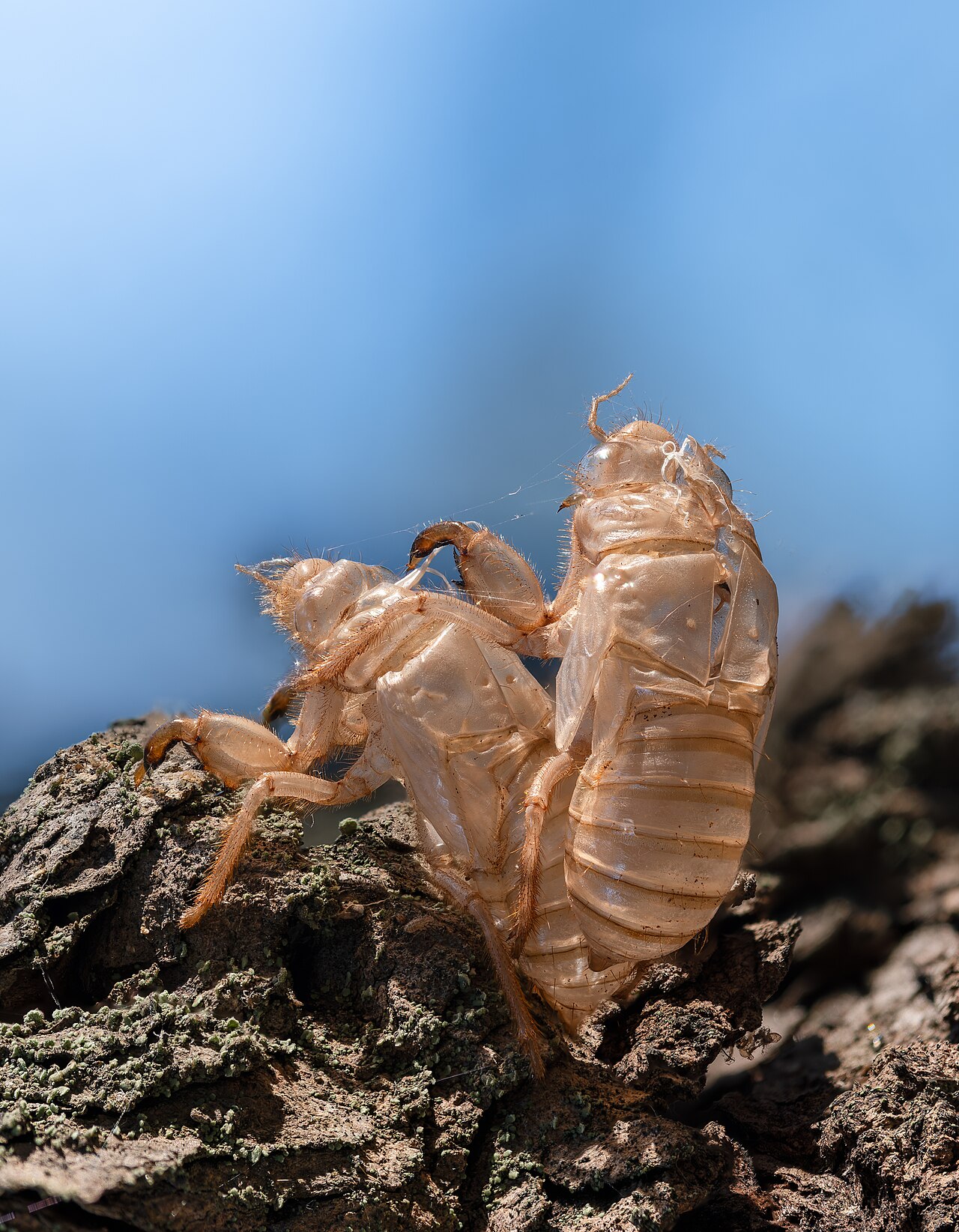
The empty, chitin-rich outer skin left behind by a cicada after moulting.
Henri Braconnot, a French professor of natural history, discovered chitin in 1811, in mushrooms, and called it "fongine".[2][6] In 1823 Odier found the same kind of material in insects and named it "chitine", the source of the modern name.[2][6] In 1824 a researcher named Children showed that chitin contains nitrogen.[6] The history of chitosan, chitin's main derivative, goes back to work by Rouget in 1859, and the name "chitosan" was introduced by Hoppe-Seyler in 1894.[6]
Chitosan and other uses
Chitosan is made by deacetylation of chitin, that is, by removing many of the acetyl groups from its units.[3][7] One review gives the share removed as between 60 and 80 percent.[2] Commercial chitosan has been produced mainly from chitin taken from crustaceans.[7] Unlike chitin, chitosan dissolves in acidic water, because its exposed amine groups take up hydrogen ions.[7] It has shown antimicrobial activity against bacteria, filamentous fungi and yeasts, and it is valued for being biodegradable and biocompatible.[7]
In medicine, chitosan has been studied and used for drug delivery and as a material for contact lenses, wound dressings and scaffolds for regrowing tissue.[7] Chitin and its derivatives have been used as scaffolds for regenerating bone and other tissues.[2] As of a 2021 review, chitosan and chitosan hydrochloride were accepted by regulatory agencies only as excipients, the inactive ingredients of medicines, and chitosan had been added to the European Pharmacopoeia in its sixth edition.[7] The United States Food and Drug Administration's premarket database records that in August 2002 a hemostatic wound dressing named Chito-Seal, from Abbott Vascular, was found substantially equivalent to existing devices and so allowed on the market.[8]
Outside medicine, Britannica lists uses of chitin, obtained as a by-product of crustacean processing, as a flocculating agent that clumps particles out of waste water, a thickener and stabiliser for foods and pharmaceuticals, an ion-exchange resin, a membrane for chromatography and electrodialysis, a binder for dyes, fabrics and adhesives, and a sizing and strengthening agent for paper.[1] Chitin and chitosan have been shown to remove copper and other heavy metals from water.[2] Chitosan is also used in the cosmetics, food and agriculture industries.[7] In plants such as rice, fragments of chitin have been shown to strengthen the plant's defence responses.[2]
Sources
Encyclopaedia Britannica. "Chitin." Encyclopaedia Britannica. No date shown; accessed 24 November 2026. britannica.com/science/chitin
Zannat, Akhiri; Shamshina, Julia L. "Chitin isolation from crustaceans and mushrooms: The need for quantitative assessment." Carbohydrate Polymers 348: 122882. Elsevier, 2025 (online October 2024); author manuscript via the US National Science Foundation Public Access Repository. par.nsf.gov/servlets/purl/10639441 (DOI: doi.org/10.1016/j.carbpol.2024.122882)
Muthukrishnan, Subbaratnam; Merzendorfer, Hans; Arakane, Yasuyuki; Kramer, Karl J. "Chitin Metabolism in Insects." Chapter 7 in an Elsevier insect biochemistry volume. Elsevier, 2012. Copy hosted by Kansas State University. k-state.edu/bmb/docs/faculty-pubs/Chiitn%20metabolism%20chapter.pdf