George V (1865–1936) was King of the United Kingdom and the British Dominions and Emperor of India from May 1910 until his death in January 1936.[1]
Early life and naval career
George was born in London on 3 June 1865, the second son of the Prince and Princess of Wales, who later became King Edward VII and Queen Alexandra.[1] As a younger son he was intended for a career in the Royal Navy, and in 1877 he and his elder brother, Prince Albert Victor, became naval cadets.[1]
Heir to the throne and marriage
Albert Victor died suddenly in January 1892, which ended George's naval career and placed him directly in line to inherit the throne.[1] He was created Duke of York in May 1892.[1] In May 1893 he became engaged to Princess Victoria Mary of Teck, known as May, who had previously been engaged to his late brother.[1] They married on 6 July 1893 at the Chapel Royal, St James's Palace.[1] The couple had six children: Edward, Albert, Mary, Henry, George and John.[1]
He was created Prince of Wales in November 1901, after his father's accession.[1]
Accession and the constitutional crisis of 1910–1911
George was proclaimed king on 6 May 1910, following his father's death, and was crowned in Westminster Abbey on 22 June 1911.[1] His reign opened during a constitutional crisis over the Liberal government's plan to remove the House of Lords' power to veto bills from the Commons.[1] The government obtained the King's promise to create enough new peers to overcome Conservative opposition in the Lords if necessary.[1] After the Liberals won a second general election in 1910, the Lords passed the Parliament Bill in 1911 without a mass creation of peers.[1]
The resulting Parliament Act 1911 meant that the Lords could no longer exercise an absolute veto over most public bills sent up by the Commons.[2] It also cut the maximum length of a parliament from seven years to five.[2]
Delhi Durbar, 1911
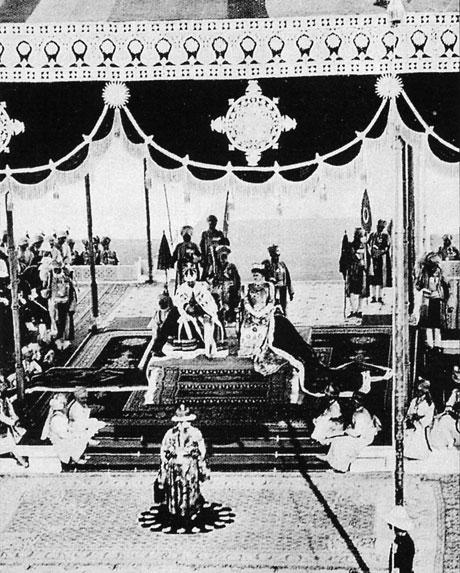
A durbar, in this setting, was an imperial ceremony held in India to mark the accession of each new Emperor or Empress of India, beginning with Queen Victoria in 1877.[3] In 1911 George visited India with Queen Mary, the only monarch to do so as King-Emperor.[1] He was the first monarch to attend a durbar in person.[3] At the Delhi Durbar he met Indian princes and rulers and announced that the capital of British India would move from Calcutta to Delhi.[3] Because the crown regalia could not legally be taken out of England, a new Imperial Crown of India was made for the ceremony.[3] The King wore it for three and a half hours, and his diary records that it "hurt my head" because it was "pretty heavy".[3]
King George V and Queen Mary seated beneath a canopy at the Delhi Durbar in December 1911.
Via Wikimedia Commons: Delhi durbar 1911 2 by Unknown author Unknown author, public domain.
First World War and the House of Windsor
During the First World War the King made more than 450 visits to troops and more than 300 to hospitals.[1] He pressed for proper treatment of German prisoners of war and for more humane treatment of conscientious objectors.[1]
Anti-German feeling during the war led the royal family to adopt the name Windsor in 1917.[1] Until then the King had been head of the house of Saxe-Coburg and Gotha.[4] On 17 July 1917, at a meeting of the Privy Council at Buckingham Palace, he declared that "Our House and Family shall be styled and known as the House and Family of Windsor", and the declaration was published in The London Gazette.[4] According to a Gazette article on the change, the name reflected the family's long connection with Windsor, site of one of the King's main castles.[4] Under the same declaration, male-line descendants of Queen Victoria who were British subjects gave up their German styles and titles.[4]
Ireland, domestic politics and the Statute of Westminster
According to the royal household's official history, the 1916 Easter Rising and the conflict that followed led to the creation of the Irish Free State in 1922, while six northern counties remained part of the United Kingdom, and George played a conciliatory role.[1] On 22 June 1921 he opened the new Northern Ireland parliament in Belfast with a speech that asked "all Irishmen to pause" and to offer "the hand of forbearance and conciliation".[6] The historian Marie Coleman writes that the speech did not lead seamlessly to the truce in the Irish War of Independence 19 days later, but was read as an invitation to the process that produced it.[6]
At home, he accepted the first Labour government in 1924 and, after the economic slump of 1929, persuaded the Labour leader to head a National Government made up of all parties.[1]
The Statute of Westminster, dated 11 December 1931, was a UK Act of Parliament that gave the self-governing Dominions legal control over their own laws.[5] It covered six Dominions: Canada, Australia, New Zealand, the Union of South Africa, the Irish Free State and Newfoundland.[5] It ended the rule, set by the Colonial Laws Validity Act 1865, under which a Dominion law could be struck down for conflicting with English law, and provided that no later UK Act would extend to a Dominion unless that Dominion had requested and consented to it.[5] Its main sections applied to Australia, New Zealand and Newfoundland only once their own parliaments adopted them.[5] The royal household's history notes that, because the Dominions were now linked chiefly by a common allegiance to the Crown, the Statute paradoxically increased the monarchy's importance.[1]
George began the royal Christmas broadcast.[1] On Christmas Day 1932 he spoke by radio from Sandringham, in a broadcast proposed by Sir John Reith, the founder of the BBC, to launch the BBC Empire Service, now the BBC World Service.[7] The text was written by Rudyard Kipling and opened with the words "I speak now from my home and from my heart to you all".[7] The royal household says it lasted about two and a half minutes and reached 20 million listeners.[7] The historian Matthew Glencross notes that the King had turned down Reith's first request to broadcast, in 1923.[8] Accounts of the room differ: the royal household describes two rooms converted for the purpose, while Glencross places the King in a box room under the stairs at Sandringham House.[7][8]
In 1935 the King celebrated his Silver Jubilee, the 25th anniversary of his accession, which the royal household describes as an occasion of great public rejoicing.[1] On 6 May 1935 he and Queen Mary attended a service of thanksgiving at St Paul's Cathedral.[9]
George V died at Sandringham, in Norfolk, shortly before midnight on 20 January 1936, after a chronic lung condition that had first appeared in 1928 worsened over the preceding months.[10] He was succeeded by his eldest son, who became Edward VIII.[1] The private journal of his physician, Lord Dawson of Penn, records that Dawson ended the King's life with injections of morphine and cocaine, writing that he wanted a painless death and for the news to appear first in the morning newspapers.[10] This remained private until the biographer Francis Watson disclosed it in History Today in 1986.[10] Writing in the BMJ in 1994, J. H. R. Ramsay stated that the King was comatose and close to death when Dawson gave what Ramsay called "a lethal combination of morphine and cocaine".[11] The act has been described variously as euthanasia, medically assisted suicide or murder.[10]
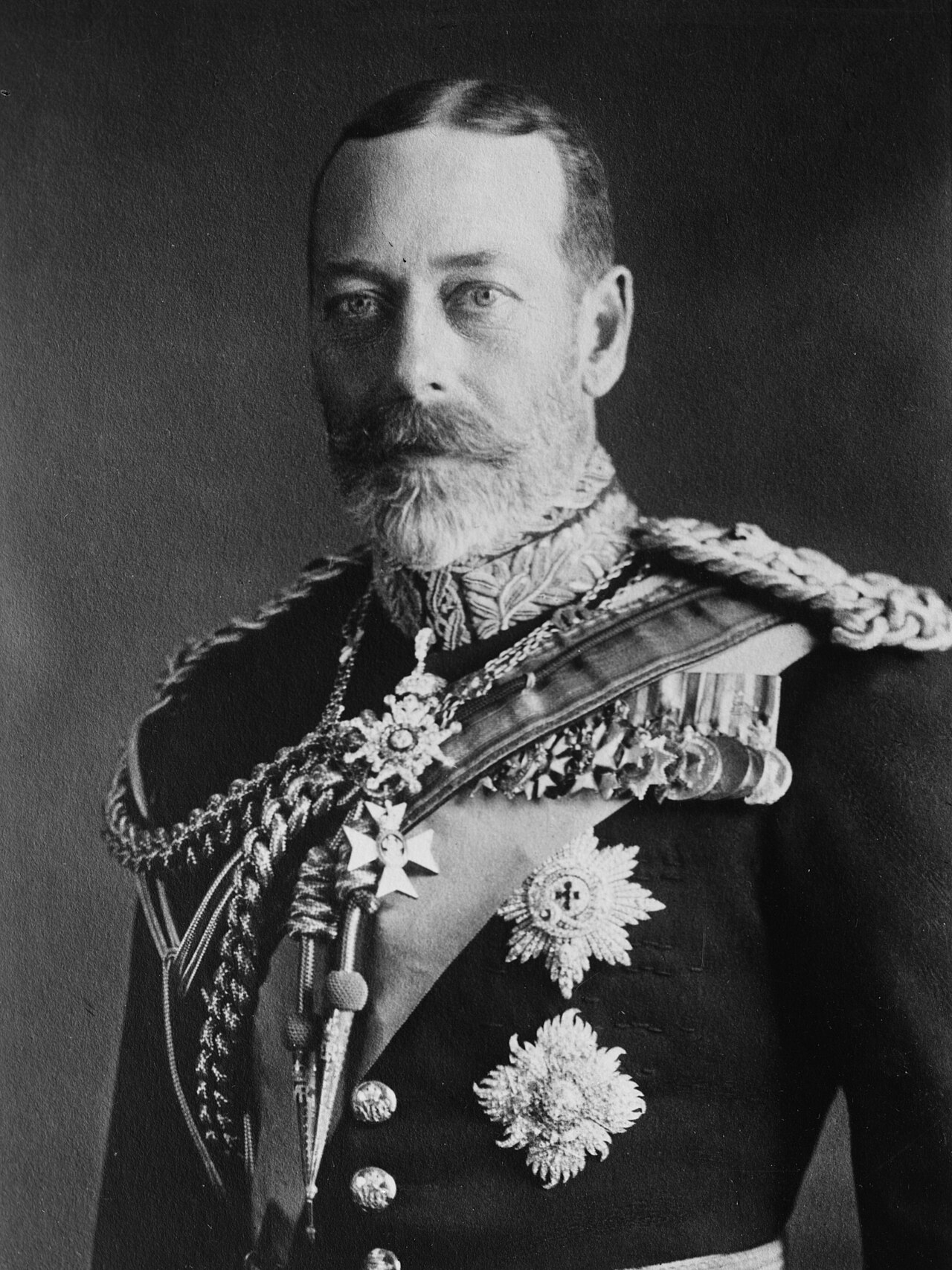
Formal portrait of King George V in military uniform.
Russell Malloch. "The centenary of the creation of the House of Windsor". The Gazette. No date shown; accessed 25 November 2026. thegazette.co.uk/all-notices/content/101228
Topical Press Agency Ltd. "King George V's Silver Jubilee - Service of Thanksgiving at St Paul's Cathedral" (RCIN 2000396; photograph dated 6 May 1935). Royal Collection Trust. No page date shown; accessed 25 November 2026. rct.uk/collection/stories/royal-jubilees/king-george-vs-silver-jubi…