The Wampanoag are an Algonquian-speaking Indigenous people of southeastern Massachusetts and eastern Rhode Island, whose federally recognised nations are the Mashpee Wampanoag Tribe and the Wampanoag Tribe of Gay Head (Aquinnah).[1][2][3]
Name and communities
Pilgrim Hall Museum gives the meaning of "Wampanoag" as "people of the first light" or "people of the east".[2] As of November 2026, the Mashpee Wampanoag Tribe's website says the tribe is also known as the People of the First Light.[4]
Separate communities took the names of their places, such as Mashpee, Aquinnah, Patuxet and Pokanoket, each led by its own sachem (leader); several villages could join in a confederation when needed, and lineage and inheritance passed through women.[2] The Aquinnah tribe's website says the Wampanoag Nation once covered all of southeastern Massachusetts and eastern Rhode Island and included more than 67 communities, of which six visible communities remain.[5] The Mashpee tribe's website describes Mashpee as one of three surviving tribes of an original sixty-nine.[6]
Accounts of how long they have lived in the region differ: at least 10,000 years (Aquinnah tribe), more than 12,000 years (Mashpee tribe) or 13,000 years or more (Pilgrim Hall Museum).[5][4][2] Aquinnah tradition tells of Moshup, a being who shaped the island of Noepe (Martha's Vineyard) and taught the people to fish and catch whales.[5]
Contact and the Great Dying
The magazine of the Smithsonian's National Museum of the American Indian (NMAI) says the Wampanoag dealt with European explorers, traders and enslavers for nearly a century before 1620.[7] In 1614 an English captain, Thomas Hunt, tricked a group of Wampanoag men and boys aboard his ship and sold them as slaves in Spain; one of them, Tisquantum (often called Squanto), was later freed, reached England, and came home in 1619 to find that nearly everyone in his village had died.[8]
An epidemic swept the coast from Maine to Narragansett Bay from 1616 to 1619.[9] Estimates of the toll differ: Pilgrim Hall Museum says the Wampanoag lost at least 75 percent and perhaps 90 percent of their people, while the NMAI magazine puts deaths at about 90 percent of the Indigenous population of the northeastern coast and about 75 percent in northern and coastal Wampanoag villages.[9][7] Pilgrim Hall says nearly all of Patuxet's roughly 2,000 people died.[9] The neighbouring Narragansett largely escaped the disease, and their leaders pressed the Wampanoag sachem Ousamequin, known to the English as Massasoit, to pay them tribute.[9]
Ousamequin and Plymouth
English colonists settled at Patuxet in 1620 and renamed it Plimoth.[7] On 22 March 1621 Ousamequin and the colony's governor, John Carver, concluded a treaty, with Tisquantum helping the two sides understand each other.[10] The English record of it, first printed in London in 1622 in the book known as Mourt's Relation, says neither side would harm the other, offenders would be handed over, each would help the other if attacked, visitors would leave their bows and arrows behind, and King James would regard Ousamequin as a friend and ally.[10] The NMAI magazine says Ousamequin decided to make the treaty after much debate among Wampanoag leaders, at a time when the epidemic had left his people more open to attack.[7] The later Plymouth chronicler Nathaniel Morton wrote that Ousamequin kept the treaty for the rest of his life.[10] Tisquantum later lost Ousamequin's favour and died of illness in 1622.[8] The harvest gathering of autumn 1621 and the Indigenous National Day of Mourning are covered in the Thanksgiving entry.
King Philip's War and its aftermath
Ousamequin's son Metacom, known to the English as King Philip, formed an alliance of nations against the colonists after, in Britannica's words, "bad treatment by settlers who encroached on tribal lands".[1] The war that began in 1675 is known as King Philip's War.[6] Metacom was killed during it in 1676 at Mount Hope, in what is now Bristol, Rhode Island.[11] The Mashpee tribe's timeline says the war killed more than 40 percent of the Wampanoag population and that many healthy men were sold into slavery.[6] The US National Library of Medicine's Native Voices timeline says colonists sold about 500 Wampanoag into slavery, including Metacom's widow and son, and that many were sent to the West Indies, where they died.[12] Britannica says some survivors fled inland and others joined relatives on Nantucket and Martha's Vineyard who had stayed neutral.[1]
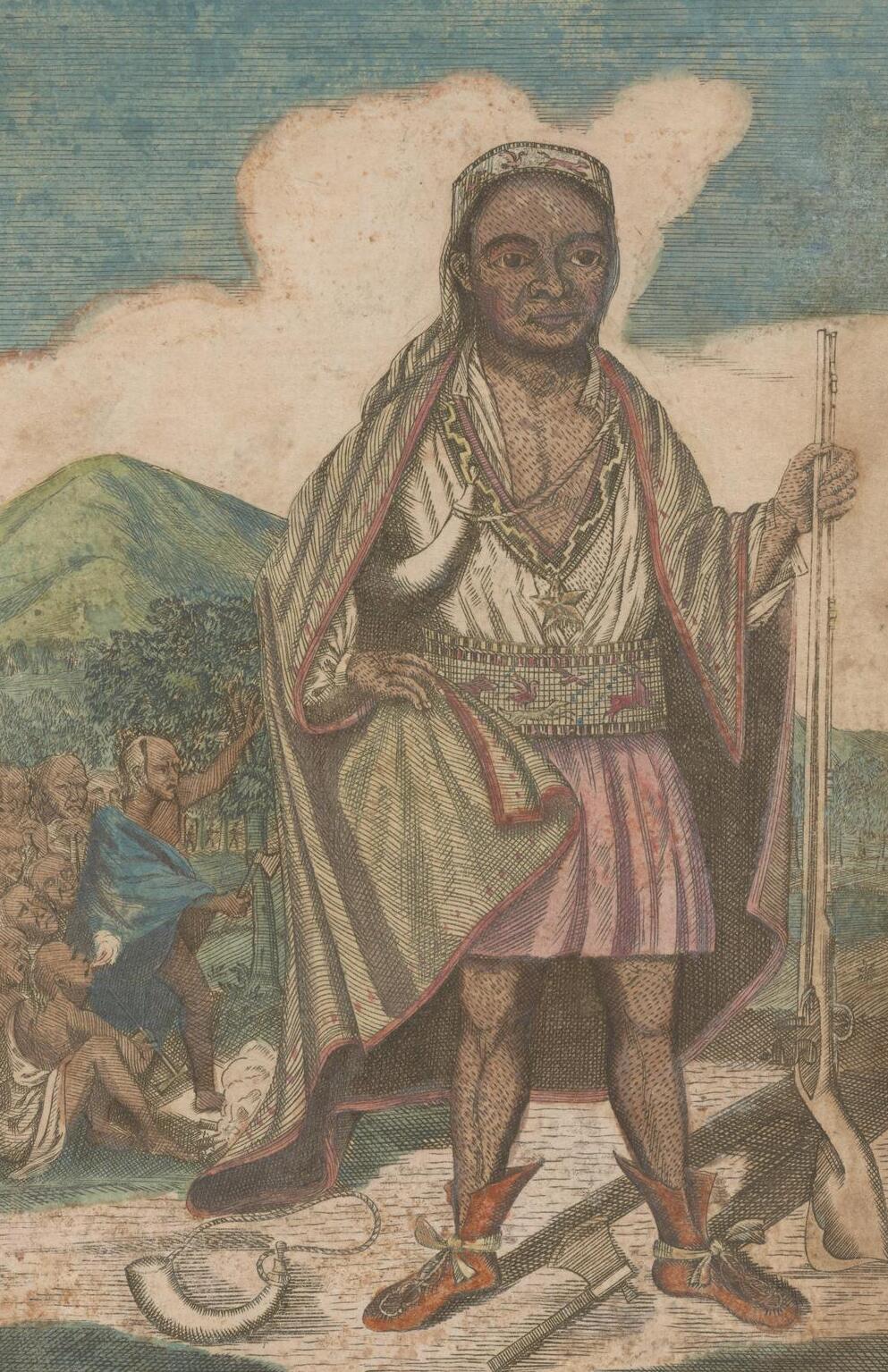
A later artist's depiction of Metacom (King Philip), a hand-coloured engraving by Paul Revere made in 1772 for Benjamin Church's history of King Philip's War.
In 1665 Wampanoag leaders reserved about 25 square miles at Mashpee by deed, which Plymouth Colony confirmed in 1685.[6] After Mashpee delegates complained to the King about colonial guardians, Mashpee was recognised in 1763 as a "self-governing Indian district".[6]
By the 1830s Mashpee was again under white guardians. On 21 May 1833 its people, helped by the Pequot preacher William Apess, drew up a protest, signed by nearly 100 people, forbidding outsiders to take their wood or hay without permission; when men from Barnstable came for wood that July, residents unloaded the wagons, Apess was jailed for 30 days, and the governor threatened to call out the militia.[13] In 1834 the legislature created a self-governing Indian District of Mashpee.[13][6]
The Mashpee timeline records that the state divided tribal land into individual lots in 1842, allowed the lots to be sold to outsiders in 1869, and in 1870 abolished the district and created the town of Mashpee, steps the tribe says lacked the federal approval required by a 1790 act of Congress.[6] The same year, according to the Aquinnah tribe, the town of Gay Head was incorporated "over the unanimous objections" of its Wampanoag residents.[5] The Mashpee timeline adds that Mashpee children were sent to the federal Carlisle Indian School between 1904 and 1916.[6]
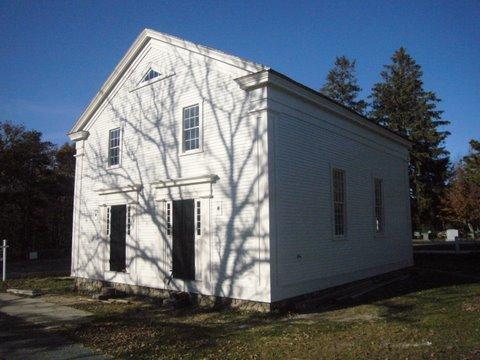
The Old Indian Meeting House, a church in Mashpee, Massachusetts, in a photograph published in 2009.
Recognition and land in the 20th and 21st centuries
In 1972 the Wampanoag Tribal Council of Gay Head was formed to seek federal recognition and the return of tribal lands.[5] On 10 February 1987 the Bureau of Indian Affairs (BIA), the federal agency for relations with tribes, published a final determination acknowledging the Gay Head council as a tribe, reversing a negative finding of 1986.[14] The tribe's own website describes the 1987 acknowledgment as coming "by an act of the U.S. Congress", with a Settlement Act that returned part of its land; the page gives about 485 acres under that act, including the Gay Head Cliffs, and elsewhere says the tribe cares for 477 acres.[5] In 1998 the state renamed the town of Gay Head as Aquinnah.[5]
The Mashpee filed a federal land claim in 1976.[6] A 1978 jury verdict found that the Mashpee did not meet the legal definition of a tribe applied in that case.[15] The BIA acknowledged the Mashpee Wampanoag Tribe on 22 February 2007.[15]
A long dispute followed over land held "in trust" (owned by the United States for a tribe). According to the US Court of Appeals for the First Circuit, the Interior Department decided on 18 September 2015 to take 151 acres in Taunton and 170 acres in Mashpee into trust; Taunton residents sued in 2016, and a federal district court set the decision aside.[15] In 2018 the department found that the tribe had not been "under Federal jurisdiction" in 1934 and so did not qualify; a federal court in Washington vacated that finding in June 2020, and on 22 December 2021 the department concluded that the tribe did qualify and that the Taunton land was its "initial reservation" under the Indian Gaming Regulatory Act, the federal law on tribal gambling.[15] A district court upheld the 2021 decision on 10 February 2023, and the First Circuit affirmed it on 31 October 2023.[15] The Supreme Court declined to hear an appeal on 1 April 2024.[16] The Cape Cod Times reported on 4 April 2024 that the tribe planned a hotel and casino in Taunton, which some Taunton residents had opposed since at least 2016.[17]
The Wampanoag today
The BIA's list of federally recognised tribes published on 30 January 2026 includes the Mashpee Wampanoag Tribe and the Wampanoag Tribe of Gay Head (Aquinnah) among 575 entities; it does not include the Herring Pond, Chappaquiddick or Pokanoket groups.[3]
As of November 2026, the Mashpee tribe's website gives about 3,200 enrolled citizens and lists a Tribal Council, a Tribal Chief and a judicial branch; its reservation lies in Mashpee and Taunton.[4] As of November 2026, the Aquinnah tribe's website gives 901 members, about 300 of them living on Martha's Vineyard, and describes an elected council of chair, vice chair, secretary, treasurer and seven members, with a Chief and a Medicine Man who serve for life.[5] It lists 27 affordable homes, a shellfish hatchery and two yearly events, Cranberry Day and the Legends of Moshup Pageant.[5]
On 19 November 2024 Governor Maura Healey of Massachusetts issued an executive order recognising the Herring Pond Wampanoag Tribe, whose homelands run from the Plymouth area to the upper Cape and which the order says has close to 200 members; the order also names the Mashpee, Aquinnah and Hassanamisco Nipmuc tribes as recognised by the Commonwealth.[18] Pilgrim Hall Museum lists other present-day communities in Assonet, Chappaquiddick, Pocasset, Pokanoket and Seekonk.[2] In November 2024 Brown University transferred about 255 acres at Mount Hope to a preservation trust set up by the Pokanoket Indian Tribe, which The Associated Press described as not federally recognised.[11]
Population figures differ: Britannica gives early 21st-century estimates of about 4,500 Wampanoag descendants, WBUR reported in November 2020 that more than 4,000 Wampanoag lived in New England, and Pilgrim Hall Museum gives about 5,000 across all groups, without a date.[1][19][2]
Language and culture
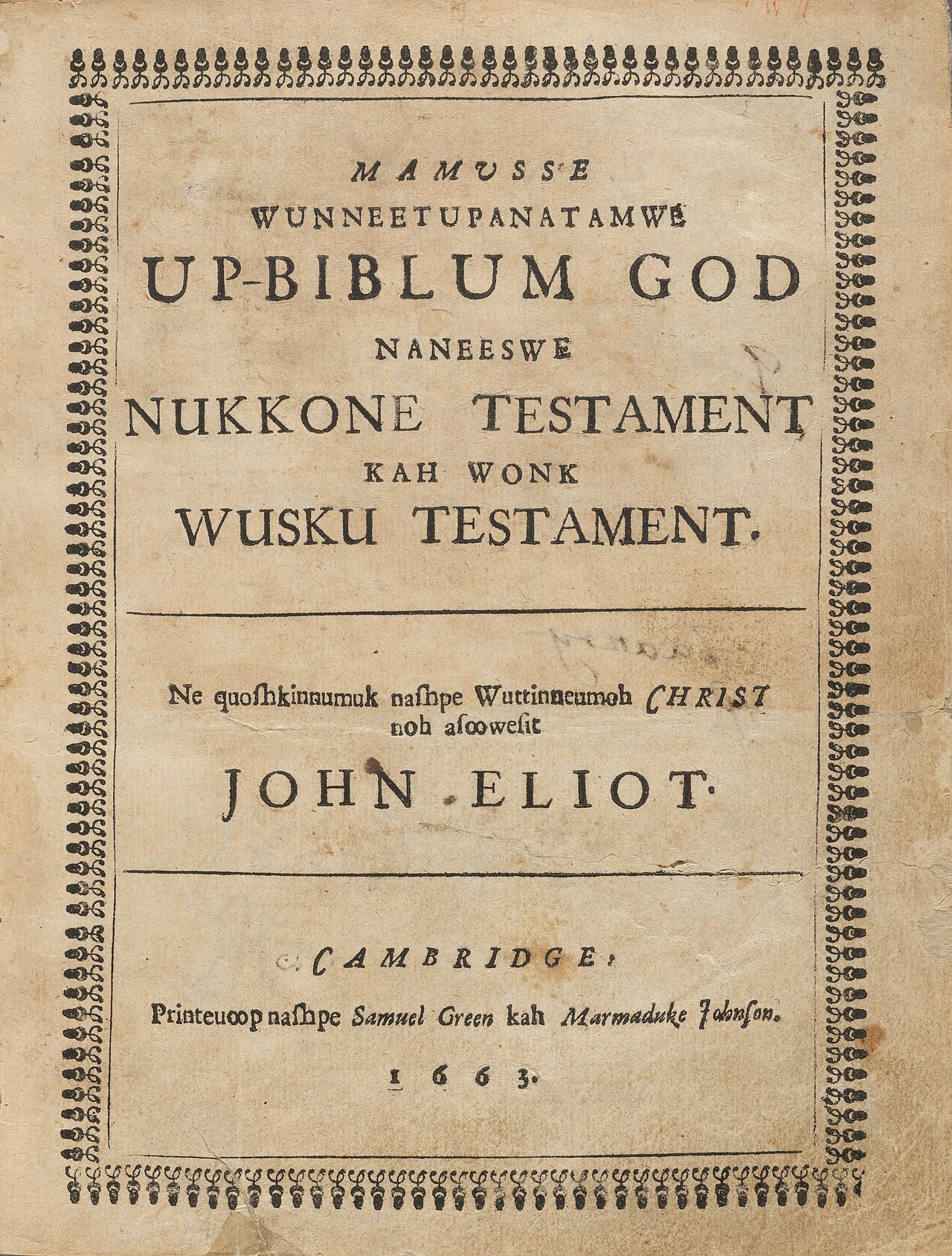
The Wôpanâak Language Reclamation Project was founded in 1993 by jessie "little doe" baird and serves the Mashpee, Aquinnah, Assonet and Herring Pond communities.[20] It rebuilds the language, which the project says had not been in regular use for six generations, from deeds, wills and petitions that Wampanoag people wrote in Wôpanâak and from John Eliot's Bible, which the project calls the first full translation of the Bible into a Native American language.[20] The Mashpee tribe set up a Language Department with the project by ordinance on 10 June 2009; as of November 2026 its website describes a full-time school for children aged 3 to 9 and a daily class at Mashpee High School.[21] WBUR reported in November 2020 that about 15 to 20 people could hold a conversation in the language and more than 100 students took lessons each week.[19]
Title page of the Bible translated into a Native American language by John Eliot and printed in 1663, from the copy at Harvard's Houghton Library.
As of November 2026, the Mashpee tribe's website calls its Powwow the tribe's annual homecoming and lists the 105th annual Powwow as the most recent.[22] For the 400th anniversary of the Mayflower's arrival in 2020, WBUR reported, the Plymouth 400 commemoration had a Wampanoag Advisory Committee chaired by an Aquinnah tribal member, and its executive director said it needed to include "the native voice".[19]
Sources
The Editors of Encyclopaedia Britannica. "Wampanoag". Encyclopaedia Britannica. No date shown; accessed 26 November 2026. britannica.com/topic/Wampanoag
Bureau of Indian Affairs, US Department of the Interior. "Indian Entities Recognized by and Eligible To Receive Services From the United States Bureau of Indian Affairs". Federal Register, vol. 91, no. 20, pp. 4102-4106. 30 January 2026. govinfo.gov/content/pkg/FR-2026-01-30/html/2026-01899.htm
Mashpee Wampanoag Tribe. Home page. Official tribal website. No date shown; accessed 26 November 2026. mashpeewampanoagtribe-nsn.gov/home
Wampanoag Tribe of Gay Head (Aquinnah). "Wampanoag History". Official tribal website. No date shown; accessed 26 November 2026. wampanoagtribe-nsn.gov/wampanoag-history
US National Library of Medicine. "AD 1675: Metacomet Assassinated; King Philip's War Begins". Native Voices timeline. No date shown; accessed 26 November 2026. nlm.nih.gov/nativevoices/timeline/217.html
Bureau of Indian Affairs, US Department of the Interior. "Final Determination for Federal Acknowledgment of the Wampanoag Tribal Council of Gay Head, Inc.". Federal Register, vol. 52, no. 27, p. 4193. 10 February 1987. bia.gov/sites/default/files/media_document/52_fr_4193.pdf