Saint Nicholas Day is the Christian feast of Nicholas, a 4th-century bishop of Myra in Lycia, now Demre in Turkey, kept on 6 December in the Western churches and on 19 December in Eastern churches that follow the Julian calendar, and marked in many countries with customs of gift-giving.[1][2][9]
Dates
Encyclopaedia Britannica gives 6 December as the Western feast day of St Nicholas and 19 December as the Eastern one.[1] Some countries hold the main celebration on the eve, 5 December.[2] In the calendar of the Roman Catholic Church the day is an optional memorial, a lesser commemoration that a parish may keep or leave out; the Catholic Culture liturgical calendar listed it this way for Friday 6 December 2024.[10]
In 2026, 6 December falls on a Sunday. The 2026 calendar of the Liturgy Office for England and Wales lists that day as the Second Sunday of Advent and does not list St Nicholas on it.[12] Under the Catholic Church's General Norms for the Liturgical Year and the Calendar, issued in 1969, the Sundays of Advent hold the second rank in the table of liturgical days and optional memorials the twelfth; when several celebrations fall on the same day, the one of highest rank is observed and the others are left out for that year.[11] In the Roman rite, then, the commemoration is not kept on Sunday 6 December 2026.
Churches that still use the older Julian calendar keep the same commemoration on 19 December of the everyday (Gregorian) calendar.[1][14] The Moscow Patriarchate's DECR Communication Service described 19 December 2025 as the commemoration day of St Nicholas the Wonderworker, Archbishop of Myra in Lycia, in the Russian Orthodox Church.[13] On the same reckoning the date in 2026 is 19 December 2026. Ukraine changed in 2023: Ukrinform reported on 24 May 2023 that the Bishops' Council of the Orthodox Church of Ukraine had approved a full move to the new calendar from 1 September 2023, which moved Saint Nicholas Day from 19 December to 6 December; the Ukrainian Greek Catholic Church had already announced a change of its own.[14]
A second feast, of the transfer of his relics, is kept on 9 May, the date in 1087 on which his remains reached Bari in Italy.[7][8]
The historical bishop
Very little about Nicholas can be shown from records. Britannica states that his existence is not attested by any historical document, and that he was probably a bishop of Myra in the 4th century.[1] The Catholic Encyclopedia of 1911, in an article by Michael Ott, says that hardly anything about him is historically certain beyond his being bishop of Myra in that century, and gives his death as 6 December in 345 or 352.[3] Other writers give other years: National Geographic, writing in 2018, said he likely died in AD 343.[9]
Tradition, as Britannica summarises it, says that he was born in the Lycian seaport of Patara, that he was imprisoned and probably tortured under the Roman emperor Diocletian, and that he was freed under Constantine the Great.[1] Gerardo Cioffari, of the Centro Studi Nicolaiani at the Basilica of San Nicola in Bari, argues in a 1996 lecture published by the St Nicholas Center that the birth at Patara, about 100 km west of Myra, has a sound historical basis.[4]
Whether he attended the Council of Nicaea in 325 is disputed. Britannica says he may have attended.[1] The Catholic Encyclopedia doubts it, because his name is missing from all the old lists of bishops present.[3] Cioffari notes that his presence is first affirmed by Theodore the Lector around 515, and suggests that, since the oldest lists lack his name, it probably entered later lists from an early life of the saint.[4] The Orthodox Church in America's life of the saint, by contrast, states as part of its tradition that he took part in the First Ecumenical Council in 325.[7]
The written lives come long after his time. The oldest text is an anonymous Greek account of about AD 400, the Stratelatis ("The Military Officers", known to scholars as the Praxis de stratelatis), which the St Nicholas Center describes as the only surviving chapter of the earliest known life.[5] Cioffari treats it as the first text to read on Nicholas of Myra.[4] Fuller lives followed, among them those of Michael the Archimandrite in the 9th century, Methodius and John the Deacon (about 880), and Symeon the Metaphrast (about 912).[6] The Catholic Encyclopedia notes that the emperor Justinian I built a church in his honour at Constantinople as early as the 6th century, and that Metaphrastes first gathered his traditional legends in Greek in the 10th century.[3]
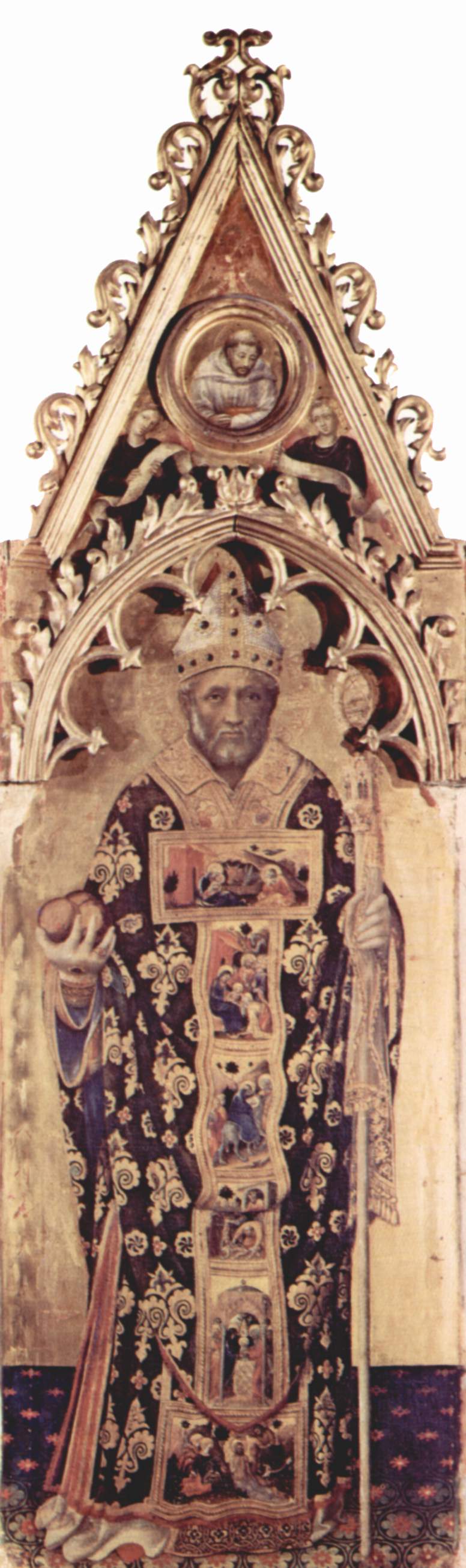
Saint Nicholas of Bari, a side panel of the Quaratesi altarpiece painted by Gentile da Fabriano in about 1425.
The stories told about Nicholas are known from these later lives and from church tradition, not from records of his lifetime.
The best known tells of a poor man with three daughters. Britannica gives it as the tradition that Nicholas provided gold for their dowries, saving them from being forced into prostitution.[1] In the Orthodox Church in America's account he throws a bag of gold through the family's window at night so that the eldest can marry, and later provides for the other two.[7] The Catholic Culture calendar connects the three bags of gold with the emblem of pawnbrokers.[10]
The story of the three military officers is the subject of the Stratelatis, and the St Nicholas Center notes that it may be the earliest incident attributed to him and is the only one named in the official Roman Martyrology.[5] As the Orthodox Church in America tells it, Nicholas first saves three men unjustly condemned by a bribed governor; three officers who saw this are later slandered and sentenced to death, and Nicholas appears to the emperor Constantine in a dream to save them.[7]
The same Orthodox life says that he calmed the sea by prayer for frightened travellers and more than once saved people from drowning.[7] Britannica records the tradition that he brought back to life three children whom a butcher had killed and put in a tub of brine.[1] A further story, told in the Orthodox Church in America's life, has Nicholas strike Arius on the face at Nicaea, for which he was removed from office and later restored by the council.[7] Britannica presents this as an alleged event at a council he may have attended, and the Catholic Encyclopedia doubts that he was there at all.[1][3]
Britannica describes him as one of the patron saints of children and of sailors, and as patron saint of Russia and Greece.[1] The Catholic Encyclopedia adds mariners, merchants, bakers and travellers to children.[3]
Relics
In 1087 men from Bari took remains believed to be his from Myra; Britannica and the Catholic Encyclopedia describe them as Italian sailors or merchants who stole the body.[1][3][8] The St Nicholas Center's account says that 47 men sailed from Bari in three ships, broke into the tomb, and returned to Bari on 9 May 1087, where the Basilica di San Nicola was built for the saint.[8] The Catholic Encyclopedia reported in 1911 that the relics were still kept there and that an oily substance called the Manna di S. Nicola was said to flow from them.[3] Britannica adds that fragments have been acquired by churches around the world.[1]
Venice has a rival claim. National Geographic reported in 2018 that Venetian sailors said they had found remains of the saint in 1099 at the nearly abandoned church in Myra, and that the anatomist Luigi Martino, who examined the bones in both cities decades earlier, concluded they could come from the same skeleton.[9] The same report quoted the historian Adam English as having a good deal of confidence that the Bari bones are those of Nicholas while allowing that this can be contested.[9] It also reported that Turkish authorities suggested in October 2017 that remains might still lie in an unexplored space beneath the church at Demre, a claim English doubted because the church had been sacked, abandoned and rebuilt.[9]
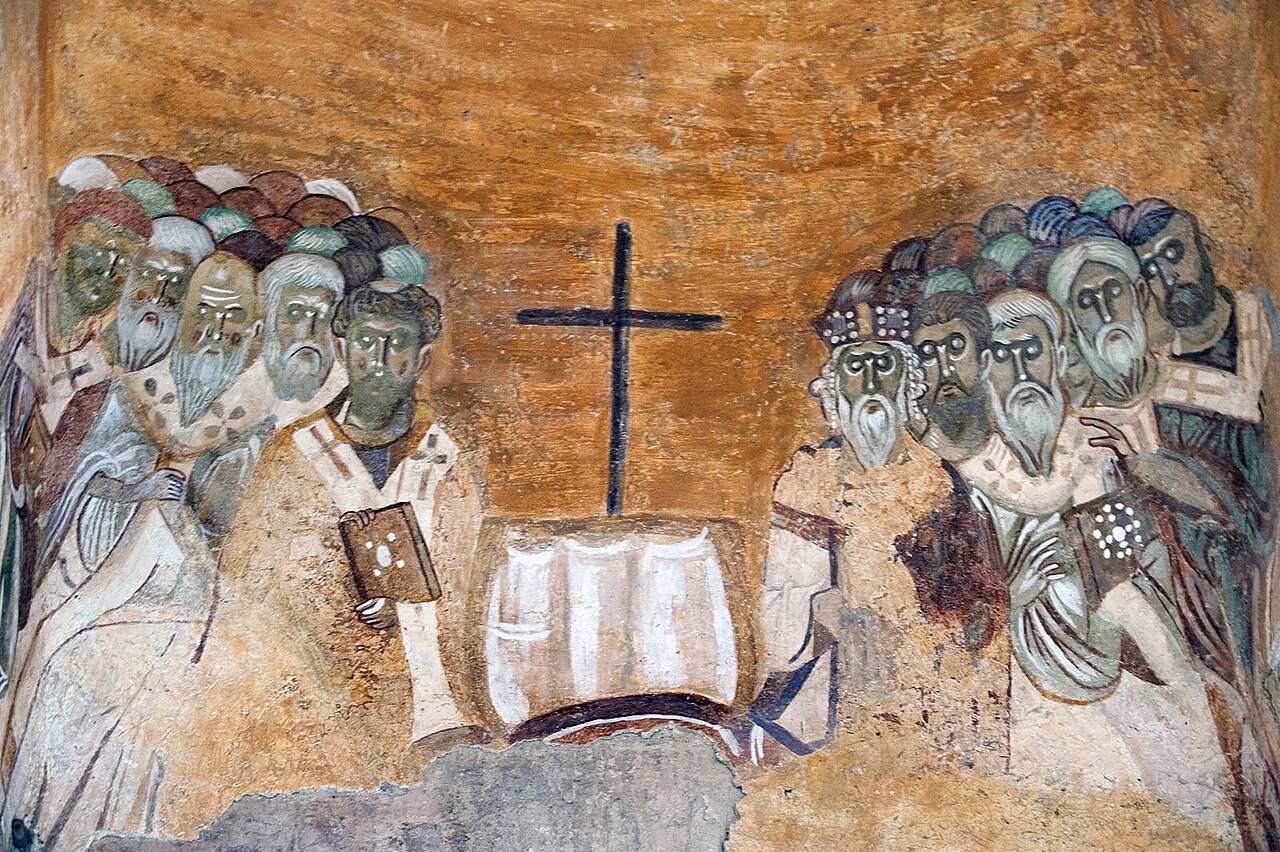
A fresco of bishops and an emperor at a church council, thought to date from about the 12th century, in the Church of St Nicholas at Demre (ancient Myra), photo
Britannica notes that after the Reformation, St Nicholas was largely forgotten in Protestant Europe but was remembered in the Netherlands as Sinterklaas, and that in Britain he was largely replaced by Father Christmas.[2] In many places children find small presents in shoes, stockings or plates set out for him.[2]
Netherlands and Belgium. According to the St Nicholas Center, Dutch television broadcasts the official arrival of Sinterklaas live in mid-November; in the story he comes by steamer from Spain, docking at a different city or village each year.[15] Children put out their shoes by a window, door or fireplace, with a drawing or a wish list and a carrot or hay for his horse.[15] Until the 1940s Dutch children found their presents in their shoes on the morning of 6 December; the main celebration then moved to family parties on the eve, 5 December, called pakjesavond ("packages evening").[15] Britannica describes him arriving on horseback with his helper Zwarte Piet ("Black Pete").[2] The St Nicholas Center traces Piet as Sinterklaas's helper to an 1845 Dutch book, Sinterklaas en Zijn Knecht, and notes Piets in Flanders in Belgium as well.[16]
The appearance of Zwarte Piet, traditionally played with a black-painted face, has been disputed for years. AFP reported on 2 December 2022 that an I&O Research poll of 1,457 Dutch adults found 33 percent wanted to keep the traditional costume of black face paint, red lips, an afro wig and a gold earring, down from 65 percent six years before; 55 percent favoured a change, for example to soot-smeared cheeks or no face paint, and 4 percent wanted the figure abolished.[17] The same report said that anti-racism campaigners protest at the November arrival parades and that support for the traditional costume was strongest among voters for two far-right parties, 79 percent of whom wanted to keep it.[17] DutchNews.nl reported on 20 February 2024 that Kick Out Zwarte Piet, the campaign group founded in 2010 by Jerry Afriyie, planned to close on 5 December 2025, and that blackface Piets were by then found mainly in rural and traditionalist areas.[18]
Germany and Austria. Britannica names Knecht Ruprecht as St Nicholas's servant in Germany and describes the devil-like Krampus as common in many central European regions.[2] The St Nicholas Center places Krampus in Austria and Alpine southern Germany, sometimes shown in chains as a sign that he is under the saint's control, and describes Knecht Ruprecht as a helper with a face sooty from going down chimneys.[16]
Czech Republic and Slovakia. In Czech and Slovak tradition, according to the St Nicholas Center, Nicholas comes with a shaggy, horned devil with a long red tongue, usually chained, and an angel who protects the children from him.[16]
Poland, Switzerland, France and Luxembourg. The St Nicholas Center lists angels among the saint's helpers in Poland, Belgium, Germany, Ukraine and Austria; in Switzerland his helper is Schmutzli, who carries a switch and a sack but no longer uses them.[16] In France and Luxembourg he is followed by Père Fouettard, who in legend whips naughty children or gives them coal.[2][16]
Russia and Ukraine. The Orthodox Church in America's life says there is perhaps no city without a church dedicated to him and describes many churches and icons of him in Russia.[7] In Ukraine, Saint Nicholas Day moved with the church calendar from 19 December to 6 December from 2023.[14]
Britannica states that Dutch colonists took the Sinterklaas tradition to New Amsterdam, now New York City, where the legend joined old Nordic tales of a magician who punished naughty children, and that from this came the American figure of Santa Claus.[1] The Catholic Encyclopedia already noted in 1911 that in the United States St Nicholas had become identified with Santa Claus.[3] That later development is the subject of the separate Santa Claus entry, and its place in the season is covered under Christmas.
Sources
The Editors of Encyclopaedia Britannica (revised and updated by Melissa Petruzzello). "St. Nicholas." Encyclopaedia Britannica. No date shown; accessed 26 November 2026. britannica.com/biography/Saint-Nicholas
The Editors of Encyclopaedia Britannica (revised and updated by Melissa Petruzzello). "St. Nicholas Day." Encyclopaedia Britannica. No date shown; accessed 26 November 2026. britannica.com/topic/Saint-Nicholas-Day
Michael Ott. "St. Nicholas of Myra." The Catholic Encyclopedia, vol. 11. New York: Robert Appleton Company, 1911; online at New Advent. Accessed 26 November 2026. newadvent.org/cathen/11063b.htm
Gerardo Cioffari, O.P. "Nicholas of Patara, Bishop of Myra (3rd–4th century)." St. Nicholas Center (excerpt from a lecture given at Kemer, Turkey, 4 December 1996). No page date shown; accessed 26 November 2026. stnicholascenter.org/who-is-st-nicholas/real-person/nicholas-of-patara
"Stratelatis, or The Military Officers" (anonymous Greek account, about AD 400, translated by Charles W. Jones). St. Nicholas Center. No date shown; accessed 26 November 2026. stnicholascenter.org/pages/istratelatis/
"Lives of all saints commemorated on December 6." Orthodox Church in America. Page dated 6 December 2021; accessed 26 November 2026. oca.org/saints/all-lives/2021/12/06
"General Norms for the Liturgical Year and the Calendar." Sacred Congregation of Rites, Vatican Polyglot Press, 21 March 1969; text at Catholic Culture. Accessed 26 November 2026. catholicculture.org/culture/library/view.cfm?id=5932
DECR Communication Service. "Archbishop Gabriel of Montreal and Canada and Bishop Matthew of Sourozh lead patronal celebrations at St. Nicholas Patriarchal Cathedral in New York." Moscow Patriarchate, 21 December 2025. Accessed 26 November 2026. mospat.ru/en/news/93863