Boxing Day is a holiday on 26 December, the day after Christmas, observed in Great Britain and some Commonwealth countries, among them Australia, Canada and New Zealand, and traditionally a day when servants, tradespeople and the poor were given gifts.[1]
The name
No single explanation of the name is agreed. Encyclopaedia Britannica gives two: one links it to the opening of alms boxes, collection boxes for the poor that had been placed in churches; the other to boxes of gifts given to employees on the day after Christmas, because servants were needed for their employers' own Christmas Day celebrations.[1] A popular joke links the name to the sport of boxing; the FIFA Museum is among those that say the name has nothing to do with it.[5]
What the written records show
The phrase "Christmas box" is older than "Boxing Day". The site World Wide Words gives as the first known example an entry in Randle Cotgrave's French and English dictionary of 1611, which glosses the French tirelire as "a Christmas box; a box having a cleft on the lid, or in the side, for money to enter it".[2] According to the same site, such a box was an earthenware container, something like a piggy bank, that apprentices and other workers carried round after Christmas to collect money; at the end of the round the box was broken and the money shared out, and by the 18th century "Christmas box" had come to mean any seasonal tip.[2]
The diarist Samuel Pepys wrote on 28 December 1668 that he had been woken by drums and trumpets, and that "these things and boxes" had already cost him much money that Christmas and would cost more; the online edition of the diary marks the reading of the word "boxes" as uncertain.[3]
The earliest example of the phrase "Boxing Day" cited by World Wide Words is a transcript of a trial at the Old Bailey in London, dated 14 January 1743, in which a witness says, "It was the Day after Boxing Day".[2] The same site says the term did not become widespread until the early 19th century.[2] When James Murray compiled the entry for "Christmas box" for the first edition of the Oxford English Dictionary in 1889, he defined it as a present or gratuity given at Christmas, in Great Britain usually confined to gratuities given to certain classes of people, and World Wide Words reads his sharp wording as a sign that the custom had become a personal annoyance to him.[2]
Later accounts
Some modern writers place the custom much earlier. An article in The Conversation says Boxing Day goes back to the Middle Ages, when servants were given a box of leftover food and treats to share with their families.[4] The article cites no dated record for this, and the earliest written uses given by World Wide Words are those of 1611 and 1743 above.[2][4]
St Stephen's Day
The date of Boxing Day is also a church feast. Britannica notes that 26 December, the day after Christmas, is the feast day of St Stephen, whom it calls the patron saint of horses.[1]
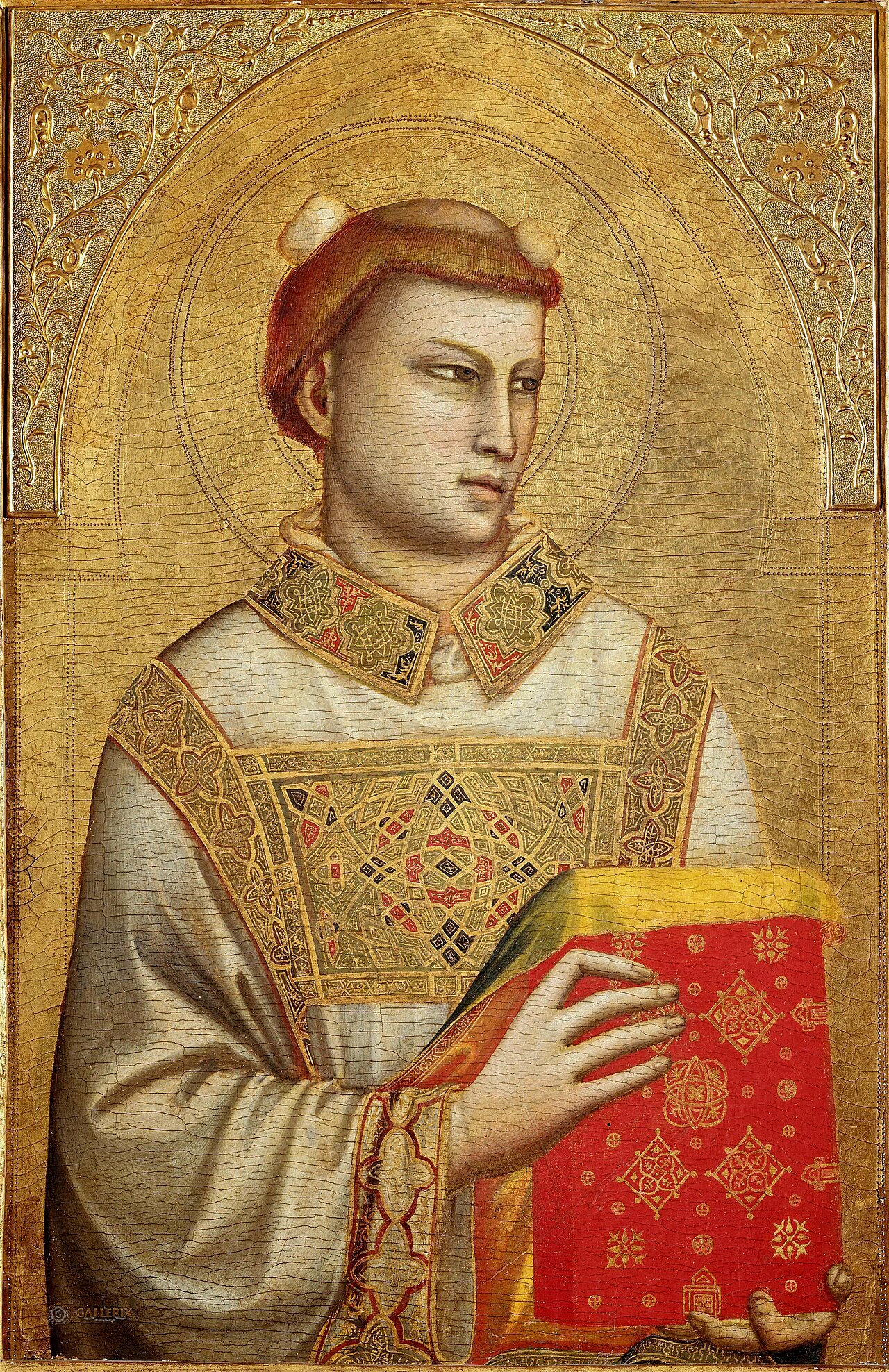
Catholic Church. In the Catholic calendar as presented by the Catholic Culture liturgical calendar, the Church celebrates the Feast of St Stephen on the second day within the octave of Christmas (the eight days that begin on Christmas Day). It describes Stephen as the first Christian martyr, one of the seven deacons who helped the apostles, who was stoned outside Jerusalem and died praying for his executioners.[6]
Orthodox Church. The Orthodox Church in America keeps the feast on 27 December. Its calendar dedicates the third day of the Nativity to the Protomartyr Saint Stephen and calls it the third day of the three-day "Winter Pascha". It gives him the title "archdeacon" as the eldest of the seven deacons.[7]
Saint Stephen, the first Christian martyr, in a panel painted by Giotto between about 1320 and 1325.
In Ireland the day is known as St Stephen's Day, and it is also Wren Day (in Irish, Lá an Dreoilín).[8] The Horniman Museum, writing in December 2023, describes groups of "Wren Boys" in ragged clothes and painted faces who go from door to door singing, dancing and playing music, traditionally for food, drink or money; in the past they carried poles decorated with holly, and some groups wear straw suits or bring a hobby horse.[8] The museum says the custom's exact origins are unknown.[8] Explanations it lists, none of them established, include driving away the darkness of winter, the wren's link with good luck, a story in which a wren betrayed St Stephen, and a legend of a wren alerting a Viking camp.[8] According to the museum, the custom was widespread across Ireland for most of the 20th century and survives mainly in pockets, notably County Kerry and parts of Limerick and Galway, and wrens are no longer killed.[8]
Where it is a public holiday
Britannica states that when 26 December falls on a Saturday or Sunday, the following Monday is designated as the official public holiday.[1] In 2026, 26 December falls on a Saturday.
United Kingdom
According to The Conversation, the day was formally recognised as a public holiday in the United Kingdom in 1871.[4] The law in force as of 26 November 2026 is the Banking and Financial Dealings Act 1971, which received Royal Assent on 16 December 1971 and was passed "to make new provision in place of the Bank Holidays Act 1871".[9] Its Schedule 1 makes 26 December a bank holiday in England and Wales and in Northern Ireland if it is not a Sunday, and adds 27 December in a year when 25 or 26 December is a Sunday.[9]
The UK government's bank holidays page states that when a bank holiday falls at a weekend, a "substitute" weekday becomes a bank holiday, normally the following Monday.[10] For 2026 it lists Friday 25 December as Christmas Day and Monday 28 December as "Boxing Day (substitute day)" in England and Wales, in Scotland and in Northern Ireland (page read 26 November 2026).[10]
Ireland
St Stephen's Day is on the Irish government's 2026 list of public and bank holidays, issued by the Department of Justice, Home Affairs and Migration, which gives the date as "28 December Monday (in lieu of Saturday 26 December)".[11]
Canada
Canada's federal Labour Code names Boxing Day among the general holidays, together with New Year's Day, Canada Day, the National Day for Truth and Reconciliation, Remembrance Day and Christmas Day, for which special rules apply when they fall at a weekend: when one falls on a Saturday or Sunday that is a non-working day, the employee is entitled to a holiday with pay on the working day immediately before or after it (text current to 29 October 2026).[12]
Australia
The Fair Work Ombudsman notes that each state and territory sets its own public holidays.[13] Its list for 2026 (read 26 November 2026) shows Boxing Day on Saturday 26 December with an additional public holiday on Monday 28 December in the Australian Capital Territory, New South Wales, the Northern Territory, Queensland, Victoria and Western Australia.[13] Tasmania's list shows Boxing Day on Monday 28 December.[13] In South Australia the 26 December holiday is called the Proclamation Day holiday, with an additional public holiday on Monday 28 December.[13]
New Zealand
The national tourism website newzealand.com lists Boxing Day 2026 as 26 December, observed on Monday 28 December.[14]
Sport
Britannica records that the day became associated with sporting events, including horse races, foxhunting and rugby.[1]
Football. The FIFA Museum says that in 19th-century Britain the holiday became a day for outings and, by the 1870s, for sport; that the newly formed Football League put Boxing Day matches on its fixture list in 1888; and that they have stayed there since.[5] Clubs also played on Christmas Day for many years, often against local rivals to cut travel, until the last Christmas Day matches in the 1957–58 season.[5]
Horse racing. The King George VI Chase, run at Kempton Park in England, grew out of an earlier race and was renamed in 1937 to celebrate the accession of King George VI.[16] According to the Jockey Club, which runs the course, racing at Kempton was suspended from 1939 to 1945, when the site was used as a prisoner-of-war camp, and the race became the highlight of the Boxing Day programme after racing resumed in 1946.[16] As of 26 November 2026 the Jockey Club lists the race, a Grade 1 steeplechase (the top class of jump race over fences), for Saturday 26 December 2026.[16]
Hunting. Boxing Day was a traditional day for foxhunting.[1] Britannica records that traditional foxhunting was modified in 2005 after legislation in England and Wales largely banned the use of hounds in hunts.[1] Section 1 of the Hunting Act 2004 makes it an offence to hunt a wild mammal with a dog unless the hunting is exempt.[15]
Cricket. In Australia the Boxing Day Test match is held at the Melbourne Cricket Ground, which announced on 22 March 2026 that the 2026 match would be Australia against New Zealand from 26 to 30 December 2026, with a 10.30 am start.[17]
Sailing. The New South Wales government's page for the Sydney to Hobart Yacht Race (updated 16 October 2026) gives the 2026 start as Boxing Day, Saturday 26 December 2026, at 1:00 pm, off Nielsen Park on Sydney Harbour.[18]
Shopping
Britannica notes that by the 21st century Boxing Day had become associated with shopping as well as sport.[1] The Conversation traces how this happened in Australia. Because Boxing Day was a public holiday, large retailers such as department stores were at first not permitted to trade on it.[4] A gradual shift began in the economic boom after the Second World War, and by 1954 a Melbourne department store was advertising a "pre-stocktaking sale".[4] Trading hours were extended in each state over the 1980s and 1990s, and a department store that opened a Melbourne branch in 1991 advertised a small number of heavily discounted goods.[4] By 2000, according to the article, Boxing Day sales had become a firmly entrenched tradition in Australia, and by 2018 some of that shopping was moving online.[4]
"Lives of all saints commemorated on December 27". Orthodox Church in America. Calendar page for 2026; accessed 26 November 2026. oca.org/saints/all-lives/2026/12/27
Canada Labour Code (R.S.C., 1985, c. L-2), section 193. Justice Laws Website, Government of Canada. Current to 29 October 2026; accessed 26 November 2026. laws-lois.justice.gc.ca/eng/ACTS/L-2/page-27.html