Thanksgiving dinner is the large family meal eaten in the United States on Thanksgiving Day, a federal holiday that in 2026 falls on Thursday 26 November, and it is most often built around a turkey.[1][8]
Date in 2026
The US Office of Personnel Management's federal holiday schedule for 2026 lists Thanksgiving Day on Thursday, 26 November.[1] The holiday itself, its proclamations and its fixed date are described in the Thanksgiving entry; this entry is about the food.
What records show was eaten in 1621
The autumn 1621 harvest gathering at Plymouth, later called the "first Thanksgiving", is described in only a few written lines, and none of them is a menu. Plimoth Patuxet Museums, the living-history museum at Plymouth, Massachusetts, points out that the only eyewitness account, Edward Winslow's letter of December 1621, names just two foods: wildfowl, from a hunt that Winslow says fed the company almost a week, and venison, from five deer that the Wampanoag leader Ousamequin (Massasoit) and his men gave to the English leaders.[2] The museum treats the gift of deer as part of the diplomacy between the two peoples as well as part of the meal.[2] (The Wampanoag entry covers the people themselves.)
William Bradford, the colony's governor, described the food of that autumn in his history Of Plimouth Plantation, written between about 1630 and 1650.[3] He wrote that the settlers fished for "codd, & bass, & other fish", that "store of foule" arrived as winter approached, and that there was a "great store of wild Turkies", of which they took many, besides venison.[3] He also recorded a weekly ration of about a peck of meal per person, or Indian corn in the same proportion after the harvest.[3] These lines describe the season's supplies, not a particular meal.[3]
Everything beyond venison and wildfowl is the judgement of historians. Plimoth Patuxet considers wild turkey probable, along with ducks and geese; cod, bass, mussels, lobster and eel; flint corn ("Indian corn") made into porridge, pudding or flat bread; Wampanoag beans, squashes and pumpkins; English garden vegetables and herbs; and wild plants and nuts, cranberries among them.[2] It suggests that water was most likely the main drink.[2] The museum also lists what was probably not on the table: no potatoes, white or sweet, which were not yet common in English diets; no pumpkin pie, since the colony probably lacked enough butter and wheat flour for pastry; no apple pie, since there were no apples at Plymouth yet; and probably no cranberry sauce as known later, because sweetened cranberry recipes did not appear in print for about another half century.[2] An essay published on the Smithsonian's National Museum of the American Indian (NMAI) blog in 2020 likewise lists wild turkey among the wild fowl described in colonists' journals, "though not explicitly on the menu in 1621".[4]
Plimoth Patuxet describes Wampanoag foodways of the time: men hunted deer and other game, mostly in autumn and winter, while women grew beans, squash and other crops, gathered wild plants, gathered cranberries from wild bogs in late summer, and dried or smoked meat and fish.[2] The museum names sobaheg (a stew) and nasaump (a corn porridge) as dishes that may have been prepared, most likely by Native women.[2]
How the menu became fixed
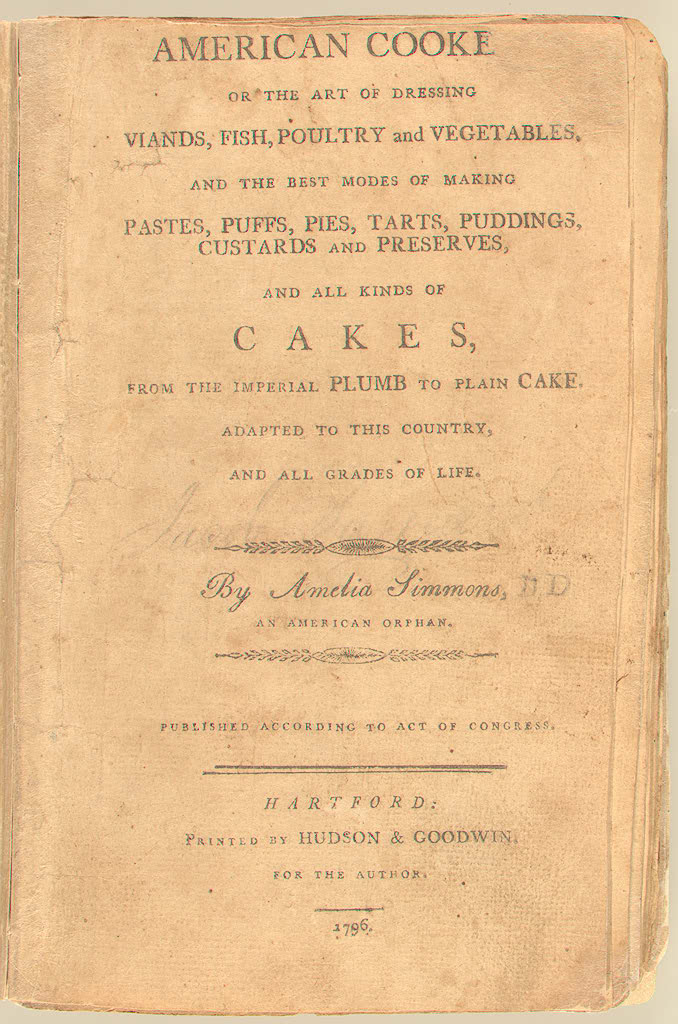
The turkey-centred menu took shape in New England over the following two centuries. Amelia Simmons's American Cookery, printed in Hartford, Connecticut, in 1796 and often described as the first cookbook by an American author, includes a recipe "To stuff and roast a Turkey, or Fowl" with a bread stuffing, served with "boiled onions and cramberry-sauce".[5] One variation in the same recipe replaces the bread with mashed boiled potatoes.[5] The book also gives two "Pompkin" puddings baked in pastry or "in a crust", the forerunners of pumpkin pie.[5]
The cover of the first edition of Amelia Simmons's American Cookery, printed in Hartford, Connecticut, in 1796.
Sarah Josepha Hale, the editor who later campaigned for a national Thanksgiving, described an idealised New England Thanksgiving table in her novel Northwood (1827).[6] In her account "the roasted turkey took precedence", with savoury stuffing, gravy and vegetables, followed by plum pudding, custards and pies, among which "the pumpkin pie occupied the most distinguished niche"; the drinks were currant wine, cider and ginger beer.[6] The Massachusetts Historical Society notes that Hale grew up in New Hampshire, where Thanksgivings were common, at a time when they were unknown in much of the country.[6] Her campaign, which led to Abraham Lincoln's proclamation of 1863, is covered in the Thanksgiving entry.
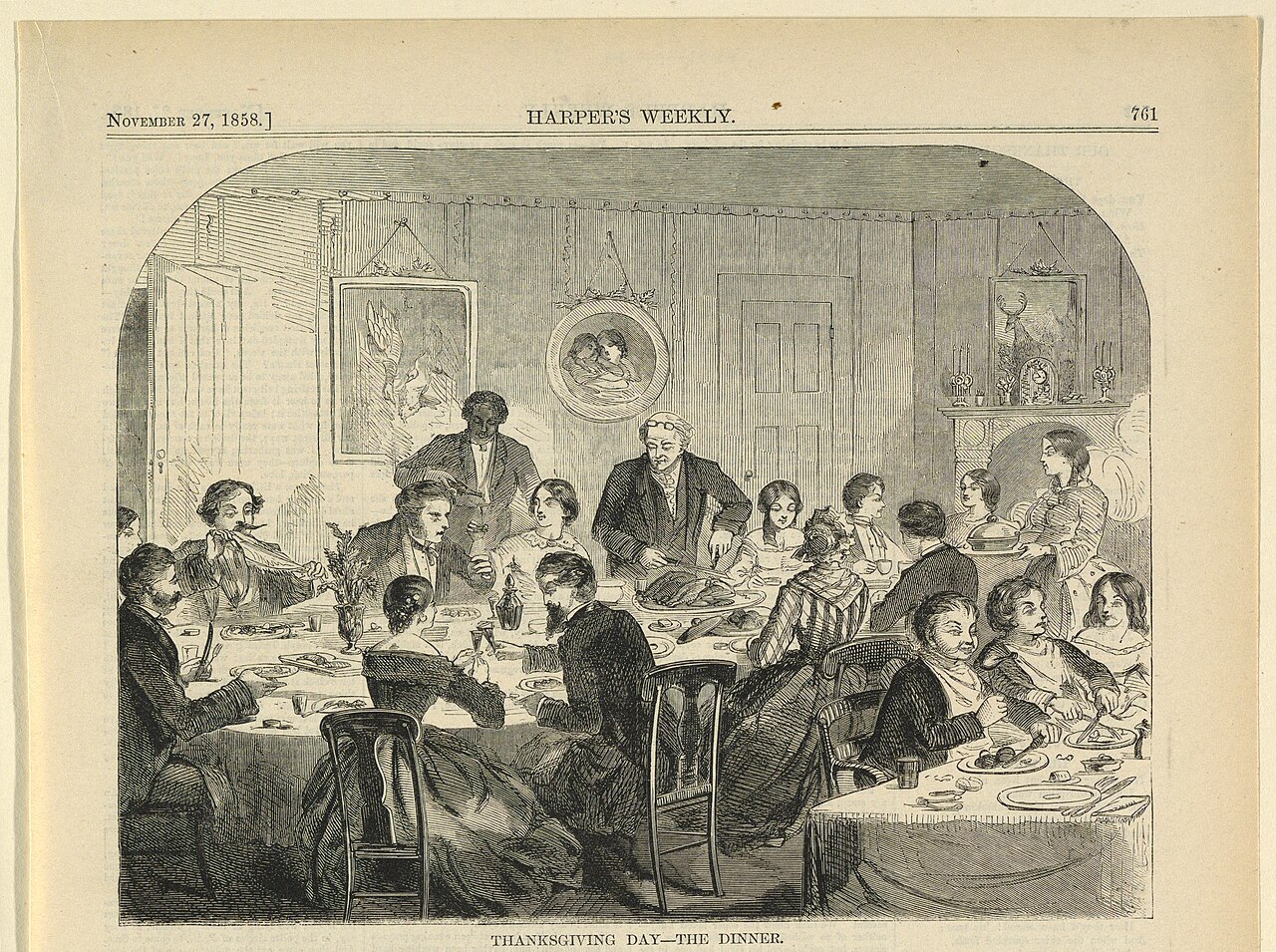
A family at its Thanksgiving dinner table, a wood engraving after Winslow Homer published in Harper's Weekly in November 1858.
Turkey. The domestic turkey is an American bird. A study led by the University of York, published in Royal Society Open Science in January 2018, analysed 55 turkeys from Mesoamerica (central Mexico to northern Costa Rica) that lived between 300 BC and AD 1500, and confirmed through ancient DNA that modern European turkeys descend from Mexican ancestors.[7] The researchers found that most of those ancient turkeys had not been eaten; some were buried in temples and human graves, and deer and rabbit were the more common meat.[7] In a poll of 1,000 consumers commissioned by the National Turkey Federation (NTF), the US turkey industry's trade association, in August 2025, 87 per cent of those who celebrate Thanksgiving said turkey was part of their holiday meal in most years, and 74 per cent planned to serve a whole bird; the NTF estimated that nearly 30 million turkeys would be eaten at Thanksgiving 2025, as reported by The National Provisioner on 4 November 2025.[8]
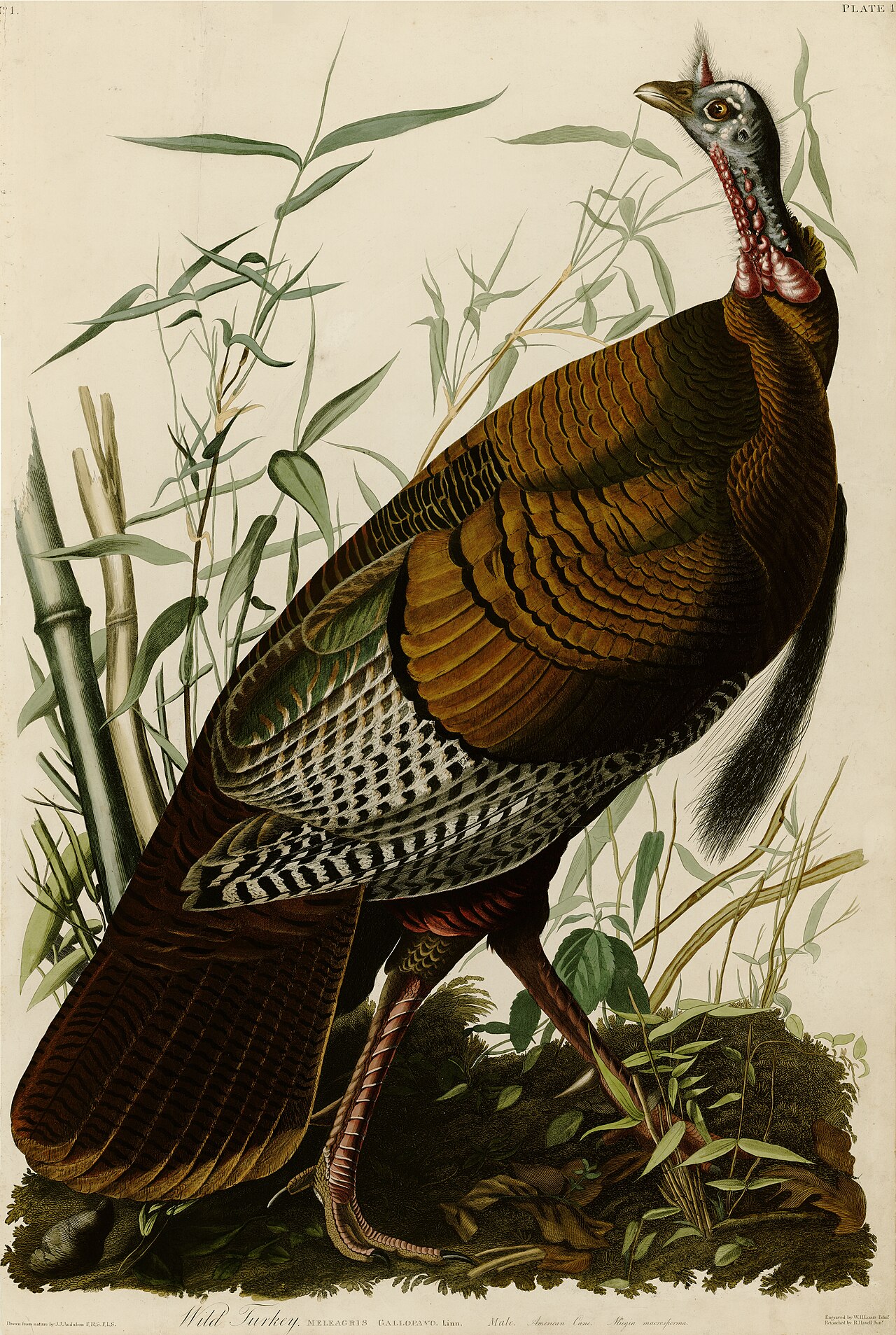
A male wild turkey, plate 1 of John James Audubon's The Birds of America, printed between 1827 and 1838.
Via Wikimedia Commons: 1 Wild Turkey by John James Audubon, public domain.
Stuffing. A bread stuffing seasoned with herbs was already standard by 1796, when Simmons's recipe called for wheat bread, beef suet, eggs, thyme and marjoram.[5] Hale's 1827 description of the table also gives the turkey a savoury stuffing.[6]
Cranberry sauce. Wild cranberries were known to the Wampanoag and available in 1621, but Plimoth Patuxet dates sweetened cranberry sauce recipes to about half a century later.[2] Simmons paired cranberry sauce with turkey in 1796.[5] Canned jellied cranberry sauce dates from 1912, when Marcus Urann, a lawyer turned cranberry grower, began canning cranberries at a packing house in Hanson, Massachusetts; according to Smithsonian magazine, the jellied sauce became available nationwide in 1941, sold by the growers' cooperative that later took the name Ocean Spray.[9]
Potatoes and sweet potatoes. Neither kind of potato was part of the 1621 meal, in Plimoth Patuxet's judgement.[2] Sweetened sweet potato dishes are older than the marshmallow topping: Atlas Obscura reports an American sweet potato pudding recipe from the 1790s and a glazed sweet potato recipe from 1896, and dates the first known marshmallow-topped sweet potato casserole to a 1917 recipe booklet issued by the Angelus marshmallow company.[10]
Green bean casserole. The casserole of green beans, cream of mushroom soup and fried onions was developed in 1955 by Dorcas Reilly, a supervisor in the Campbell Soup Company's test kitchen in Camden, New Jersey, and was first called "Green Bean Bake".[11] The Philadelphia Inquirer reported in its 2018 obituary of Reilly that she wanted a quick dish made from things most households already kept, that Campbell gave her original recipe card to the National Inventors Hall of Fame in 2002, and that Campbell expected the dish on the Thanksgiving tables of more than 20 million Americans in 2018.[11]
Pumpkin pie. Pumpkin was eaten at Plymouth in some form, but Plimoth Patuxet places the earliest pumpkin pie recipes after 1621.[2] Simmons's "Pompkin" puddings in pastry appeared in 1796, and by 1827 Hale gave pumpkin pie first place among the desserts.[5][6]
Regional and community variation
African American traditions. The food writer Adrian Miller, author of Soul Food: The Surprising Story of an American Cuisine, One Plate at a Time, described soul food in a 2013 NPR interview as the Southern food that Black migrants carried to other parts of the country.[12] He said macaroni and cheese "used to be royalty food", that enslaved African Americans often cooked it in plantation houses, and that because dairy was scarce it became a dish for weekends and special occasions.[12] He named sweet potato pie, candied yams, black-eyed peas, mixed greens and chitterlings ("chitlins", stewed or fried pig intestines) among the dishes of a soul food Thanksgiving, alongside a red drink that he traced to West African drinks such as hibiscus tea.[12]
Baltimore sauerkraut. In Baltimore, Maryland, sauerkraut is a customary side dish with the turkey.[13] Baltimore magazine, in a 2022 article, links the custom to the city's German immigrants of the later 19th century, citing an estimate that about a quarter of Baltimoreans had come from Germany shortly after 1863, and quotes a local chef who says the custom "spilled over to everyone".[13]
Mexican American homes. As one example of dishes from Mexican holiday cooking at Thanksgiving, in 2014 the Austin public radio station KUT described a Mexican American family that marked Thanksgiving by making more than 1,000 tamales for their employees instead of turkey, stuffing and pumpkin pie, presenting it as a blend of American Thanksgiving with Mexican Christmas Eve (Nochebuena) customs, in which tamales are essential.[14]
Native American perspectives. The 2020 NMAI blog essay noted that Native peoples of the Americas developed corn, potatoes, squash, beans, tomatoes, peanuts and chili peppers, foods that are now part of the meal.[4] It also reported the view of a Comanche contributor that Thanksgiving is "a European concept", since in Native traditions thanks are given whenever people gather, and noted that many historians now regard the 1621 feast as above all a political meeting between two peoples.[4] Plimoth Patuxet likewise presents the gift of deer in 1621 as diplomacy.[2]
William Bradford. Of Plimouth Plantation (1630–1650), Book Two, Chapter 12 (1621), in Jared Aragona (ed.), The Renewable Anthology of Early American Literature, Maricopa Open Digital Press. No date shown; accessed 26 November 2026. open.maricopa.edu/earlyamericanliteratureanthology/chapter/from-of-…
National Museum of the American Indian. [Essay on Native chefs and Thanksgiving], National Museum of the American Indian blog, Smithsonian magazine website, 23 November 2020 (date from the page address; none shown on the page). Accessed 26 November 2026. smithsonianmag.com/blogs/national-museum-american-indian/2020/11/23…
Amelia Simmons. American Cookery. Hartford: Hudson & Goodwin, 1796. Project Gutenberg eBook 12815. Accessed 26 November 2026. gutenberg.org/ebooks/12815.txt.utf-8
Rakashi Chand. "'Our National Thanksgiving'". The Beehive (blog), Massachusetts Historical Society, November 2023 (date from the page address; none shown on the page). Accessed 26 November 2026. masshist.org/beehiveblog/2023/11/our-national-thanksgiving
NPR, Tell Me More. "Soul Food For Thanksgiving: Mac And Cheese, 'Red Drink,' And More" (transcript, host Michel Martin, guest Adrian Miller), 2013 (year from the copyright line; no day shown). Accessed 26 November 2026. npr.org/transcripts/246334552