Russia, officially the Russian Federation, is a country covering the eastern third of Europe and the whole of northern Asia, and the largest country in the world by area.[1]
Developing story. This entry is updated as events change; every changing fact is dated.
Geography
Britannica describes Russia as by far the world's largest country, stretching across northern Asia and the eastern third of Europe and spanning 11 time zones.[1] Its landscapes run from Arctic tundra and wide forests in the north to steppe (open, treeless grassland) and semidesert in the south.[1] The Volga is the longest river in Europe, and Lake Baikal in Siberia is the deepest lake in the world.[1]
Population
According to Britannica, most of the population are ethnic Russians, and more than 120 other ethnic groups also live in the country; people are concentrated in European Russia, above all around Moscow.[1]
Rosstat, the Federal State Statistics Service, published a preliminary estimate of 146,028,325 people on 1 January 2025, a fall of 0.08% during 2024, the state news agency TASS reported on 31 January 2025.[2] Rosstat-based population figures have included the Republic of Crimea and the city of Sevastopol since 2015, according to a note on Statista's data page (on Crimea's status, see War with Ukraine below).[3] The Moscow Times reported on 7 July 2025 that Rosstat had stopped publishing monthly figures for births, deaths, migration and total population, and that the demographer Alexei Raksha said almost no public demographic data had been available since March 2025.[4] The same report said the Institute for the Study of War (ISW) linked the blackout to efforts to hide high military losses.[4]
Government and politics
Russia's constitution was approved by a national vote on 12 December 1993, according to the Encyclopedia of Russian History.[5] It gives the president primary responsibility for foreign and defence policy and the power to issue binding decrees and to veto laws; a veto can be overridden by a two-thirds vote in both chambers.[5] The parliament, the Federal Assembly, has two chambers: the State Duma, with 450 deputies, and the upper house, the Federation Council, which the 1993 text formed from two members for each federal subject (the country's constituent regions and republics).[5] The president appoints the prime minister, who heads the government, with the consent of the State Duma.[5]
In a week-long nationwide vote that ended on 1 July 2020, the Central Election Commission reported that about 78% of votes counted supported a package of constitutional amendments, with turnout of 65%, Reuters reported.[6] The changes allowed Vladimir Putin to run for two more six-year terms after his term ending in 2024, and the package also included pension protections and a de facto ban on same-sex marriage.[6] The election commission said the vote was transparent, while the election-monitoring group Golos cited numerous irregularities and the opposition politician Alexei Navalny called it illegitimate.[6]
Britannica's list of Russian leaders gives Putin as president from 1999 to 2008 and again from 2012, with Dmitry Medvedev as president from 2008 to 2012.[7] In the presidential election of March 2024, the Central Election Commission reported that Putin won 87.29% of the vote with nearly all precincts counted, giving him a fifth term, according to the Associated Press (AP), as published by The Irish Times on 18 March 2024.[8] Three other candidates ran, none of whom opposed the war in Ukraine, and AP described the vote as following the harshest crackdown on the opposition and free speech since Soviet times.[8] Western governments dismissed the election as a sham, and the foreign secretary of the United Kingdom wrote that it was "not what free and fair elections look like"; Golos reported searches of voters and attempts to check completed ballots.[8]
In elections to the State Duma in September 2026, United Russia won 349 of the 450 seats, a record for the party, according to Central Election Commission results reported by The Moscow Times on 25 September 2026; the Communist Party won 37 seats, the Liberal Democratic Party 23, New People 19 and A Just Russia 17.[9] Turnout was given as 59.8%, a figure that included voting in occupied Ukrainian territories.[9] The Moscow Times cited independent experts who called the election the most uncompetitive in the country's modern history, and reported that the Supreme Court had removed the Yabloko party, which campaigned for peace, from the party-list ballot in August 2026.[9] As of 1 October 2026, Mikhail Mishustin was chairman of the government (prime minister): on that day the legal news agency RAPSI reported that he had signed the order sending the draft federal budget for 2027 to 2029 to the State Duma.[10]
History
Britannica dates the first East Slavic state, known as Rus and centred on Kyiv (Kiev), to the rise of that city in the 10th century.[11] By the 13th century the principality of Moscow had gained importance, rising in part through cooperation with the Golden Horde, the Mongol state that then dominated the region.[11] Ivan IV, grand prince of Moscow from 1533, took the title of tsar in 1547 and ruled as tsar until 1584.[7] In 1721 Peter I was crowned emperor, which Britannica treats as the formal establishment of the Russian Empire.[11] The Romanov dynasty, to which Peter belonged, ruled until 1917, when the reign of Nicholas II, emperor since 1894, ended and a provisional government took over.[7]
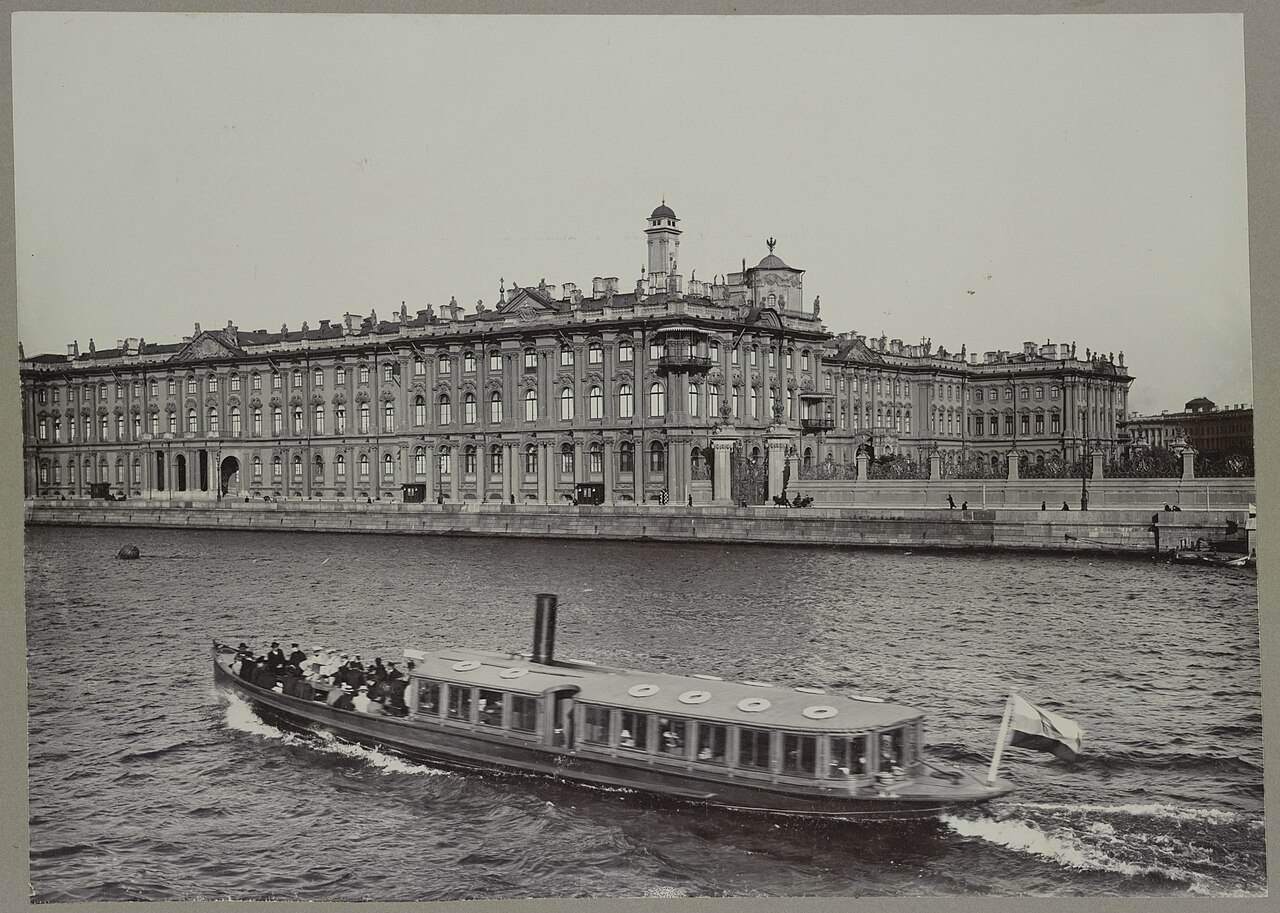
The Winter Palace in St Petersburg in a gelatin silver photographic print of about 1890 held by the Library of Congress.
Vladimir Lenin led the Communist Party from 1917 until 1924, and the Soviet Union was formed in 1922, with Moscow keeping its dominant position.[7][11] Russia was the principal republic of the Soviet Union, which Joseph Stalin led from 1924 to 1953 and Mikhail Gorbachev from 1985 to 1991.[1][7] Russia became an independent country when the Soviet Union was dissolved in December 1991.[1] The 1990s brought political and economic upheaval, including high inflation and falling life expectancy.[1] Boris Yeltsin was president from 1991 to 1999 and was followed by Putin.[7]
Stalin-era repression
The forced collectivisation of agriculture under Stalin, carried out mainly in 1929–32, met strong rural resistance, and Britannica writes that Ukraine suffered especially harshly, with a famine, above all in 1932–33, in which "possibly millions" died.[12][13] Demographers from Ukraine's Ptoukha Institute of Demography and Social Studies and the University of North Carolina, in work published by the Harvard Ukrainian Research Institute, estimate about 3.9 million excess deaths in Ukraine in 1932–34, most of them in 1933, and 8.7 million across the Soviet Union, including about 3.3 million in Russia; they conclude that Ukraine's losses could not have exceeded 5 million.[14] In Kazakhstan, where nomadic herders were forcibly settled and collectivised, more than 1.5 million people, about a quarter of the population, died in the famine of 1930–33, according to the historian Sarah Cameron's account as presented by Columbia University.[15]
Whether the Ukrainian famine, known as the Holodomor, was genocide is disputed between governments. On 15 December 2022 the European Parliament voted by 507 to 12, with 17 abstentions, to recognise it as genocide against the Ukrainian people, and Radio Free Europe/Radio Liberty (RFE/RL) reported that Ukraine and at least 16 other countries had done the same; Moscow has long denied any systematic effort to target Ukrainians and points to famine deaths elsewhere in the Soviet Union.[16]
The Gulag, the secret police's system of labour camps, held about 100,000 inmates in the late 1920s and then filled in three main waves: collectivisation in 1929–32, the purges of 1936–38 and the years after the Second World War, according to Britannica.[13] Britannica reports that figures attributed to the Gulag administration give 10 million people sent to the camps in 1934–47, and that Western scholars' estimates of deaths in the Gulag between 1918 and 1956 range from 1.2 to 1.7 million.[13] The historian Anne Applebaum estimated in 2003 that about 18 million people passed through the camps between 1929 and 1953, and Time's review of her book described the official figure of 2.7 million camp deaths that she cites as almost certainly low.[17]
Britannica describes the show trials of August 1936 to March 1938 as resting on cases fabricated by the NKVD (the secret police) and on confessions obtained by torture and intimidation.[18] The historian Sergey Bondarenko, who works with the rights society Memorial, told Meduza in 2017 that from August 1937 to November 1938, after NKVD Order No. 00447 of 30 July 1937, more than 1.7 million people were arrested on political charges and more than 700,000 were executed.[19] During the Second World War whole nationalities were deported on security grounds, among them the Volga Germans in 1941 and, from 1944, the Chechens and Ingush, who were accused of collaborating with Germany; Britannica counts more than 50 nationalities and about 3.5 million people, and notes that Boris Yeltsin later apologised for the deportations.[12]
The Chechen wars
Chechnya, a republic in the North Caucasus, declared independence in November 1991 under Dzhokhar Dudayev, and Russian troops invaded on 11 December 1994, taking the capital, Grozny, in March 1995; guerrilla fighting continued, and Dudayev was killed by Russian shelling in 1996, according to Britannica.[20] On 31 August 1996 the Chechen commander Aslan Maskhadov and Alexander Lebed, secretary of Russia's Security Council, signed agreements at Khasavyurt that provided for the withdrawal of Russian troops and put off a decision on Chechnya's status until the end of 2001, the Caucasian Knot news site recorded.[21]
In September 1999 apartment buildings were blown up in Moscow and Volgodonsk; together with a blast in a Moscow shopping centre on 31 August, more than 300 people were killed, RFE/RL reported in 2019.[22] Vladimir Putin, then prime minister, blamed Chechen separatists, and Russian troops returned to Chechnya in late 1999; Britannica notes that evidence never proved Chechen involvement.[20] In Ryazan the authorities first announced that an apartment-building bombing had been prevented, and the FSB (Federal Security Service) later called the episode a training exercise; the journalist David Satter, and Alexander Litvinenko and Yury Felshtinsky in their book Blowing Up Russia, have argued that the FSB was behind the bombings, and a proposed State Duma inquiry failed for lack of votes, RFE/RL reported.[22]
In the second war Russian forces regained control of the republic while Chechen fighters kept up a guerrilla war from the mountains, and in April 2009 President Dmitry Medvedev announced the end of counterinsurgency operations in Chechnya, though sporadic violence continued.[20]
Casualty figures vary widely. Britannica gives up to 100,000 deaths in Chechnya and more than 400,000 people displaced during the 1990s.[20] Aleksandr Cherkasov of Memorial, quoted by AFP in August 2005, said the state statistics office had estimated 30,000 to 40,000 civilians killed in the first war against Memorial's estimate of 50,000, and that Memorial and Human Rights Watch (HRW) put civilian deaths in the second war at about 25,000.[23] Officials of the Moscow-backed Chechen administration gave far higher totals in 2005, of about 160,000 and about 300,000 killed in both wars; Al Jazeera said the second claim could not be independently verified.[23][24]
In July 2006 the European Court of Human Rights held Russia responsible for the "disappearance" and killing of a Chechen man, its first such ruling on Chechnya; HRW said more than 200 Chechen cases were pending and estimated that 3,000 to 5,000 people had disappeared in the republic over seven years.[25] By June 2009 HRW, the Memorial Human Rights Center and the Russian Justice Initiative said Russia was not acting on 104 judgments that found it in breach of the European Convention on Human Rights, Jurist reported.[26]
After the Russian-backed Chechen president Akhmad Kadyrov was killed in a bomb blast in 2004, his son Ramzan Kadyrov became president in 2007 with Putin's backing; he has denied accusations by human rights groups that he used kidnapping, torture and murder against opponents, Britannica records.[20]
War with Georgia, 2008
Fighting over South Ossetia, a breakaway region of Georgia, escalated on 7–8 August 2008, when Georgia's president, Mikheil Saakashvili, declared a "state of war", and on 11 August Russia also moved troops and armour into Abkhazia, Georgia's other breakaway region, according to a timeline by the Royal United Services Institute (RUSI).[27] A fact-finding mission commissioned by the European Union and led by the Swiss diplomat Heidi Tagliavini reported on 30 September 2009 that Georgia had triggered the war by shelling Tskhinvali, South Ossetia's main town, on the night of 7–8 August, after tensions and provocations by Russia.[28] It judged Russia's first counter-strike legal but found that much of the Russian military action went far beyond reasonable defence and broke international law once Russian forces pushed into Georgia proper, and it found evidence of ethnic cleansing of ethnic Georgians; Georgian and Russian officials each said the report supported their account, RFE/RL reported.[28]
Dmitry Medvedev, then Russia's president, signed a six-point ceasefire on 16 August 2008, which RUSI describes as brokered by the EU and the White House as brokered by France.[27][29] On 26 August he formally recognised South Ossetia and Abkhazia as independent states.[27] The US secretary of state, Condoleezza Rice, called the move "regrettable", and a White House statement said it conflicted with the ceasefire and that both regions remained within Georgia's internationally recognised borders.[29][30]
The prosecutor of the International Criminal Court (ICC) opened an investigation into the conflict in January 2016, and on 30 June 2022 the court issued arrest warrants for three officials of the de facto South Ossetian administration on charges including unlawful confinement, torture, hostage-taking and unlawful transfer; HRW noted that no Russian official was among them.[31]
On 21 January 2021 the Grand Chamber of the European Court of Human Rights ruled in Georgia v. Russia (II) that the active fighting of 8 to 12 August 2008 fell outside Russia's jurisdiction under the European Convention on Human Rights (by 11 votes to 6), but that events after the ceasefire fell within it because Russia exercised effective control (by 16 votes to 1).[32] It found administrative practices breaching the Convention in the detention of Georgian civilians, including the conditions in which some 160 were held, the torture of Georgian prisoners of war and Georgians' inability to return to their homes, and found that Russia had failed to investigate deaths adequately.[32]
Political repression
Alexei Navalny
The opposition politician Alexei Navalny, founder of the Anti-Corruption Foundation (FBK), fell gravely ill on a flight from Tomsk to Moscow on 20 August 2020 and was later treated at the Charité hospital in Berlin, where German doctors said he had been poisoned with a nerve agent of the Novichok group.[33] On 6 October 2020 the Organisation for the Prohibition of Chemical Weapons (OPCW), the international chemical weapons watchdog, said his blood samples contained a nerve agent of the Novichok family; Russia denied involvement and questioned whether he had been poisoned at all.[34]
Navalny returned to Moscow on 17 January 2021 and was detained for breaking the terms of a suspended sentence by leaving the country.[33] On 2 February 2021 a court sentenced him to two years and eight months, according to Radio Free Europe/Radio Liberty (RFE/RL); the Associated Press (AP) later described the term he was serving as two and a half years.[33][35] On 9 June 2021 the Moscow City Court declared FBK and an affiliated group "extremist" in a closed hearing, which the authorities said was closed because the case files held classified information; the designation exposed members and supporters to prison terms of up to six years.[36] On 22 March 2022 a court convicted him of fraud and contempt of court and sentenced him to nine years in a maximum-security prison and a fine of 1.2 million roubles; he called the charges politically motivated.[35] On 4 August 2023 he received a further 19 years in a "special regime" prison after conviction under six articles of the Criminal Code, including creating and financing an extremist community.[33]
On 16 February 2024 the prison service announced that Navalny, aged 47, had died after feeling unwell following a walk at the IK-3 penal colony, known as "Polar Wolf", in Kharp in the Yamal-Nenets region.[37][38][39] The Kremlin spokesman, Dmitry Peskov, said that medics should establish the cause, and the Russian Foreign Ministry spokeswoman, Maria Zakharova, criticised Western governments for reaching conclusions without forensic evidence.[37][40] His mother, Lyudmila Navalnaya, said he had been "alive, healthy and happy" when she last saw him on 12 February, and she was later told at the colony that he had been struck down by "sudden death syndrome", a vague term for different heart conditions that cause sudden cardiac arrest.[40][38] His widow, Yulia Navalnaya, said that Putin and his associates should not go unpunished.[40] Western leaders led by US President Joe Biden held Putin responsible for the death, and the Kremlin called the Western reaction "absolutely rabid" and unacceptable.[40][38] According to Meduza, regional investigators about six months later declined to open a criminal case, attributing the death to a "combined illness" and a sudden rise in blood pressure; Navalny's team disputed that finding.[41]
On 17 September 2025 Yulia Navalnaya said that laboratories in two countries had found that he was poisoned, using samples taken out of Russia before his burial, but she did not name the laboratories or the substance.[39] On 14 February 2026 the United Kingdom, France, Germany, Sweden and the Netherlands said in a joint statement that analysis of samples from his body had found epibatidine, a toxin from the skin of South American poison dart frogs that does not occur naturally in Russia, and that only Russia had "the means, motive and opportunity" to administer it.[42][43] The five countries said they were reporting Russia to the OPCW for breaching the Chemical Weapons Convention; the Kremlin denied involvement, and Russian authorities maintained that he had died of natural causes.[42][43][44]
Laws on the press, protest and speech
A 2012 law required non-governmental organisations that receive foreign funding and engage in "political" activity to register as "foreign agents"; later amendments extended the label to media (2017) and to individuals (2019), according to Human Rights Watch (HRW).[45] A law adopted in July 2022, in force from 1 December 2022, replaced these rules with one category covering any person or group deemed to be "under foreign influence", designated without a court ruling; HRW called it an attack on civil society aimed at silencing criticism.[45] A law signed in May 2015 allows the authorities to declare foreign and international organisations "undesirable", with the stated aim of countering foreign-financed "extremist organisations"; repeated involvement can bring prison terms of two to six years.[46] HRW reported that the Justice Ministry named 215 new "foreign agents" in 2025 and that 78 groups were declared "undesirable" that year, bringing the total to 281.[47]
On 8 June 2012 Putin signed a law raising the maximum fine for taking part in an unsanctioned rally to 300,000 roubles and for organisers to 1 million roubles; United Russia said it acted "in the name of public safety and harmony".[48] In December 2015 the activist Ildar Dadin became the first person convicted under article 212.1 of the Criminal Code, which punishes repeated breaches of protest rules; the Supreme Court overturned his conviction on 22 February 2017 after a Constitutional Court ruling, and he was released on 26 February.[49][50]
On 4 March 2022, a week after the full-scale invasion of Ukraine, a new article 207.3 of the Criminal Code made spreading "knowingly false information" about the armed forces punishable by up to 15 years in prison; the State Duma speaker, Vyacheslav Volodin, said such laws protected soldiers and "the truth".[51] Rights groups count prosecutions under both this law and the offence of "discrediting" the army: HRW, citing OVD-Info, reported 692 such prosecutions from February 2022 to the end of September 2025, and that the penalties for "discrediting" were raised in April 2025.[47] In early March 2022 the authorities blocked the Echo of Moscow radio station and the TV channel Dozhd, accusing them of false information about the "special operation"; Echo's board shut it down on 3 March and Dozhd suspended broadcasting.[52] A Moscow court revoked the print licence of Novaya Gazeta on 5 September 2022 after the regulator Roskomnadzor said it had not supplied ownership documents; its editor, Dmitry Muratov, called the ruling a "political hit job".[53]
The Supreme Court ordered the closure of Memorial International, Russia's oldest human rights group, on 28 December 2021 for failing to label its publications as those of a "foreign agent"; Memorial said the ruling showed that political terror remained "an acute problem".[54] Memorial shared the 2022 Nobel Peace Prize.[55] HRW reported that on 9 April 2026 the Supreme Court banned Memorial as "extremist" in a closed hearing and that, on 4 June 2026, OVD-Info, a group that monitors political prosecutions, was added to the official list of extremist organisations; OVD-Info said it would continue working.[56]
Notable cases include the Moscow municipal councillor Alexei Gorinov, sentenced in July 2022 to seven years for "false information" about the army after criticising the war at a council meeting, and given three more years for "justifying terrorism" in November 2024.[57] The opposition politician Vladimir Kara-Murza was sentenced on 17 April 2023 to 25 years for treason and other charges over speeches against the war; the Kremlin declined to comment.[58] Ilya Yashin received eight and a half years in late 2022 under the wartime laws on statements about the army.[59] Kara-Murza, Yashin and the Wall Street Journal reporter Evan Gershkovich, sentenced to 16 years for espionage weeks earlier, were freed in an exchange of prisoners between Russia and Western countries in Ankara on 1 August 2024; Moscow said a court had established that Gershkovich collected secret information on CIA instructions, while his newspaper said he had been wrongfully imprisoned.[60] The rights group Memorial counted 1,217 political prisoners at the end of 2025, up from 805 a year earlier, according to HRW.[47]
War with Ukraine
Crimea, 2014
On 6 March 2014 the parliament of Crimea, then part of Ukraine, voted to leave Ukraine and join the Russian Federation, and a referendum was held on 16 March.[61] The official result was 97% in favour of joining Russia, while observers reported irregularities, including armed men at polling stations.[61] Putin signed a treaty incorporating Crimea into Russia on 18 March and a law formally integrating it on 21 March; he described the move as protecting Russian citizens and military assets in Crimea.[61] The move was broadly condemned in the West, and the United States and the European Union imposed asset freezes and travel bans on many Russian officials.[61] On 27 March 2014 the UN General Assembly adopted resolution 68/262, "Territorial integrity of Ukraine", by 100 votes to 11 with 58 abstentions; Russia voted against.[62] Al Jazeera described the resolution as declaring the referendum invalid.[63]
Full-scale invasion, 2022
Russia's full-scale invasion of Ukraine began on 24 February 2022, when Putin announced what he called a "special military operation".[61][63] Before the invasion he had made demands that, in Britannica's words, included a de facto veto over the expansion of NATO.[61] On 2 March 2022 the UN General Assembly voted by 141 to 5, with 35 abstentions, for a resolution that "deplores in the strongest terms the aggression by the Russian Federation against Ukraine" and demanded that Russia withdraw all its forces immediately, completely and unconditionally, The Guardian reported.[64]
In September 2022 Russia proclaimed the annexation of four partly occupied Ukrainian regions, Donetsk, Luhansk, Kherson and Zaporizhzhia, after votes it called referendums; Ukraine and its allies denounced the votes as illegal and coercive.[63] On 12 October 2022 the General Assembly, with 143 countries in favour and 35 abstaining, condemned Russia's "attempted illegal annexation" and reaffirmed Ukraine's territorial integrity within its internationally recognised borders, after Russia had vetoed a similar resolution in the Security Council.[63] Russia's ambassador to the UN, Vassily Nebenzia, called the resolution "politicised and openly provocative".[63]
International Criminal Court
On 17 March 2023 the International Criminal Court (ICC) in The Hague issued an arrest warrant for Putin, saying he was responsible for the alleged war crimes of unlawful deportation of children and unlawful transfer of people from Ukrainian territory to Russia.[65] In June 2024 the court issued warrants for the chief of the general staff, Valery Gerasimov, and the former defence minister, Sergei Shoigu, over missile strikes on Ukrainian electricity infrastructure from October 2022 to March 2023, AFP reported.[66] Moscow called the warrant for Putin "void" and issued its own warrant against the ICC's president, and Russia's Security Council argued that the court's jurisdiction does not cover Russia; the ICC depends on its member states to carry out arrests.[66]
Territory and civilian casualties
An AFP analysis of ISW data, published by The Moscow Times in May 2026, found that Russia controlled just over 19% of Ukraine's territory, including about 7% in Crimea.[67] The same analysis found a Russian net loss of about 120 square kilometres between March and April 2026, the first since mid-2023.[67] The UN human rights office documented 15,280 civilians killed or injured in Ukraine in the first eight months of 2026, 55% more than in the same period of 2025, according to a UN statement to the Human Rights Council on 2 October 2026 reported by the Kyiv Independent.[68]
Military casualties
Neither government regularly publishes its own military losses, and the published figures, from the two governments, Western intelligence, think tanks and independent journalists, differ widely; none of them can be independently checked.[69][70][71]
Russia last gave an official figure for its own dead in September 2022, when it said 5,937 soldiers had been killed.[69][70] In January 2026 the Kremlin spokesman, Dmitry Peskov, said casualty figures should be trusted only if they came from Russia's Defence Ministry, and said of a US think-tank estimate that such reports should not be viewed as reliable information.[69] Ukraine's President Volodymyr Zelensky said in an interview with France TV on 4 February 2026 that 55,000 Ukrainian soldiers had officially been killed on the battlefield, and that a large number were missing.[71] Ukraine's Ministry of Defence put Russian losses at 1,648,161 personnel killed or wounded between 24 February 2022 and 27 November 2026, figures that RBC-Ukraine reported as estimated.[72]
In a report of January 2026, the Center for Strategic and International Studies (CSIS), a US think tank, estimated that about 325,000 Russian soldiers were killed and another 875,000 wounded or missing between February 2022 and December 2025, and that Ukraine had lost 100,000 to 140,000 killed and 460,000 to 500,000 wounded or missing.[69] A later CSIS report, published at the start of July 2026, estimated that Russia had probably suffered 1.4 million battlefield casualties, of whom 400,000 to 450,000 had died, and that Russian casualties in 2026 were running at 30,000 to 34,000 killed, wounded or missing a month.[70] British Defence Intelligence estimated in an update of 14 February 2026 that Russia had likely sustained about 1,245,000 casualties (killed and wounded) since the full-scale invasion began.[73]
The outlet Mediazona, working with BBC News Russian and volunteers, compiles a list of Russian military dead confirmed by name from public sources such as obituaries, relatives' posts and local media, last updated on 23 November 2026; it describes the list as incomplete and the true toll as higher.[74] In the same update, Mediazona and Meduza reported that leaked records of Rosstat, the state statistics service, showed at least 490,000 officially registered Russian military deaths in the war up to 29 September 2026, and Mediazona estimated total Russian military deaths at more than 700,000.[74]
Sanctions
The United States and the European Union first imposed sanctions on Russian officials over Crimea in 2014.[61] On 22 October 2025 the US Treasury's Office of Foreign Assets Control designated the oil companies Rosneft and Lukoil and many of their subsidiaries under Executive Order 14024, with the stated aim of cutting a source of revenue for the war, the law firm K&L Gates reported.[75] The Brussels Times reported on 15 June 2026 that the EU had added 34 individuals and 47 entities to its Russia sanctions list, among them suppliers of drones and military equipment and companies linked to the so-called shadow fleet of tankers carrying Russian oil, and had extended its Crimea-related sanctions to 23 June 2027.[76] The EU's foreign policy chief, Kaja Kallas, said Western sanctions had cost Russia an estimated €1 trillion to €1.3 trillion.[76]
Talks and the state of the war, November 2026
Delegations from Ukraine, the United States and Russia held talks in Abu Dhabi on 10 and 11 November 2026, with the US envoys Steve Witkoff and Jared Kushner mediating, the Kyiv Post reported.[77] The Council on Foreign Relations (CFR) and Time both reported that the talks ended without a major breakthrough and with plans for a prisoner exchange; CFR said the sides had agreed to one in principle.[78][79] Both reported that Russia continued to demand that Ukraine withdraw from the whole of the eastern Donbas region, and Time reported that Kyiv had rejected the demand.[78][79] Witkoff and Kushner then met Putin in Moscow on 12 November.[78][79]
Ukrainian forces struck the Kerch Bridge, which links Russia with occupied Crimea, overnight on 17 November 2026; Ukraine's Security Service (SBU) said a metal arch and the road span beneath it were destroyed.[80][81] On 19 November Putin met Donald Trump and Xi Jinping in Shenzhen, China, on the sidelines of the Asia-Pacific Economic Cooperation (APEC) summit, and the three leaders issued a joint statement.[82][81] Afterwards Putin told reporters that Russia would not negotiate after the strikes on the bridge and would respond to them.[82][83][81] CBS News reported this as ruling out direct negotiations with Ukraine and talks on a limited ceasefire, while bne IntelliNews reported it as ruling out an energy truce.[82][83][81] At the meeting Trump described Putin as a friend, CBS News and AFP reported.[82][84]
On 21 November 2026 drones struck the Sparta II, a sanctioned Russian-operated cargo ship, in the Gulf of Finland; the Finnish military said the attack had probably been carried out by Ukraine.[85][86] The next day, 22 November, explosions hit the Russian navy corvette Merkury, commissioned in 2023, while it was docked at the naval base in Benghazi, in eastern Libya.[87][85][86] On 23 November Ukraine's President Volodymyr Zelensky said Ukrainian forces had used seven Ukrainian-made naval drones in what he called an exemplary operation, and the SBU said it had carried out the attack; both said a Ka-27 helicopter on board had been destroyed.[87][86] Ukraine said the corvette had been sunk.[85][86] Russia's Defence Ministry did not comment, and the Kremlin said it had taken note of Zelensky's statement and referred questions to the ministry; in these reports Russia had not confirmed the loss, and they cited no independent confirmation of the sinking.[87][85][86] The Kyiv Independent reported that satellite imagery taken late on 22 November showed the ship capsized and almost completely sunk; it did not name the image provider.[88] The eastern-based Libyan government said the ship had been hit by unmanned vehicles and opened a joint investigation with Russia, while the UN-recognised government in Tripoli condemned the operation and asked Kyiv for an explanation.[87][85][86][89]
On 25 November 2026 Trump and the NATO secretary general, Mark Rutte, met at Mar-a-Lago in Florida and issued a joint statement on the importance of Russia avoiding any actions that "intentionally, or unintentionally, expand the war".[84][90]
Economy
The International Monetary Fund (IMF) forecast in its October 2026 World Economic Outlook that Russia's economy would grow by 0.9% in both 2026 and 2027, 0.2 percentage points below its July forecast, Interfax reported on 13 October 2026.[91] Russia's Economic Development Ministry forecast 0.6% growth for 2026.[91]
The draft budget sent to the State Duma on 1 October 2026 planned federal spending of 48.8 trillion roubles and revenue of 43.3 trillion roubles for 2027, with support for participants in the "special military operation" and their families, and defence and security, among its priorities.[10]
Society and culture
Britannica describes high culture in Kievan Rus as mainly religious and says the Orthodox church acted as a "beacon of national life".[92] Russian literature and music have a long tradition, with figures such as the writers Alexander Pushkin, Leo Tolstoy and Fyodor Dostoyevsky and the composer Pyotr Tchaikovsky.[1]
In science and space, the Soviet cosmonaut Yuri Gagarin, launched from the Baikonur Cosmodrome in Kazakhstan on 12 April 1961, made a single orbit of Earth, as NASA records.[93]
Sources
Encyclopaedia Britannica, "Russia". Encyclopaedia Britannica. No date shown; accessed 28 November 2026. britannica.com/place/Russia
TASS, "Russian population stands at 146 mln as of January 1, 2025 — statistics". TASS, 31 January 2025. tass.com/society/1907243
Andrew Osborn and Anton Zverev (Reuters), "Russians grant Putin right to extend rule until 2036" (as published by Global News). Global News, 1 July 2020, updated 2 July 2020. globalnews.ca/news/7130453/russia-putin-2036-vote-results
"Demographic Research" (Estimation of Regional Losses of the 1932–1934 Famine in Ukraine). Harvard Ukrainian Research Institute, MAPA Digital Atlas of Ukraine. No date shown; accessed 28 November 2026. gis.huri.harvard.edu/demographic-research
"The Hungry Steppe: Famine, Violence, and the Making of Soviet Kazakhstan" (event page, talk by Sarah Cameron, 12 March 2019). Columbia University News. news.columbia.edu/node/1792
European Court of Human Rights, press release ECHR 028 (2021), "Georgia v. Russia (II)", 21 January 2021, as reproduced in UN document A/75/727–S/2021/82 (letter from Georgia's Permanent Representative). United Nations Digital Library. digitallibrary.un.org/record/3900488/files/A_75_727--S_2021_82-EN.pdf
Dawn, "5 European countries say Russia 'poisoned' Putin critic Navalny in prison with 'rare toxin'". Dawn, February 2026 (full date not confirmed); accessed 28 November 2026. dawn.com/news/1973196
CBC News, "Russian journalist Vladimir Kara-Murza given 25-year sentence for treason". CBC News. No date shown; accessed 28 November 2026. amp.cbc.ca/lite/story/1.6812671
United Nations Digital Library, "Territorial integrity of Ukraine: resolution adopted by the General Assembly" (A/RES/68/262, voting data). United Nations, vote of 27 March 2014. digitallibrary.un.org/record/767565?ln=en
Joe Walsh and Tucker Reals, "Trump, Xi and Putin sit down for a rare 3-way meeting in China, but appear to achieve little". CBS News, 19 November 2026. cbsnews.com/news/trump-xi-putin-china-apec-summit/
Sevinj Osmanqizi, "'The Corvette Is at the Bottom of the Sea': Zelensky Vows More Naval Strikes Against Russia". Kyiv Post, 24 November 2026. kyivpost.com/post/90991