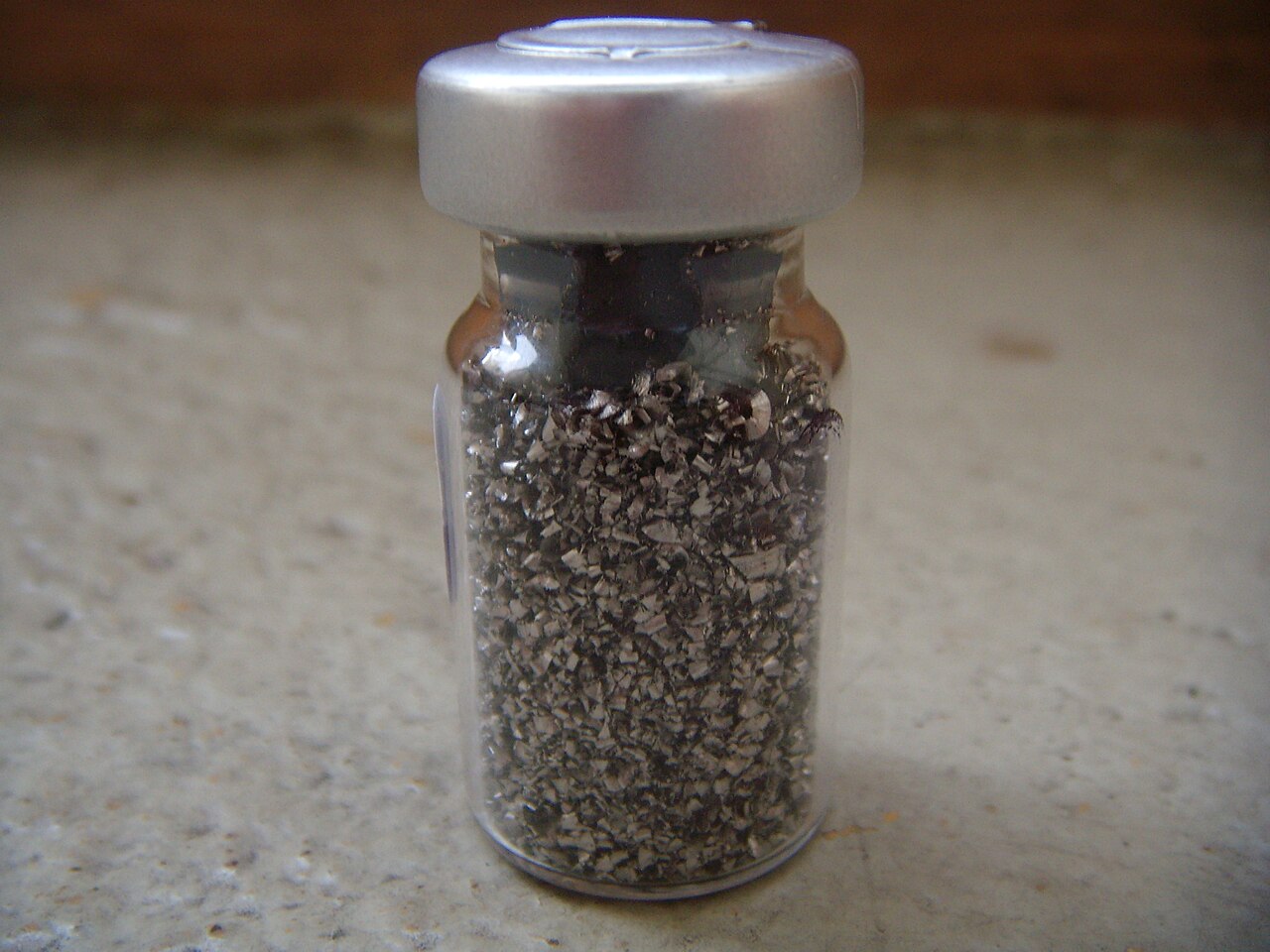
Cobalt is the chemical element with atomic number 27 and the symbol Co, a metal in group 9 of the periodic table that is used in magnets, high-temperature alloys and blue pigments.[1]
A piece of cobalt metal.
Via Wikimedia Commons: Cobalt-Metall by J. Murawski, public domain.
This entry is about the element. Its relative atomic mass is 58.933, it is in group 9 of the periodic table, and it is a solid at room temperature.[1] For its place in the table and its basic facts, see the [periodic table page for Cobalt](/element/Q740/cobalt).
Properties
The Royal Society of Chemistry lists cobalt's melting point as 1495 °C (1768 K), its boiling point as 2927 °C (3200 K), and its density as 8.86 g/cm³.[1] It has a single stable isotope, cobalt-59, so its atomic weight is a single value, 58.933194(3) since 2017 according to the atomic weights commission of the International Union of Pure and Applied Chemistry; NIST gives 58.933194(4).[3][2] The commission says the radioactive isotope cobalt-60 decays to nickel-60 with a half-life of 5.272 years.[3]
Discovery and name
The Swedish chemist Georg Brandt discovered cobalt, which the atomic weights commission dates to 1735 and the Royal Society of Chemistry to 1739, when he published his work after studying a dark blue ore; the Royal Society of Chemistry says other chemists disputed the claim for years, arguing that the substance was an iron-arsenic compound.[1][3] The name comes from the German Kobold, "goblin."[1][3]
Where it comes from
The Royal Society of Chemistry gives cobalt's crustal abundance as 26.6 parts per million and says most cobalt is formed as a by-product of nickel refining. The top three producers listed are the Democratic Republic of the Congo, China and Zambia, without a date.[1]
Uses
The Royal Society of Chemistry lists magnets (aluminium-nickel-cobalt alloys), alloys for jet and gas turbines, electroplating, blue pigments in paint, porcelain and glass, and cobalt-60 as a gamma-ray source for cancer treatment and food irradiation. It says cobalt is an essential trace element and part of the active site of vitamin B12, and that in large doses it is carcinogenic.[1]