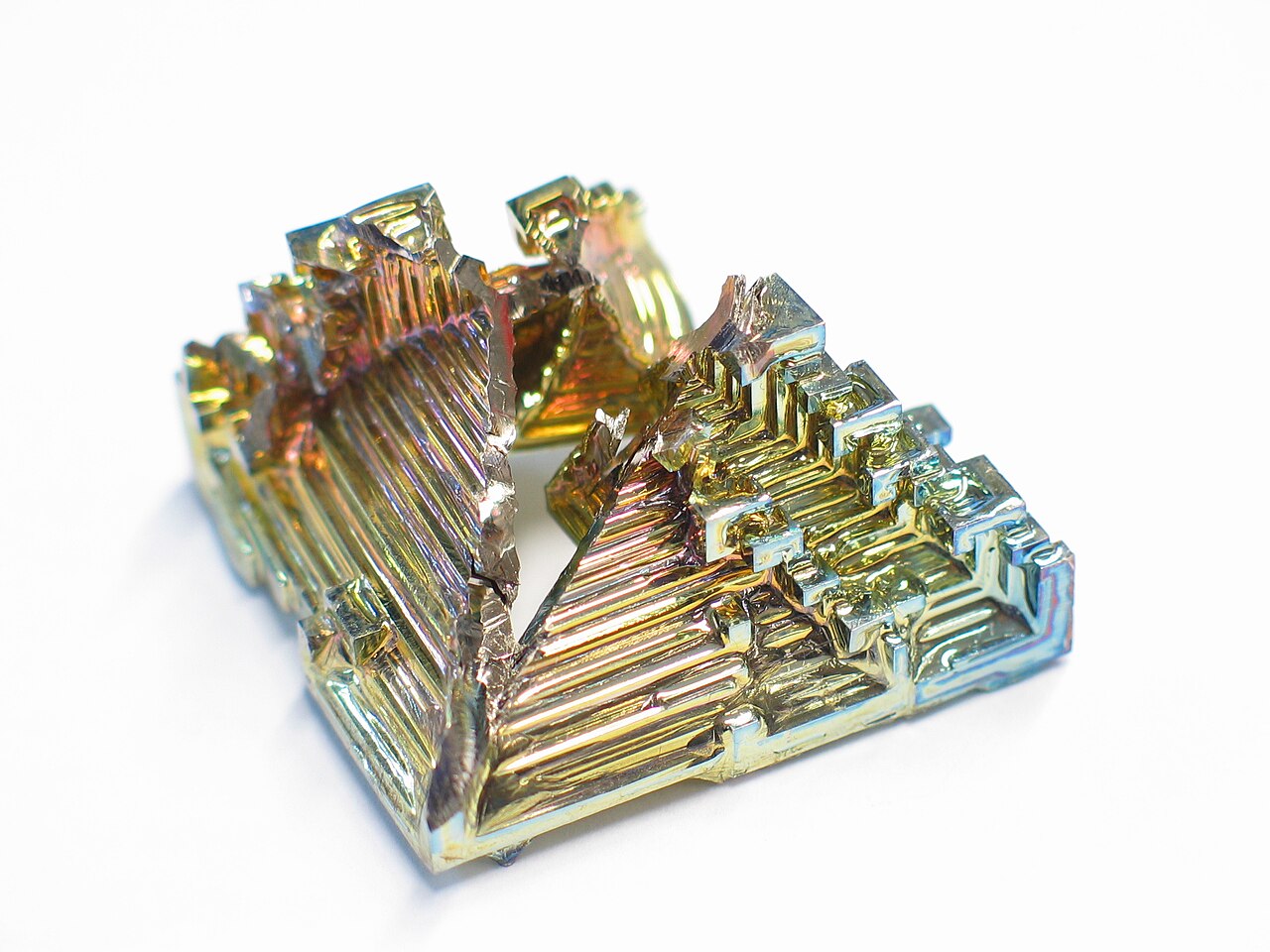
Bismuth is the chemical element with atomic number 83 and the symbol Bi, a solid in group 15 of the periodic table that is used in low-melting alloys and in cosmetics.[1]
This entry is about the element. Its relative atomic mass is 208.980, it is in group 15 of the periodic table, and it is a solid at room temperature.[1] For its place in the table and its basic facts, see the [periodic table page for Bismuth](/element/Q942/bismuth).
Properties
The Royal Society of Chemistry lists bismuth's melting point as 271.406 °C, its boiling point as 1564 °C, and its density as 9.79 g/cm³.[1] It has a single natural isotope, bismuth-209, so its atomic weight is a single value, 208.98040(1) since 2005 according to the atomic weights commission of the International Union of Pure and Applied Chemistry; NIST gives the same figure.[3][2] The Royal Society of Chemistry lists bismuth-209 as very slightly radioactive, with a half-life of about 19 quintillion years.[1]
History and name
The atomic weights commission says the ancients did not distinguish bismuth from lead, and that the French chemist Claude-François Geoffroy showed in 1753 that it was distinct; the Royal Society of Chemistry dates its discovery to an unknown alchemist around 1400 or 1500 AD.[1][3] The name comes from the German Bisemutum, a corruption of Weisse Masse, "white mass."[1][3]
Where it comes from
The Royal Society of Chemistry gives bismuth's crustal abundance as 0.18 parts per million. It occurs as the native metal and in the ores bismuthinite and bismite, and the major commercial source is as a by-product of refining lead, copper, tin, silver and gold ores. China, Mexico and Japan are listed as the top three producers, without a date.[1]
Uses
The Royal Society of Chemistry lists low-melting alloys with tin or cadmium for fire detectors and extinguishers, electric fuses and solders, bismuth oxide as a yellow pigment for cosmetics and paints, and bismuth oxychloride for pearly cosmetics. It says bismuth has no known biological role and is non-toxic.[1]