Mars is the fourth planet from the Sun, a cold, dusty desert world with a very thin atmosphere, polar ice caps, extinct volcanoes, canyons, seasons and weather. It is the only planet where rovers have been sent to roam the surface.[1]
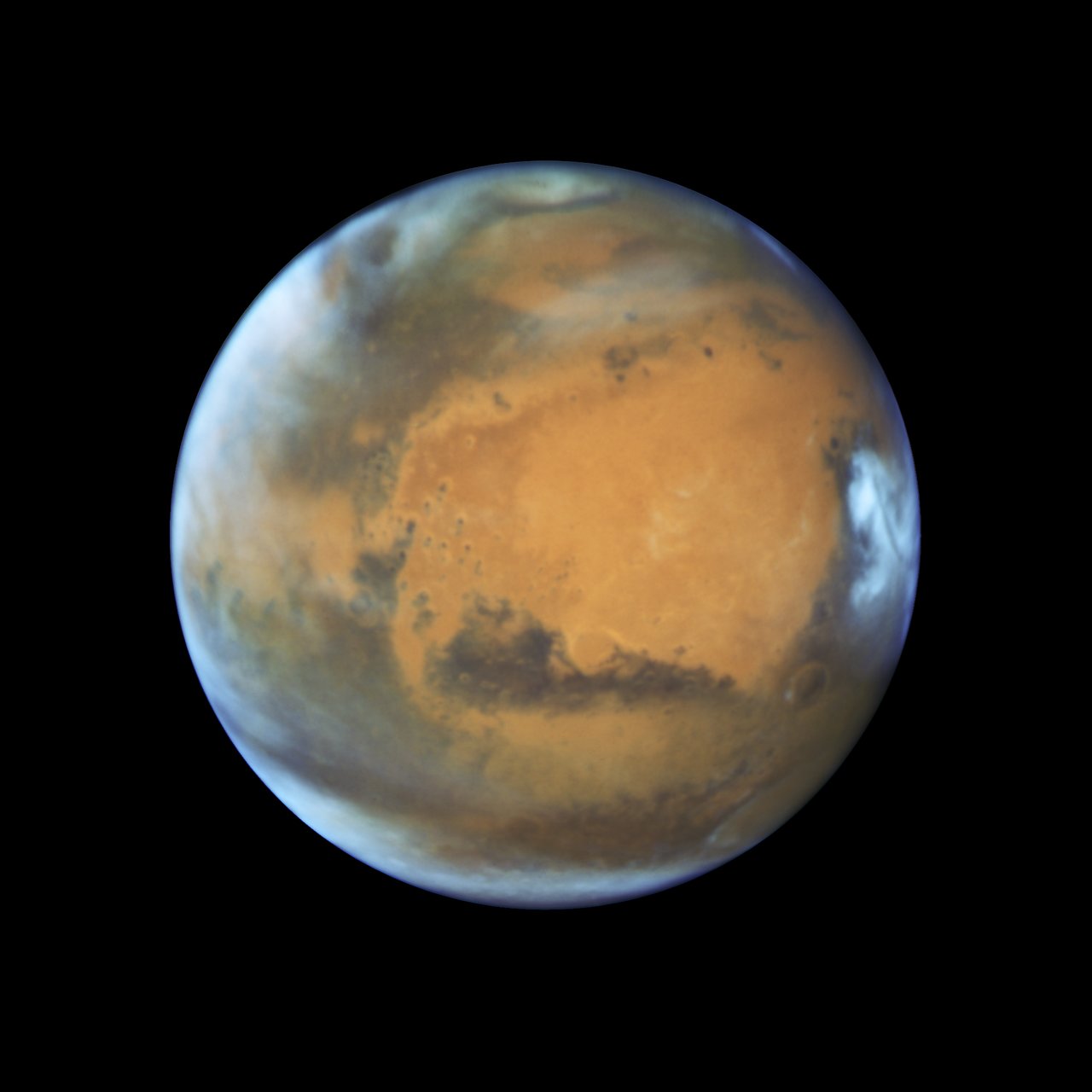
Mars photographed by the Hubble Space Telescope, a red-orange disk with dark markings and a white polar cap.
Mars has a radius of 3,390 kilometres, about half Earth's, and orbits the Sun at an average distance of about 228 million kilometres (1.5 astronomical units), so sunlight takes about 13 minutes to arrive.[1] It spins once every 24.6 hours, very close to Earth's day. A Martian day is called a sol, and a Martian year is 669.6 sols, or 687 Earth days.[1] Its axis is tilted 25 degrees, close to Earth's 23.4, so Mars has distinct seasons, but they are longer than Earth's and unequal in length because of its elliptical orbit. According to NASA, the northern spring is the longest at 194 sols and the northern autumn the shortest.[1]
Moons
Mars has two small moons, Phobos and Deimos, which NASA says may be captured asteroids. They are potato-shaped because their mass is too small for gravity to make them round, and are named after the horses that pulled the chariot of the Greek war god Ares. Phobos, the larger and inner moon, is slowly moving toward Mars and, in about 50 million years, will crash into the planet or break apart, which could form a dusty ring. Deimos is about half as big as Phobos and orbits two and a half times farther out.[1] Mars has no rings today.[1]
Interior and magnetism
NASA says Mars has a dense core of iron, nickel and sulfur, with a radius between 1,500 and 2,100 kilometres, surrounded by a rocky mantle 1,240 to 1,880 kilometres thick and a crust 10 to 50 kilometres deep.[1] Mars formed about 4.5 billion years ago.[1] It has no global magnetic field today, but highly magnetized areas of its southern crust suggest it had one about 4 billion years ago.[1]
Surface
Mars looks red because iron in its rocks, regolith and dust has oxidized, or rusted. NASA notes that the surface itself shows many colors, such as brown, gold and tan, and that dust lifted into the atmosphere makes the planet look mostly red from afar.[1] Although Mars is about half Earth's diameter, its surface area is nearly the same as Earth's dry land.[1]
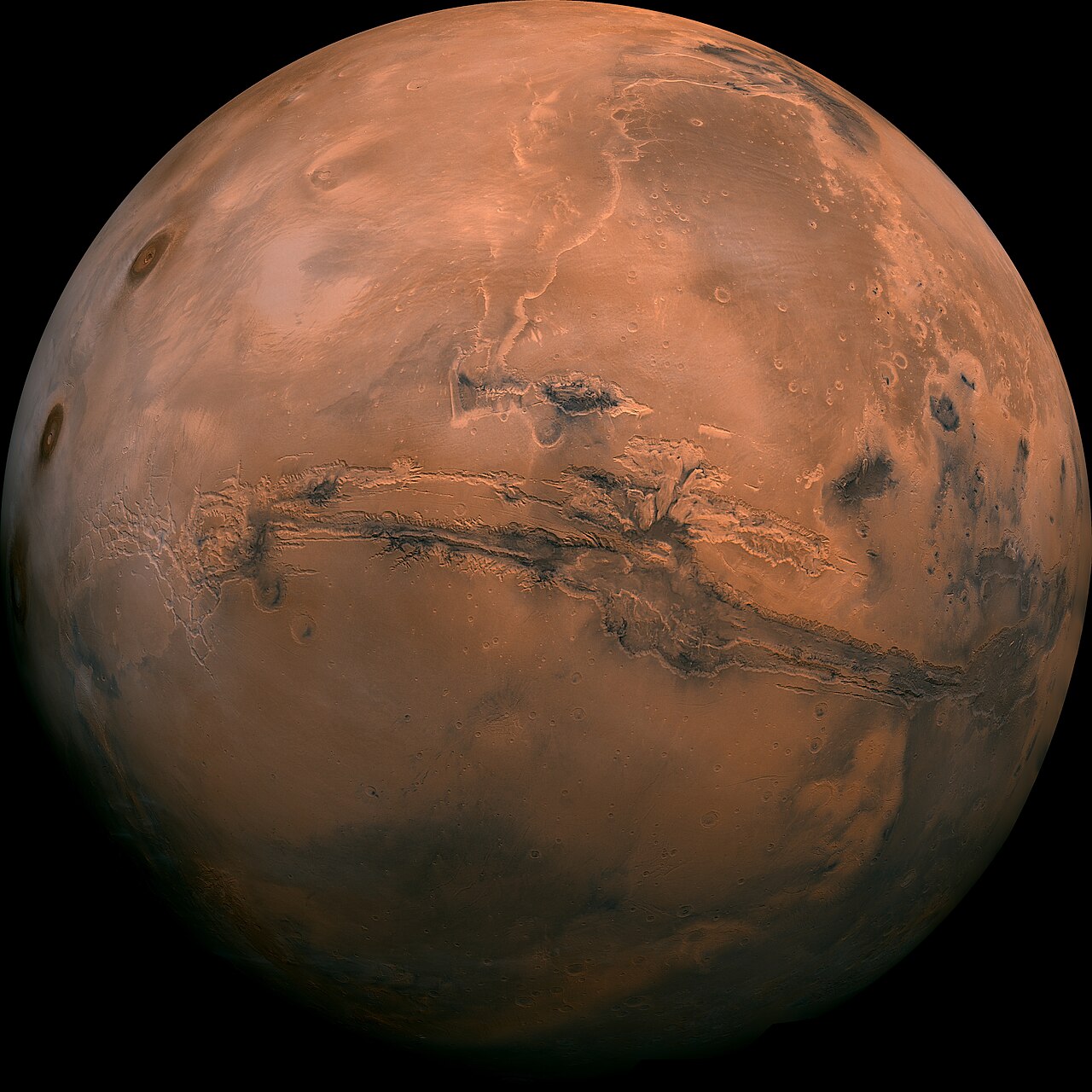
Valles Marineris, NASA says, is the largest canyon in the Solar System: about 3,870 kilometres long, up to 600 kilometres wide and 9.3 kilometres deep, more than 10 times longer and wider than the Grand Canyon.[1] Olympus Mons, the largest volcano in the Solar System, rises more than 40 kilometres from base to summit, and its base covers an area as large as Arizona.[1]
A mosaic of Viking orbiter images of Mars, with the Valles Marineris canyon system stretching across the middle of the planet.
The atmosphere is thin and made mostly of carbon dioxide, nitrogen and argon, and the sky would look hazy and red because of suspended dust.[1] Temperatures range from about 20 °C to about −153 °C, and because the air is so thin, heat escapes easily.[1] Winds sometimes create dust storms that cover much of the planet, and it can be months before the dust settles.[1]
Water
NASA says Mars appears to have had a watery past, with ancient river valley networks, deltas and lakebeds, and minerals that could only have formed in liquid water; some features suggest huge floods about 3.5 billion years ago.[1] Today the thin atmosphere cannot keep liquid water on the surface for long. Water is found as ice just under the surface in the polar regions and as briny water that, NASA says, seasonally flows down some hillsides and crater walls.[1] NASA says river channels spilled over the wall of Jezero Crater more than 3.5 billion years ago and created a lake there.[5]
The search for life
NASA says scientists do not expect to find living things thriving on Mars now; instead they look for signs of life that existed long ago, when Mars was warmer and wetter.[1]
Perseverance. In 2024 the rover investigated a rock nicknamed "Cheyava Falls". In September 2025 the journal Nature published validated results saying its "Sapphire Canyon" sample contains potential biosignatures, clues suggesting past life may have been present but requiring more data or further study before any conclusion about the presence or absence of life.[2]
Curiosity. Its instruments found the largest organic molecules discovered on Mars so far (decane, undecane and dodecane) in a drilled rock sample called "Cumberland". NASA reports that a study in the journal Astrobiology concluded that the non-biological sources the researchers considered could not fully account for the abundance of these compounds.[3] That is a statement about the sources considered, not a finding of life.
Exploration
NASA's Viking 1 lander touched down on 20 July 1976 and made the first truly successful landing on Mars. The Soviet Mars 3 lander claimed a technical first with a survivable landing in 1971, but contact was lost seconds after touchdown.[4] The two Viking orbiters returned 52,663 images and mapped about 97% of the surface at 300-metre resolution; the landers returned 4,500 photographs.[4]
Europe's first spacecraft to Mars, ESA's Mars Express, launched on 2 June 2003 and arrived on 25 December 2003. Its Beagle 2 lander was declared lost on 6 February 2004 after no signals were received, and the orbiter was listed as in operation on ESA's factsheet.[6]
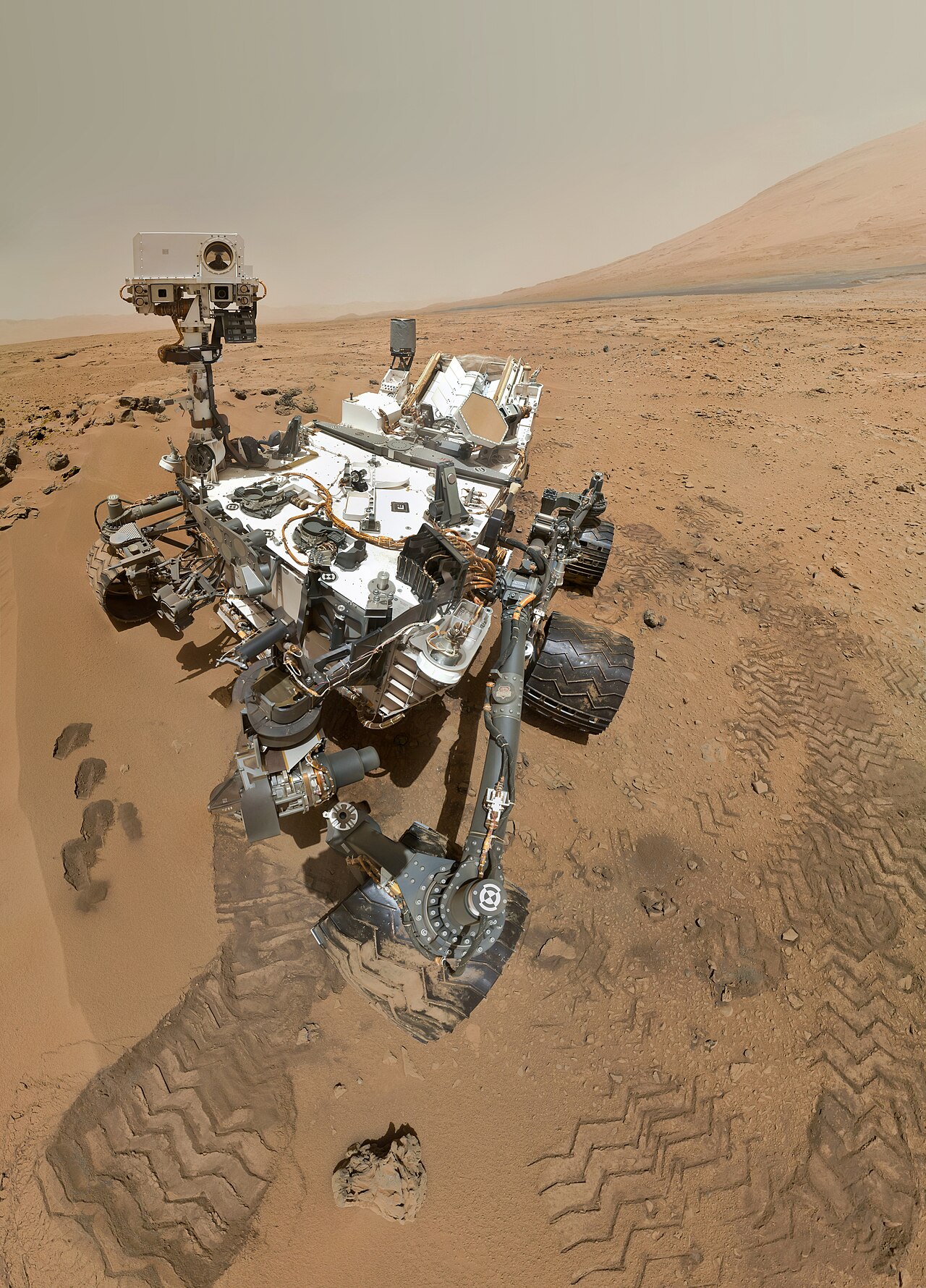
A self-portrait of NASA's Curiosity rover on the surface of Mars.
NASA's Curiosity rover launched on 26 November 2011 and landed in Gale Crater on 6 August 2012. On 26 August 2026 it reached 1 kilometre of elevation gain on its climb up Mount Sharp.[3] Perseverance launched on 30 July 2020 and landed in Jezero Crater on 18 February 2021. On 11 October 2026 its odometer reached 45.22 kilometres, passing the 45.16-kilometre record set by the Opportunity rover.[2] Perseverance carried the Ingenuity helicopter, which completed 72 flights and became the first aircraft to achieve powered, controlled flight on another planet.[2]
Perseverance is collecting rock and soil samples for possible return to Earth. NASA's Mars Sample Return page describes the NASA and ESA plan to bring those samples to Earth in the past tense, as a proposed campaign.[5] The page I read did not state its current status. NASA's Mars facts page says the twin ESCAPADE orbiters, which will study Mars's response to the solar wind, are scheduled to arrive in September 2027.[1]
Name
The ancient Romans named Mars for their god of war because its reddish color was reminiscent of blood. The Egyptians called it "Her Desher", meaning "the red one", and it is still often called the Red Planet.[1]