A solar eclipse happens when the Moon passes between the Sun and Earth, casting a shadow on Earth that fully or partially blocks the Sun's light in some places.[1] For observers in the Moon's darkest shadow the Sun is completely blocked, and the Sun's outer atmosphere, normally hidden by its glare, becomes visible.[1][2]
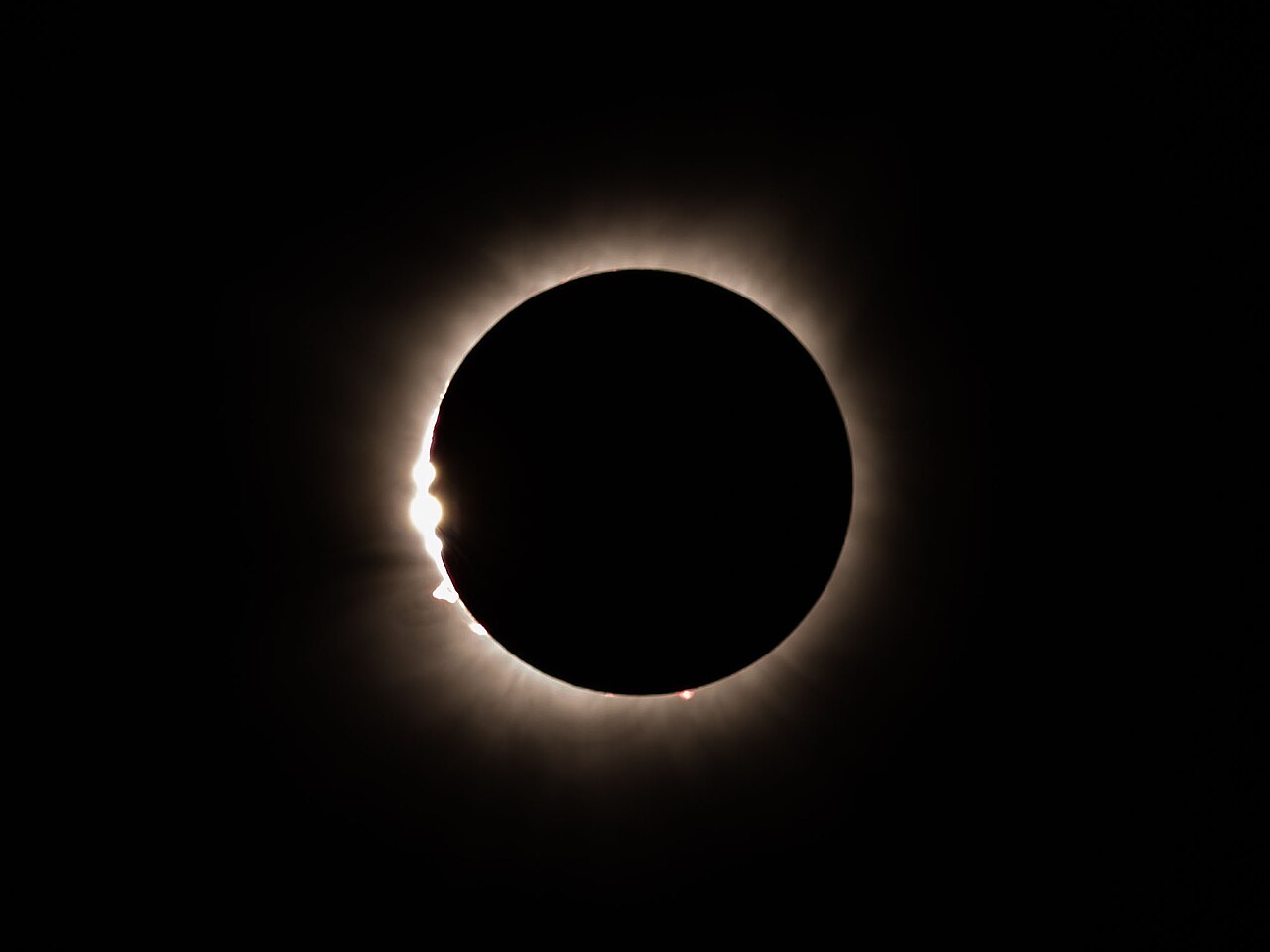
Via Wikimedia Commons: Exit Double Diamond Ring Effect during the Total Solar Eclipse by Natarajanganesan, CC BY-SA 4.0.
Why they are not monthly
NASA says an eclipse happens only occasionally because the Moon does not orbit in exactly the same plane as the Sun and Earth. The times when the three are aligned are called eclipse season, which comes twice a year.[1] NASA says each season lasts about 35 days and repeats just short of six months later.[2] See the Ecliptic entry for the plane of Earth's orbit.
Types
NASA describes four kinds:[1]
- Total. The Moon completely blocks the face of the Sun. People in the centre of the Moon's shadow see the sky darken as at dawn or dusk and, weather permitting, can see the corona, the Sun's outer atmosphere.
- Annular. The Moon is at or near its farthest from Earth, so it looks smaller than the Sun and does not completely cover it. The Moon appears as a dark disk on a larger bright one, creating a ring around the Moon.
- Partial. The Moon blocks only part of the Sun for an observer.
- Hybrid. An eclipse that appears total or annular depending on the observer's location.
NASA's mapping page explains that the Moon's shadow has two parts: the narrow umbra, where the Sun is completely blocked and a total eclipse is seen, and the much broader penumbra, where the Sun is only partially blocked.[3]
Seeing one safely
NASA says that except during the brief period of totality of a total eclipse, observers should always use eclipse glasses or another safe solar viewing method such as a pinhole projector. That includes partial and annular eclipses and the stretch before and after totality. It stresses that eclipse glasses are not the same as regular sunglasses.[1][2] NASA says a total eclipse is the only type during which viewers can momentarily remove their glasses, for the short time the Moon completely blocks the Sun.[1]
The shadow's path
NASA's Scientific Visualization Studio says many people are puzzled that the eclipse shadow moves from west to east, opposite the Sun's apparent daily motion, and explains that the shadow's direction is set by the Moon's orbital motion, which goes the same way as Earth's rotation but over twice as fast: about 2,300 miles per hour (3,700 kilometres per hour) against a little over 1,000 mph for a spot on the equator.[3] The same page says the percentages on a partial-eclipse map show obscuration, the area of the Sun covered, which differs from magnitude, the diameter covered, and that both are valid.[3]
12 August 2026
NASA says a total solar eclipse on 12 August 2026 swept across Greenland, Iceland, northern Russia, the Atlantic Ocean, Spain and a small corner of Portugal, with a partial eclipse across much of Europe and Canada, northwestern Africa and parts of the northern United States.[4] In its pre-eclipse description NASA says totality would reach a remote part of northern Russia at mid-day, Greenland and Iceland in the late afternoon or early evening, and Spain in the late evening shortly before sunset, with totality under two minutes for most people on the path, and a little longer, but under two and a half minutes, near the centre.[4] NASA Earth Observatory said the greatest eclipse would occur near Iceland's Snæfellsnes peninsula, and that satellite cloud records showed viewers in Spain were likelier to get a clear sky than those in Iceland.[5] NASA's eclipse page says it streamed the event live.[2] I read NASA's descriptions from before and around the event, not reports of how the viewing went, so I make no claim about weather or observations.
The most recent total eclipse before that, NASA says, was on 8 April 2024, whose path crossed North America.[5]
What is next
NASA's list of future eclipses gives an annular eclipse on 6 February 2027, visible in parts of South America and Africa, and a total eclipse on 2 August 2027, visible in southern Spain, North Africa and parts of the Middle East.[6] NASA's earlier eclipse pages said the next total solar eclipse visible in the contiguous United States will be on 23 August 2044.[7]
See also
Lunar eclipse, Corona, Chromosphere, Sun and Solar System.
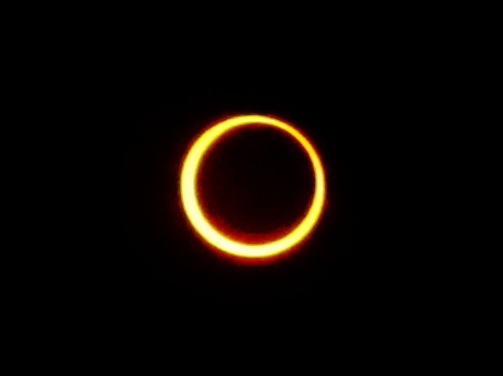
Via Wikimedia Commons: The "Ring of Fire" - Annular Solar Eclipse, Mesquite, Nevada (72393467 by Ken Lund from Reno, Nevada, USA, CC BY-SA 2.0.
Sources
- NASA Science. "Types of Eclipses." science.nasa.gov/eclipses/types/ (read 23 November 2026)
- NASA Science. "Eclipses." science.nasa.gov/eclipses/ (read 23 November 2026)
- NASA Scientific Visualization Studio. "Map of the August 12, 2026, Total Solar Eclipse." svs.gsfc.nasa.gov/5647 (read 23 November 2026)
- NASA Science. "Total Solar Eclipse on August 12, 2026." science.nasa.gov/eclipses/future-eclipses/total-solar-eclipse-on-au… (read 23 November 2026)
- NASA Earth Observatory. "Stops Along the Path of Totality." science.nasa.gov/earth/earth-observatory/stops-along-the-path-of-to… (read 23 November 2026)
- NASA Science. "Future Eclipses." science.nasa.gov/eclipses/future-eclipses/ (read 23 November 2026)
- NASA. Eclipse pages at the Eclipse 2017 site. eclipse2017.nasa.gov/chromosphere (read 23 November 2026)
