Cleopatra VII (70/69–30 BCE) was the last ruler of the Ptolemaic dynasty of Egypt, a royal house of Macedonian descent, and is best known for her alliances with Julius Caesar and Mark Antony and for the war that ended with Rome taking Egypt.[1]
Background and accession
The Ptolemaic dynasty was founded by Ptolemy I Soter, one of the generals of Alexander the Great, and its rulers were of Macedonian descent.[1] Cleopatra, born in 70 or 69 BCE, was a daughter of Ptolemy XII Auletes; Encyclopaedia Britannica describes her as having had little, if any, Egyptian ancestry.[1]
When Ptolemy XII died in 51 BCE, the throne passed jointly to Cleopatra, then about 18, and her younger brother Ptolemy XIII.[1] According to the historian Cassius Dio, their father's will directed that the two should rule together in the Egyptian manner, with the Roman people as their guardians.[4] Britannica notes that Cleopatra soon became the dominant partner, that a decree naming her ahead of her brother first appears in October 50 BCE, and that the two may have married, although this is not proven.[1] Her brother's supporters drove her out; she fled to Syria, raised an army, and in 48 BCE returned to confront him near Pelusium.[1] There the Roman general Pompey was murdered after seeking refuge with Ptolemy XIII, and the arrival of Julius Caesar brought a pause in the fighting.[1]
Julius Caesar
Ancient writers tell the story of her return to the palace in different ways. Plutarch's Life of Caesar says she came to Alexandria at nightfall with a single companion, Apollodorus the Sicilian, who carried her into the palace hidden in a bed-sack, and that this boldness won Caesar over.[3] Cassius Dio says instead that she first argued her claim through agents, then asked to plead in person, entered the city by night without her brother's knowledge, and captivated Caesar when he saw and heard her.[4] Dio adds that when Caesar summoned Ptolemy XIII before dawn and the boy found her there, he ran out crying that he had been betrayed and threw off his diadem.[4]
Caesar reconciled the siblings and made them joint rulers, but courtiers around the young king, among them Achillas and Pothinus, raised a war against him that left him besieged in the palace quarter of Alexandria.[3][4] During the fighting fire spread from the dockyards, and both Plutarch and Dio report that a great library was burned.[3][4] Cleopatra's younger sister Arsinoë was brought over to the Egyptian side and proclaimed queen.[4] When Roman reinforcements arrived, the Egyptian forces were defeated and Ptolemy XIII drowned in the Nile while trying to escape.[1][4]
Caesar did not make Egypt a Roman province. According to Dio, he gave the kingdom to Cleopatra and, to avoid unrest, had her marry her other, younger brother (Ptolemy XIV) and share the throne with him in name, while in practice she ruled alone.[4][1] In June 47 BCE she bore a son, Ptolemy Caesar, whom the Alexandrians called Caesarion; Britannica notes that Caesar's fatherhood cannot be established.[1][3]
Cleopatra made at least one state visit to Rome with her brother-husband and her son, staying at Caesar's villa across the Tiber, and a golden statue of her was reportedly set up in the temple of Venus Genetrix.[1] She was still in Rome when Caesar was assassinated in 44 BCE.[1] After her return to Alexandria later that year Ptolemy XIV died, and she then ruled with her young son, Ptolemy XV Caesar, as co-ruler.[1]
Mark Antony
After Caesar's assassins were defeated at Philippi in 42 BCE, Mark Antony took charge of Rome's eastern provinces and summoned Cleopatra to account for her conduct.[1] Plutarch says the charge was that she had given money to Cassius, one of the assassins.[2] He describes her arrival at Tarsus in Cilicia, in Asia Minor, as a deliberate spectacle: she sailed up the river Cydnus in a gilded barge with purple sails and silver oars, reclining under a canopy of gold dressed as Venus, while crowds left the marketplace to watch, leaving Antony sitting alone on his tribunal.[2][1] Antony returned with her to Alexandria, where, in Britannica's account, he treated her as an independent ruler rather than a dependent client of Rome.[1]
In 40 BCE she gave birth to twins by Antony, Alexander Helios and Cleopatra Selene.[1] Antony went back to Italy and, after the death of his wife Fulvia, married Octavia, the sister of his rival Octavian (Caesar's adopted heir, later the emperor Augustus).[1] About three years later he returned east and rejoined Cleopatra, who agreed to fund his planned campaign against Parthia in return for territory.[1] Plutarch lists his grants to her as Phoenicia, Coele Syria, Cyprus, a large part of Cilicia, the balsam-producing part of Judaea and part of Arabia, and says these gifts offended the Romans.[2] He also formally acknowledged the twins.[2] Cassius Dio names a third child of the pair, a younger son, Ptolemy, also called Philadelphus.[5]
The Donations of Alexandria
The Parthian campaign failed, but in 34 BCE Antony held a triumph in Alexandria.[1] At a ceremony later called the Donations of Alexandria, he and Cleopatra sat on golden thrones, with their children on lower seats.[1] Plutarch places it in the city's gymnasium, on a silver platform, and says Antony proclaimed Cleopatra queen of Egypt, Cyprus, Libya and Coele Syria, to reign jointly with Caesarion; Antony named his own sons by her "kings of kings", promising Alexander Armenia, Media and Parthia once they were conquered, and giving Ptolemy Phoenicia, Syria and Cilicia.[2] Cassius Dio records that Cleopatra was called "Queen of Kings" and Caesarion "King of Kings", that Antony declared Caesarion to be Caesar's true son, and that the land promised to the children differed from Plutarch's list: Ptolemy was to have Syria and all the land west of the Euphrates as far as the Hellespont, the daughter Cleopatra was to have Cyrenaica in Libya, and Alexander was to have Armenia and the lands east of the Euphrates as far as India.[5] Dio judged that the claim about Caesarion was meant to belittle Octavian, who was only Caesar's adopted son.[5]
War with Octavian
Octavian used the Donations in a campaign against Antony.[1] According to Dio, two of Antony's associates who had sealed his will as witnesses defected and revealed where it was kept; Octavian seized it and read it to the Senate and to the people.[6] Dio reports that the will acknowledged Caesarion as Caesar's son, left large gifts to Cleopatra's children and asked that Antony be buried in Alexandria beside her, which strengthened rumours that he meant to move the seat of power to Egypt.[6]
The Senate then voted for war against Cleopatra but not against Antony, and Octavian performed the ancient rites for declaring war at the temple of Bellona, the Roman war goddess.[6][13] Dio states that the war was aimed in name at Cleopatra but in reality at Antony.[6] Plutarch reports Octavian's claim that Antony had been bewitched and that the war was really being directed by Cleopatra's courtiers, the eunuch Mardion, Potheinus, and her attendants Iras and Charmion.[2]
The combined naval forces of Antony and Cleopatra were defeated by Octavian at Actium on 2 September 31 BCE.[1] Plutarch writes that, with the outcome still undecided, her sixty ships suddenly raised sail and broke away through the fighting, and that Antony abandoned his men to follow her in a small galley.[2] Dio gives a similar account but explains her flight by saying that, being a woman and an Egyptian, she could not bear the suspense.[6] Plutarch cites Octavian's own account of about 5,000 dead and 300 ships captured, and says Antony's land army of nineteen legions and 12,000 cavalry held out for seven days before surrendering.[2]
Last months and death
Dio reports that Cleopatra sailed back to Egypt ahead of the news, garlanding her ships as if she had won, then had many leading men put to death, seized their property and took treasure from temples.[7] He also writes that Octavian threatened her in public while privately promising her pardon and her kingdom if she killed Antony, and that she later surrendered the town of Pelusium to him.[7]
When Octavian reached Alexandria, Cleopatra shut herself in her mausoleum.[1][7] Antony, told falsely that she was dead, fell on his sword; when he learned she was alive he had himself carried to her, and Dio says he died in her arms.[1][7] Octavian wanted her alive, and Dio says he hoped to show her in his triumph in Rome; his agents Proculeius and Epaphroditus took her, removed the means of suicide, and allowed her to embalm Antony.[7] Plutarch says she buried Antony with royal honours, fell into a fever brought on by grief and self-inflicted wounds, and planned to starve herself with the help of her physician, Olympus, until Octavian threatened her children.[2]
Accounts of her death agree that it was suicide, but not on how it was done. Plutarch writes that a countryman brought a basket of figs past the guards, that she sent Octavian a sealed letter asking to be buried beside Antony, and that his messengers found her dead on a golden couch in royal dress, with her attendant Iras dying at her feet and Charmion straightening her diadem before falling beside her.[2] He says some held that an asp (a small venomous snake) had been hidden among the figs, others that it was kept in a water jar, and others that she carried poison in a hollow comb; no snake was found in the room, but some said two faint marks were seen on her arm, and Plutarch concludes that "the truth of the matter no one knows".[2] Cassius Dio likewise reports that the only marks were slight pricks on her arm, gives the asp version (in a water jar or among flowers) and the version of a hairpin smeared with poison, and adds that Octavian tried to revive her with drugs and with Psylli, men believed able to draw out snake venom.[7] Britannica treats the method as uncertain, while noting that later classical writers named the asp.[1] She died in August 30 BCE, aged 39.[1][2]
On her length of rule and partnership, Plutarch says she had been queen for twenty-two years and had shared power with Antony for more than fourteen; Britannica gives twenty-two years and eleven years respectively.[2][1] Octavian had her buried beside Antony, as she asked, and both Plutarch and Dio record that the two shared a tomb.[2][7] Plutarch says Antony's statues were torn down but hers were left standing after her friend Archibius paid Octavian 2,000 talents.[2]
Her children
Caesarion did not survive her for long, and the sources differ on how he died. Plutarch says she sent him away with money towards India by way of Ethiopia, that his tutor Rhodon persuaded him to come back, and that Octavian had him killed after Cleopatra's death.[2] Dio says he was killed while fleeing towards Ethiopia.[7] Antony's eldest son, Antyllus, was also put to death.[2][7] Dio records that Alexander Helios and Cleopatra Selene walked in Octavian's triumph in Rome, together with an image of the dead queen on a couch, and Plutarch says the triumph displayed an image of Cleopatra with the asp clinging to her.[7][2] Cleopatra Selene was later married to Juba, whom Dio says Octavian also gave the kingdom of Juba's fathers; Plutarch says Antony's surviving children were brought up by Octavia.[2][7]
End of Ptolemaic Egypt
Her death ended the Ptolemaic dynasty, and Egypt passed under Roman control.[1] Cassius Dio records that Octavian made Egypt a tributary territory under Cornelius Gallus, barred any senator from living there without his personal permission, and seized the palace treasure, including the offerings Cleopatra had taken from temples.[7]
Rule and administration
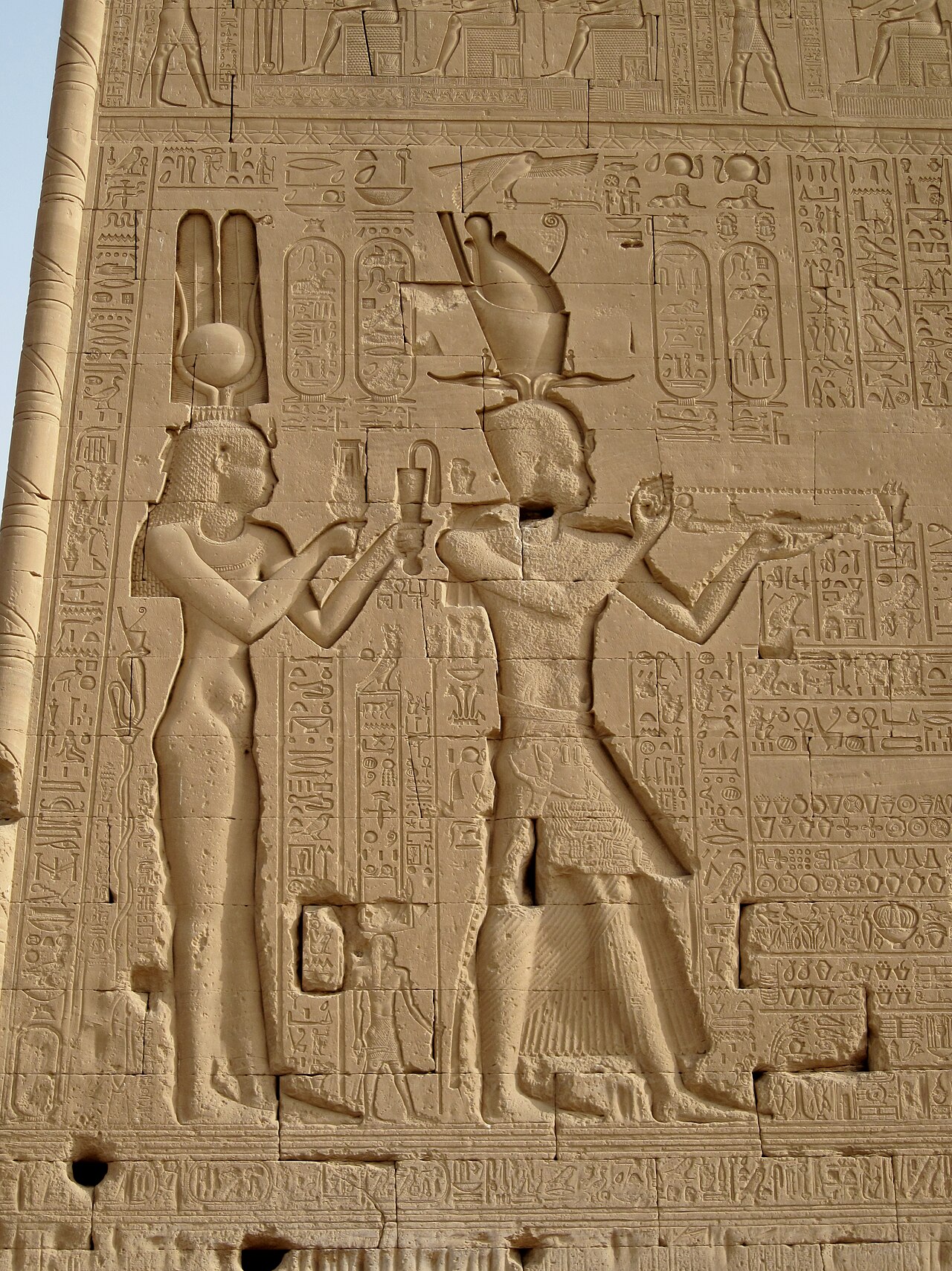
Egyptian temple art shows Cleopatra in a traditional royal role. On the south wall of the temple of Hathor at Dendera, a relief shows her with Caesarion making offerings to the gods; following Egyptian convention, the senior queen stands behind her young co-ruler, who holds the royal title.[10] Plutarch says that at the Donations and on other public occasions she wore a robe sacred to the goddess Isis and was hailed as the "New Isis".[2] Dio says that she was represented as Selene (the Moon) or Isis while Antony was presented as Osiris or Dionysus.[6]
Relief on the south wall of the temple of Hathor at Dendera showing Cleopatra VII and her son Caesarion making offerings to the gods.
She was a skilled linguist. Plutarch writes that she spoke many languages and seldom needed an interpreter with foreign envoys, including Ethiopians, Hebrews, Arabs, Syrians, Medes and Parthians, and contrasts her with earlier kings of her line, who had not troubled to learn the Egyptian language.[2] Britannica reads this as meaning that she alone of her dynasty learned Egyptian.[1]
Surviving documents show her government at work. A papyrus now in Berlin (P. Berlin 25239), received in Alexandria on 23 February 33 BCE, records a royal order granting tax exemptions to Publius Canidius, a Roman ally of Antony who later commanded his land army at Actium.[11] The text was written by a court scribe, but the papyrologist Peter van Minnen has suggested that the closing Greek word, ginesthoi ("make it so"), may be in Cleopatra's own hand; the attribution is not certain.[11]
Coins carry her portrait. A bronze coin in the British Museum, dated about 32–31 BCE, shows her diademed bust on one side and the goddess Athena on the other; it was struck at Chalcis in Ituraea (in present-day Lebanon), a district that Antony assigned to her in his settlement of 36 BCE, where she continued the local practice of issuing bronze coins in three denominations.[8] Britannica notes that her coin portraits suggest a face that was striking rather than conventionally beautiful.[1] Some sculpture is linked to her only tentatively: the Metropolitan Museum of Art describes a limestone statue of a Ptolemaic queen holding a cornucopia as "perhaps Cleopatra VII", and regards the cartouche reading "Cleopatra" on its arm as probably a modern addition.[9]
A bronze coin showing the diademed portrait of Cleopatra VII.
Modern scholars argue that the hostile picture of Cleopatra in ancient writing owes much to Octavian's propaganda, which presented the war as Rome's struggle against a foreign queen rather than as a civil war against Antony, a Roman.[13][14] Maarten Schmaal argues that Octavian cast Cleopatra as the corrupt East set against his sister Octavia as the virtuous West, so as to suggest that a foreign woman had ruined a once-admirable Roman.[14] Dio puts this line of argument in a speech he gives Octavian before Actium, in which Octavian mocks the Egyptians for being ruled by a woman and for worshipping animals, and calls on his troops not to be scorned by an Egyptian woman.[6] Dio's own verdict was that she was insatiable both in passion and in greed for wealth.[7]
Plutarch's portrait is more varied. He says her beauty was not in itself remarkable, but that her conversation was irresistible, her voice sweet and her company stimulating.[2] He also describes her staging a show of lovesickness when Octavia set out to rejoin Antony, and her flatterers persuading him to put off his Parthian campaign and return with her to Alexandria.[2]
The poets of Augustan Rome celebrated her defeat. Horace's ode on her death (Odes 1.37) first condemns her and then, from the phrase fatale monstrum ("fateful monster") onward, turns to praise her courage in choosing death over being led in a Roman triumph, according to the classicist J. V. Luce.[12] Virgil's Aeneid describes Actium as a battle between Rome's gods and the monstrous gods of Egypt, and Propertius wrote elegies that praised Octavian and mocked Cleopatra.[13] Jesse Sifuentes, writing in World History Encyclopedia, notes that there is no evidence that Augustus dictated their wording, but that their praise of him and their picture of her fit the official campaign.[13]
Later image
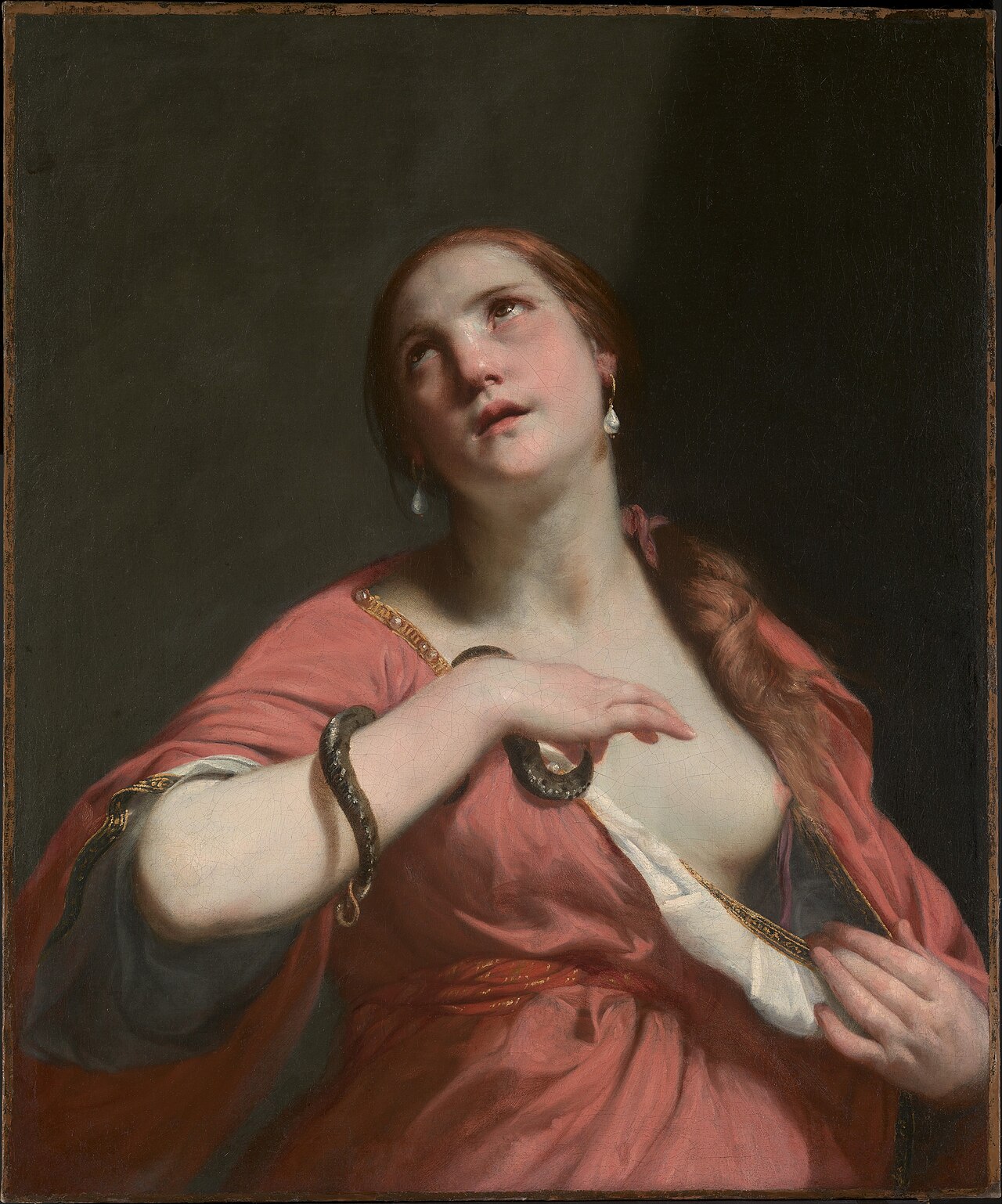
Encyclopaedia Britannica describes Cleopatra as having become, more than any other woman of classical antiquity, the model of the romantic femme fatale.[1] William Shakespeare's Antony and Cleopatra, written in 1606–07 and first printed in the First Folio of 1623, drew mainly on Sir Thomas North's 1579 English translation of Plutarch; it ends with her dying by a snake brought in a basket of figs, attended by Charmian and Iras.[15] According to the Met curator Keith Christiansen, poets and painters in 17th-century Italy were drawn to the idea of her reunion with her lover through death; examples include Guido Reni, whose Cleopatra with the Asp dates from about 1628, and Guido Cagnacci, whose The Death of Cleopatra (about 1645–55) is in the Metropolitan Museum of Art.[17]
Guido Cagnacci's painting The Death of Cleopatra, made about 1645–55, showing the queen at the moment of her death.
In the 20th century Hollywood retold her story in Cecil B. DeMille's 1934 film, with Claudette Colbert, and in the 1963 film Cleopatra, with Elizabeth Taylor opposite Richard Burton.[17] The 1963 film, released by Twentieth Century-Fox and directed by Joseph L. Mankiewicz, won four Academy Awards from nine nominations, but its production overruns nearly bankrupted the studio and it never recovered its budget.[16] Schmaal argues that both flattering and hostile modern depictions of Cleopatra and Antony go back to the messages of Octavian's propaganda.[14]
British Museum. Coin of Cleopatra VII, Chalcis, about 32–31 BC (museum number 1872,0302.3). British Museum collection online. No date shown; accessed 24 November 2026. britishmuseum.org/collection/object/C_1872-0302-3
Metropolitan Museum of Art. "Statue of a Ptolemaic Queen, perhaps Cleopatra VII" (89.2.660). The Met collection online. No date shown; accessed 24 November 2026. metmuseum.org/art/collection/search/547702
Institute of Egyptian Art and Archaeology, University of Memphis. "Dendara – Temple of Hathor" (colour tour). No date shown; accessed 24 November 2026. memphis.edu/egypt/resources/colortour/dendara3.php
Maarten Schmaal. "'She Put On a Look of Rapture': The Construction of Cleopatra and Mark Antony in Octavian's Propaganda." Groniek, no. 237, 20 March 2024, pp. 55–65. ugp.rug.nl/groniek/article/view/42567