The Vietnam War was an armed conflict, fought mainly in Vietnam and also in Laos and Cambodia from about the mid-1950s until 1975, between communist North Vietnam and its southern allies on one side and South Vietnam, the United States and their allies on the other.[1][2][11]
Names and dates
In communist histories produced in Vietnam, the war is officially called the "anti-American Resistance War to Save the Nation", a name that presents it as a war of national liberation.[1] There is no agreed starting date.[1] Historian Edward Miller notes that the US Defense Department in 1995 dated the war from 1 November 1955, when the US military advisory mission in South Vietnam was reorganised, while President Barack Obama in 2012 dated it from 12 January 1962, the first US combat mission there; scholars have proposed starting years from 1945 to 1960.[1] The US State Department's Office of the Historian describes the war as effectively ending on 30 April 1975, when North Vietnamese tanks entered the gate of the Presidential Palace in Saigon.[2]
Background
Vietnam, Laos and Cambodia, together known as Indochina, were under French control after the Second World War, though France struggled to hold them against nationalist uprisings; Laos became independent in 1949 and Cambodia in 1953.[3] Talks between France and the Viet Minh, the independence movement led by Ho Chi Minh, failed in 1946, and general war followed.[3] The United States gave France financial aid, partly because US officials feared the spread of communism in Asia after the founding of the People's Republic of China in 1949; President Dwight D. Eisenhower used the image of a row of falling dominoes to link Vietnam to the rest of Southeast Asia.[3] The French garrison at Dien Bien Phu, a fortified valley near the border with Laos, fell on 7 May 1954 after a siege of about four months.[3]
A conference at Geneva ended with a Final Declaration dated 21 July 1954, which names the representatives of Cambodia, the Democratic Republic of Viet-Nam (the Viet Minh government), France, Laos, the People's Republic of China, the State of Viet-Nam, the Soviet Union, the United Kingdom and the United States.[4] The agreements set a ceasefire and a temporary division of Vietnam at the 17th parallel, with Ho Chi Minh's forces in the North and French forces remaining in the South.[3] The Final Declaration stated that the military demarcation line was provisional and should not be interpreted as a political or territorial boundary, and it called for general elections in July 1956 under the supervision of an international commission.[4] According to the Office of the Historian, the United States did not sign this second agreement and instead chose Ngo Dinh Diem to lead South Vietnam.[3]
Historian Edwin Moïse writes that Diem announced, with American approval, that he would not hold the national elections called for at Geneva, renamed the State of Vietnam the Republic of Vietnam, and held separate elections in the South.[5] Moïse also writes that in 1959 the government in Hanoi gave communists and their sympathisers in the South permission to start a guerrilla war against the Saigon government, that guerrilla warfare broke out around the beginning of 1960, and that the National Liberation Front (NLF) was founded at the end of 1960 to lead it.[5]
Course of the war
Advisers and escalation, 1961–1965
President John F. Kennedy sent troops and military advisers to South Vietnam and increased their numbers throughout his presidency.[6] Miller describes 1963 as "the end of the beginning" of the conflict, after Hanoi's secret decision to expand the war and the overthrow of Diem.[1]
In August 1964 two US destroyers in the Gulf of Tonkin, the Maddox and the Turner Joy, reported attacks by North Vietnamese patrol boats on 2 August and again on 4 August.[7] The US National Archives states that the Maddox had been gathering electronic intelligence in support of South Vietnamese commando raids on the North, and that a 2002 National Security Agency report, released in 2007, confirmed the 2 August attack but concluded that the 4 August attack never happened.[8] On 7 August 1964 Congress passed the Gulf of Tonkin Resolution; only two senators voted against it, and the House passed it unanimously.[7][8] The resolution said the United States was prepared, "as the President determines, to take all necessary steps, including the use of armed force", to help members of the Southeast Asia Collective Defense Treaty.[8] The Johnson and Nixon administrations treated it as the legal basis for a war that Congress never formally declared, and Congress repealed it in January 1971.[8]
A bombing campaign against North Vietnam, Operation Rolling Thunder, began on 13 February 1965 and continued through spring 1967.[7] President Lyndon B. Johnson also began sending regular US ground combat forces, starting with the landing of Marines at Da Nang; by 1967 nearly 500,000 US troops were in Vietnam.[6][7]
Tet Offensive, 1968
At 3 a.m. on 31 January 1968, during the Tet lunar new year holiday, North Vietnamese and NLF forces launched simultaneous attacks on military bases, provincial capitals, district towns and Saigon, where an assault team broke into the US Embassy compound.[9] A US Army history article calls it the largest operation either side had undertaken up to that point; most attacks were contained quickly, but fighting in Hue lasted more than a month, and the attacking forces suffered very heavy losses.[9] The same article says the offensive shocked the American public, which had believed such an operation impossible, and deepened disillusionment with the war.[9] In March 1968, facing falling public support, Johnson announced that he would not seek re-election.[6][9]
Vietnamization and negotiations, 1969–1973
President Richard Nixon announced the first withdrawal of US troops on 8 June 1969, and withdrawals continued from then on, while a programme called Vietnamization aimed to build up South Vietnam's own armed forces.[2] Secret US B-52 bombing of communist base camps in Cambodia was followed on 30 April 1970 by a US–South Vietnamese ground incursion into Cambodia; campus protests followed, and four students were killed at Kent State University on 4 May.[2] After North Vietnam launched its Easter Offensive in late March 1972, the United States mined North Vietnam's harbours, began a sustained air campaign called Operation Linebacker, and on 14 December ordered heavy B-52 bombing of the North.[2] Henry Kissinger for the United States and Le Duc Tho for North Vietnam initialled an agreement on 23 January 1973, and it was signed in Paris on 27 January 1973.[2][10]
Announcing the agreement on 23 January 1973, Nixon said that an internationally supervised ceasefire would begin at 2400 GMT on 27 January, that all American prisoners of war would be freed and all US forces withdrawn from South Vietnam within 60 days, and that the people of South Vietnam had been guaranteed the right to determine their own future.[10]
End of the war, 1973–1975
According to the Office of the Historian, neither Vietnamese side abided by the settlement and fighting continued.[2] Nixon had privately promised South Vietnam's President Nguyen Van Thieu a strong and rapid response to violations, but the Office of the Historian says these promises were not kept because of congressional reluctance, economic constraints and the Watergate scandal.[2] North Vietnamese forces opened a major offensive in the Central Highlands in March 1975, and on 30 April 1975 their tanks entered the Presidential Palace in Saigon.[2]
Other countries involved
Laos and Cambodia
Historians Ben Kiernan and Taylor Owen write that the figure usually given for US bombs dropped on Laos in 1964–1973 is about 2 million tons; the researcher Holly High suggested 5.7 million tonnes in 2008 but returned to about 2 million tons in 2014.[11] Kiernan and Owen's own 2006 estimate of 2.7 million tons for Cambodia was revised in 2010, after High's analysis showed it was inflated by a data-entry error, to about 500,000 tons for 1969–1973, a figure they describe in 2015 as undisputed; High and colleagues calculated at least 472,313 tons.[11]
Allies of South Vietnam
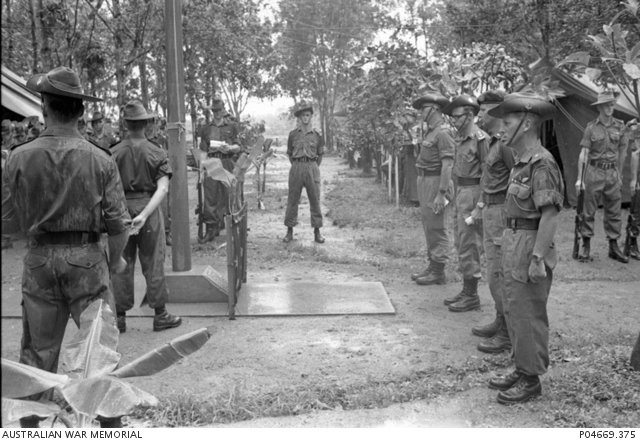
Australia's involvement began when 30 military advisers, the Australian Army Training Team Vietnam, arrived in July and August 1962.[12] The Australian War Memorial states that more than 60,000 Australians served in Vietnam, 523 died and almost 2,400 were wounded.[12] An Australian task force based at Nui Dat in Phuoc Tuy province reached about 8,500 troops at its peak; the last battalion left Nui Dat on 7 November 1971, and a proclamation by the Governor-General formally ended Australia's participation on 11 January 1973.[12] Conscripts called up under the National Service Scheme, introduced in 1964, served in the task force, and opposition to conscription grew by the late 1960s.[12]
Australian soldiers at the task force base at Nui Dat in Phuoc Tuy province, South Vietnam.
Historian Christos Frentzos writes that about 325,000 South Korean soldiers served in Vietnam between 1964 and 1973, with about 50,000 there by 1968, making South Korea the largest "third country" ally of the United States (that is, apart from South Vietnam); about 5,100 were killed in action and another 11,200 wounded.[13] He also writes that the United States paid South Korea about $1 billion between 1965 and 1970 in connection with the deployment.[13] Encyclopaedia Britannica reports that about 350 soldiers from Thailand and roughly three dozen from New Zealand died.[14]
Supporters of North Vietnam
In a review of historian Qiang Zhai's study of China and the Vietnam wars, Lucian Pye reports Zhai's figure of 320,000 Chinese support troops sent to the war against the United States, of whom more than 1,000 were killed.[15] A 2019 study by Shao Xiao and Xiaoming Zhang, citing Chinese military histories, states that Chinese engineering and anti-aircraft artillery units deployed to North Vietnam from June 1965, that 320,000 Chinese troops served there between 1965 and 1969, and that up to 170,000 were there at one time.[16] The same study cites an official Chinese history putting China's total aid to Vietnam from the 1950s to 1975 at more than 20.36 billion yuan.[16] It also records that Soviet air-defence systems arrived in Hanoi after Soviet Premier Alexei Kosygin's visit in February 1965, that more than 200 Soviet-made tanks led the 1972 Easter Offensive, and that, according to Vietnamese records, Chinese aid exceeded Soviet aid by 17% in 1971.[16]
Casualties
Published casualty figures differ in who compiled them, the years they cover and whether civilians are included, as the figures below show.
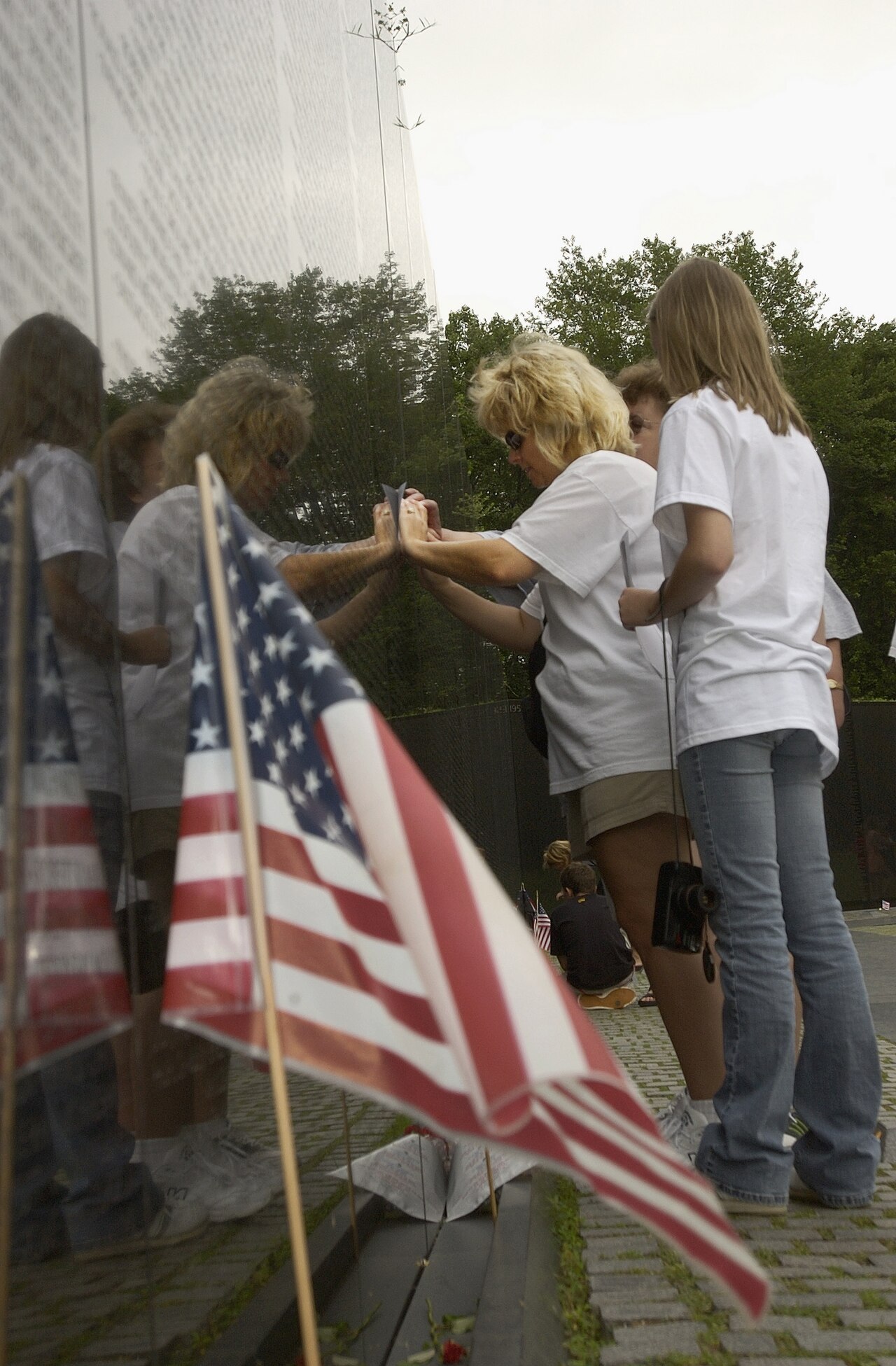
United States: A National Archives data file lists 58,220 US military fatal casualties, 47,434 of them hostile deaths and 10,786 non-hostile, with dates of death from 8 June 1956 to 28 May 2006; the Archives describes these record counts as "for informational purposes only, not official statistics".[17] The Vietnam Veterans Memorial in Washington, D.C., lists more than 58,300 names of US service members killed or missing in action, according to Britannica.[14]
South Vietnamese forces: Britannica cites a US military estimate of 200,000 to 250,000 South Vietnamese soldiers killed.[14]
Vietnamese government figures: Britannica reports that Vietnam's government released an estimate in 1995 of as many as 2,000,000 civilians killed on both sides and some 1,100,000 North Vietnamese and NLF fighters.[14]
Scholarly estimates: Demographer Giovanna Merli summarises a 1995 study by Charles Hirschman, Samuel Preston and Vu Manh Loi as estimating about 1 million Vietnamese military and civilian deaths between 1965 and 1975, and notes that the same study compared earlier estimates of 1,234,000 deaths in 1965–1974 (Guenter Lewy, 1978) and 2,358,000 in 1960–1975 (Robert McNamara, 1991).[18] A 2008 study in the BMJ by Ziad Obermeyer, Christopher Murray and Emmanuela Gakidou, based on household surveys about deaths of siblings, estimated 3.8 million violent war deaths in Vietnam (95% confidence interval 2.2 to 5.9 million), compared with 2.1 million in the Uppsala/PRIO conflict database; these figures cover all wars in Vietnam from 1955 to 2002, not only this war.[19]
Other countries: About 5,100 South Korean, 523 Australian, about 350 Thai and roughly three dozen New Zealand military deaths are reported, and more than 1,000 Chinese support troops died.[12][13][14][15]
Visitors at the Vietnam Veterans Memorial in Washington, D.C., a black granite wall engraved with the names of US service members killed or missing in the war.
Historians disagree about why the war began and whether US involvement was justified.[1][20] In a review of Gary Hess's survey of the debate, Ian Horwood explains that the "orthodox" school sees US intervention as a mistake that was bound to fail, driven by a globalised policy of containing communism and by concern for American credibility, and holds that the South Vietnamese government was too weak to succeed under any strategy.[20] The "revisionist" school argues that the war was necessary to resist communist expansion and was winnable, and that the United States let victory slip away through poor strategy and "lost victories".[20] Miller adds that revisionists blame the war on aggression by North Vietnam's communist leaders, while the orthodox school, in line with Vietnamese Communist Party historians, holds that the United States caused the war by refusing to recognise Vietnam's right to self-determination.[1]
The official Vietnamese view presents the war as resistance to US invasion.[1][21] A 2020 article by Nguyen Ngoc Hoi, published in English on the site of a Vietnamese defence journal, argues that the 1954–1975 war was a resistance war against a US invasion and not a civil war in which the North invaded the South, citing US funding of the French war, the US refusal to sign the Geneva Final Declaration and later US escalation.[21] Miller argues that the conflict was at once a war of national liberation, a Cold War conflict and a "savage civil war" that divided Indochina along political, ethnic and religious lines from the outset.[1]
Consequences
The communist victories of 1975 in Vietnam, Laos and Cambodia were followed by a large refugee movement: the UN refugee agency UNHCR states that more than three million people fled these countries over the next two decades.[22] UNHCR figures show 796,310 Vietnamese boat people arriving in countries of first asylum between 1975 and 1995, and 1,311,183 Indochinese refugees resettled in the same period; UNHCR cites one writer's estimate that about 10% of boat people died at sea, from drowning, pirate attacks or dehydration.[22]
The US Department of Veterans Affairs states that the US military sprayed more than 19 million gallons of herbicide mixtures in Vietnam between 1962 and 1971 in Operation Ranch Hand, to remove the forest cover used by opposing forces; the most used mixture, Agent Orange, contained traces of the dioxin TCDD, a toxic by-product of herbicide manufacture.[23] Merli notes the Hirschman study's conclusion that Vietnam's losses in the war were about 100 times greater than those of the United States.[18] In Australia, the Australian War Memorial describes the war as the cause of the greatest social and political dissent since the conscription referendums of the First World War.[12]
Sources
Edward Miller. "Introduction: Points of Departure – The Global and Local Origins of the Vietnam War." In The Cambridge History of the Vietnam War, Volume I, ed. Edward Miller. Cambridge University Press, 2024 (published online 2 January 2025). core-prod.cambridgecore.org/core/services/aop-cambridge-core/conten…
Office of the Historian, US Department of State. "Ending the Vietnam War, 1969–1973." Milestones in the History of U.S. Foreign Relations (series retired). No date shown; accessed 25 November 2026. history.state.gov/milestones/1969-1976/ending-vietnam
Office of the Historian, US Department of State. "Dien Bien Phu and the Fall of French Indochina, 1954." Milestones in the History of U.S. Foreign Relations (series retired). No date shown; accessed 25 November 2026. history.state.gov/milestones/1953-1960/dien-bien-phu
"Final Declaration of the Geneva Conference on the Problem of Restoring Peace in Indo-China, July 21, 1954." The Avalon Project, Yale Law School. No date shown; accessed 25 November 2026. avalon.law.yale.edu/20th_century/inch005.asp
Edwin E. Moïse. "The Aftermath of Geneva, 1954–1961." The Vietnam Wars (web pages hosted by Clemson University). No date shown; accessed 25 November 2026. edmoise.sites.clemson.edu/viet5.html
Office of the Historian, US Department of State. "Foreword, 1961–1968." Milestones in the History of U.S. Foreign Relations (series retired). No date shown; accessed 25 November 2026. history.state.gov/milestones/1961-1968/foreword
Office of the Historian, US Department of State. "U.S. Involvement in the Vietnam War: The Gulf of Tonkin and Escalation, 1964." Milestones in the History of U.S. Foreign Relations (series retired). No date shown; accessed 25 November 2026. history.state.gov/milestones/1961-1968/gulf-of-tonkin
Ben Kiernan and Taylor Owen. "Making More Enemies than We Kill? Calculating U.S. Bomb Tonnages Dropped on Laos and Cambodia, and Weighing Their Implications." The Asia-Pacific Journal: Japan Focus, vol. 13, issue 17, no. 3, 27 April 2015. apjjf.org/?p=15332
Australian War Memorial. "Vietnam War 1962–75." Last updated 30 October 2023. awm.gov.au/atwar/vietnam
Christos G. Frentzos. "Casualties of War: The Legacy of South Korean Participation in the Vietnam Conflict." International Journal of Korean Studies, vol. XXIII, no. 1, Spring/Summer 2019. icks.org/wp-content/uploads/2025/03/2019-1.pdf
Lucian W. Pye. Review of Qiang Zhai, China and the Vietnam Wars, 1950–1975. Foreign Affairs, July/August 2000. foreignaffairs.com/node/1080615
Shao Xiao and Xiaoming Zhang. "Reassessment of Beijing's economic and military aid to Hanoi's war, 1964–75." Cold War History, 2019 (DOI 10.1080/14682745.2019.1581768); copy read at viet-studies.com/kinhte/ChinaAidVN_ColdWarHistory.pdf
Ziad Obermeyer, Christopher J. L. Murray and Emmanuela Gakidou. "Fifty years of violent war deaths from Vietnam to Bosnia: analysis of data from the world health survey programme," Table 3. BMJ, 2008; 336:1482. pmc.ncbi.nlm.nih.gov/articles/PMC2440905/table/tbl3
Ian Horwood. Review of Gary R. Hess, Vietnam: Explaining America's Lost War (Wiley-Blackwell, 2008). Reviews in History, January 2009. reviews.history.ac.uk/review/711