Paradise earth is the Jehovah's Witnesses teaching that God will turn the whole earth into a lasting paradise like the garden of Eden, where faithful humans, including billions raised from the dead, will live forever.[1][2][3]
The earth as humankind's permanent home
Jehovah's Witnesses teach that the planet will never be destroyed, burned up or replaced, because God made it to be lived on forever.[1] Their publications cite passages such as Psalm 37:29, Psalm 104:5, Ecclesiastes 1:4 and Isaiah 45:18 for this view.[1] They also teach that God will not let humans ruin the earth completely through pollution, war or any other means.[1]
Witness publications read the promised "new heavens and a new earth" (2 Peter 3:13; Revelation 21:1-4) as a new government, God's Kingdom, ruling over a new human society, rather than as a new planet.[1] They read the "fire" of 2 Peter 3:7 as the end of a world of wicked people, comparing it with the Flood of Noah's day, which, in their account, destroyed a violent society but left the planet in place.[1] Under the Kingdom, they teach, God will renew conditions on earth so that they resemble those in Eden, and the earth will become a peaceful paradise.[1] (For the Kingdom itself, see Kingdom of God (Jehovah's Witnesses).)
In Witness teaching, Jesus and 144,000 corulers (see 144,000) rule from heaven over the people living on the earth.[2] Who holds which hope is covered in the entries Great crowd and Other sheep.
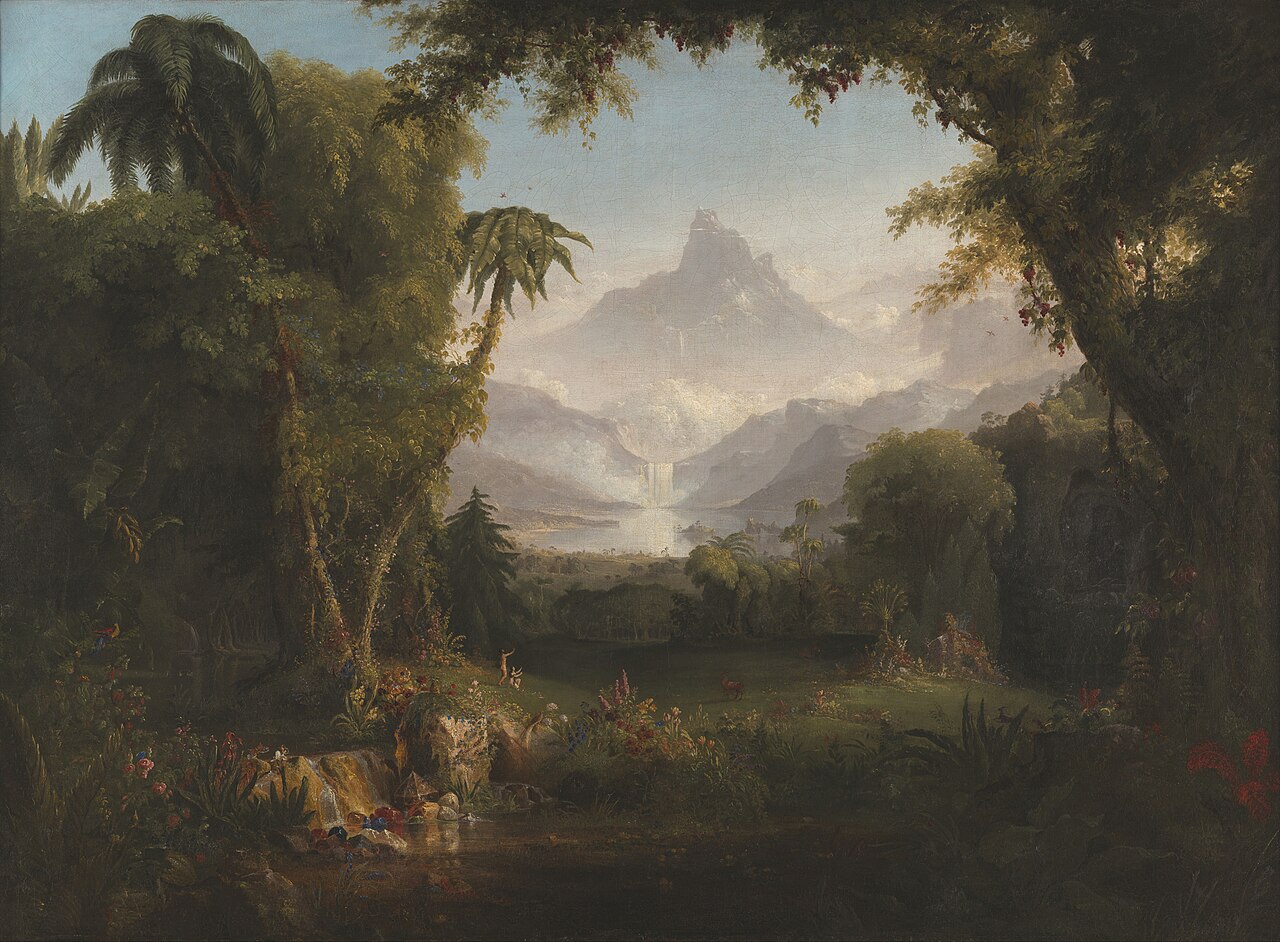
The Garden of Eden (1828) by the American painter Thomas Cole, a landscape of the first earthly paradise.
The Witnesses' interactive Bible course Enjoy Life Forever! states that under God's Kingdom the righteous will possess the earth and live on it forever.[2] It teaches that no one will get sick and that everyone will live forever, and that the Kingdom will end world hunger, solve the earth's environmental problems and fill the earth with peace and justice; the lesson cites Isaiah 33:24, Psalm 72:16, Isaiah 35:1-2 and Isaiah 11:4 among its passages.[2] It describes the end result as a global paradise filled with good people who worship Jehovah forever.[2]
Paradise is not taught as arriving all at once. A 2019 study of the teaching by a religion scholar, published in a Korean religious-studies journal, notes that in Witness thought Armageddon will not bring instant perfection to humans or to the earth; instead the earth moves gradually towards perfection during the thousand years that follow.[5] The same study describes what Witness sources expect of daily life: people will keep building houses (Isaiah 65:21-22 is cited), the homes are pictured as modest but adequate, and work will continue but will not be unduly hard.[5] It reports that Witnesses are reluctant to speculate about many details.[5] Its examples include whether the animals of Isaiah 11 will literally eat straw, and the question of language, since the new world is not expected to have a single common one.[5] It also observes that Witness artwork of the new world never shows people eating meat.[5]
A 2002 sociology paper describes the same artwork: very happy figures among green slopes, clear skies and flowing streams, some reunited with dead relatives, and little use of angels, haloes or other heavenly imagery.[6] The paper argues that such pictures play a key part in keeping members committed and confirming their beliefs.[6]
One detail has changed in print. The Watchtower study edition of 15 August 2014 said that for years the publications had taken Jesus' answer to the Sadducees about marriage in the resurrection as likely referring to the earthly resurrection, which meant that people raised to life on earth were not expected to marry.[7][5] The 2014 article said it seemed possible that Jesus had the heavenly resurrection in mind instead, and on whether people resurrected on earth could marry it concluded that "we cannot say".[7]
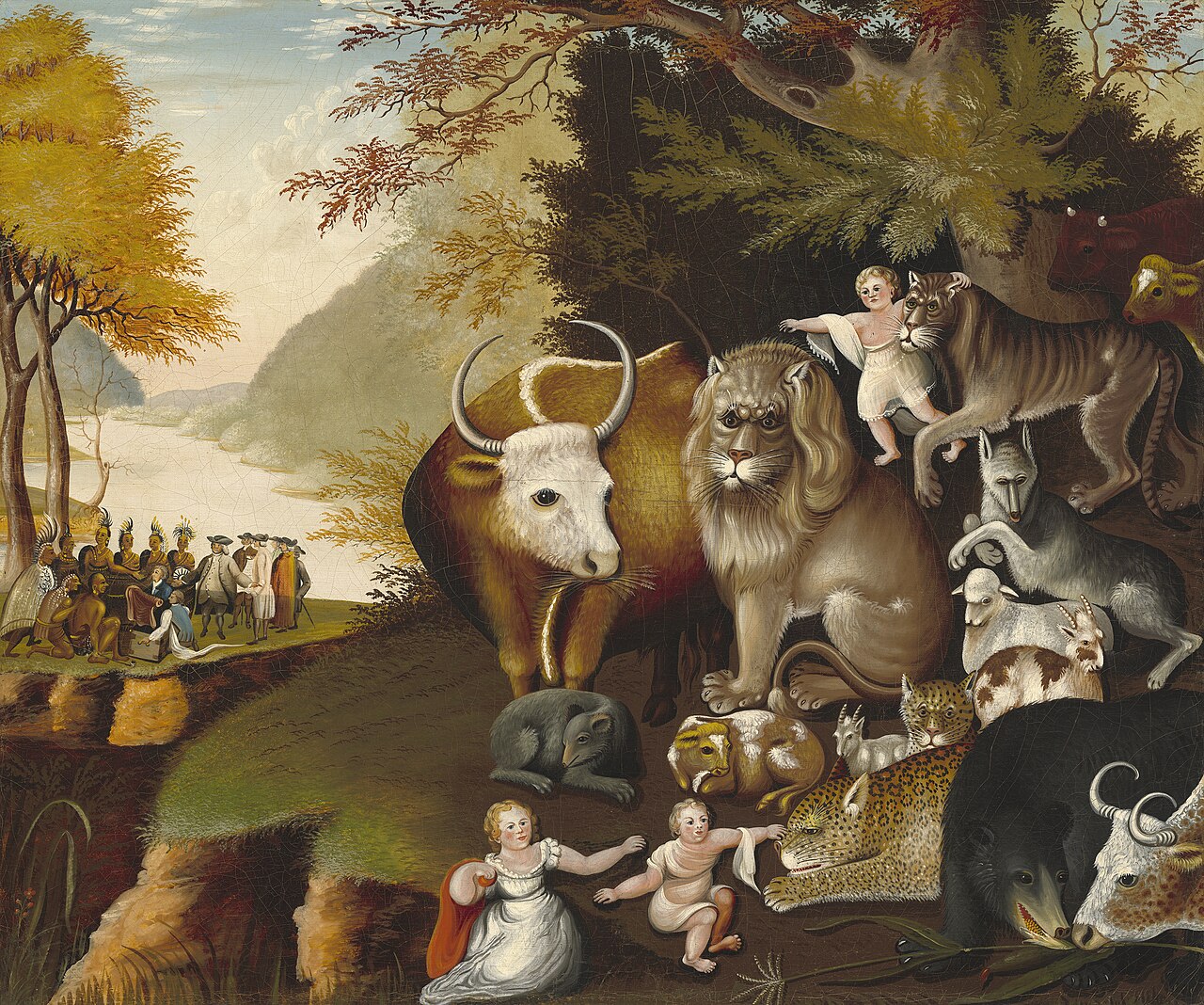
Peaceable Kingdom (about 1834) by Edward Hicks, one of many versions he painted of wild and tame animals living together in peace, now in the National Gallery o
Jehovah's Witnesses teach that most of the dead will be raised to life on earth. Enjoy Life Forever! says that the people Jesus brought back to life in the past had not gone to heaven, and that Jesus will soon resurrect billions to enjoy life forever on a paradise earth.[3] It teaches that those raised will include many more than people who worshipped Jehovah, citing Acts 24:15 and John 5:28-29.[3]
The 2019 study notes that the resurrection is expected to be physical and that it will take place after Armageddon, gradually, across the thousand years rather than all at once.[5] It points out that Charles Taze Russell had already addressed whether the earth could hold everyone: in the first volume of his Studies in the Scriptures he estimated that about 252 billion people had lived and calculated that the area of Texas alone could hold far more bodies than that.[5]
The Thousand-year reign and the final test
In Witness teaching the paradise is built during Christ's thousand-year reign, which begins after God's Kingdom destroys wicked people and governments at Armageddon.[2] During those years Jesus and his 144,000 corulers are taught to help people on earth become perfect and free of sin, and by the end of the period the earth is to be a beautiful paradise.[2]
The course teaches that Jesus will then hand rulership back to his Father, and that Jehovah will destroy Satan, the demons and anyone else who chooses to rebel (Revelation 20:7-10).[2] The 2019 study describes this as a final test: at the end of the thousand years Satan is released and given one last chance to win people to his side, and only after that is the perfected state complete.[5] Witnesses teach that the perfect conditions that follow will last forever.[2]
Roots in Russell's "restitution" teaching
The teaching grew out of the work of Charles Taze Russell (1852-1916), whose Bible Students movement came out of 19th-century Adventism but, unlike the Adventists of the time, rejected the idea that the earth would be destroyed.[5] Russell set out his view in The Divine Plan of the Ages, first issued in 1886 and published as the first volume of Studies in the Scriptures.[8] There he wrote that the purpose of Christ's second coming was the "restitution of all things", a phrase from Acts 3:21, meaning the restoring of what humans had lost.[8] He equated the "times of restitution" with the Millennial age, taught that everything mankind lost through Adam would be restored to those who believe in Christ, described people being restored to human perfection, and spoke of God's plan for the awakening of the dead.[8] In Russell's scheme this restitution of the world was to be carried out through the glorified "elect Church".[8]
The later teaching on which people share the earthly hope, including the change of 1935, is covered in the entries 144,000, Great crowd and Other sheep.
The paradise theme became the title of one of the movement's most widely distributed books. You Can Live Forever in Paradise on Earth was released in the summer of 1982 at the "Kingdom Truth" District Conventions, and by April 1983 Awake! reported that some 10 million copies had been printed in 22 languages.[4] The same hope is taught in the later course Enjoy Life Forever!.[2][3]
The 2019 study calls Jehovah's Witnesses a restorationist movement in two senses: they seek to restore what they regard as the original apostolic church, and they look to a restored paradise on earth.[5]
Comparison with other Christian views
Other Christian traditions read the end of the world and the "new earth" differently.
According to the 2019 study, mainstream Christianity has been divided on death and the afterlife, but has traditionally taught two eternal destinies, heaven and hell; Roman Catholicism adds purgatory and limbo, which Protestants generally reject.[5] The study notes that the idea of a soul existing apart from the body, which Augustine and Thomas Aquinas affirmed, came into Christian thought largely from Greek philosophy.[5]
The Catechism of the Catholic Church also teaches a renewed creation. It says that at the end of time the universe itself will be renewed, that Scripture calls this renewal "new heavens and a new earth", and that the visible universe is destined to be transformed and to share in the glory of the risen Christ.[9] It also speaks of the "beatific vision", in which, in its words, God opens himself in an inexhaustible way to the elect.[9]
Seventh-day Adventists also expect the redeemed to live forever on the earth.[10] Their Fundamental Beliefs (2015 edition) teach that on the new earth God will provide an eternal home for the redeemed and dwell with them, with suffering and death ended.[10] Unlike Jehovah's Witnesses, Adventists place the thousand-year reign in heaven, with the saints, while the earth lies desolate; the new earth follows after that period and the final destruction of sin.[10] Witnesses instead place the millennium on earth and teach that the paradise is built during it.[2]
George D. Chryssides. "Beyond Armageddon: Is the Jehovah's Witnesses' Paradise Earth Conceivable?" Daesoon Sasang Nonchong (Journal of Daesoon Thought), vol. 32, 2019, pp. 237-267. koreascience.or.kr/article/JAKO201927152090586.pdf
Andrew Holden. "Returning to Eden: Futuristic Symbolism and its Effects on Jehovah's Witnesses." Department of Sociology, Lancaster University, On-Line Papers, 2002 (web version revised 29 November 2003). lancaster.ac.uk/fass/resources/sociology-online-papers/papers/holde…
Charles Taze Russell. The Divine Plan of the Ages (Studies in the Scriptures, vol. 1), chapter 6, "Our Lord's Return: Its Object, the Restitution of All Things." First issued 1886; online edition with 1916 foreword. thestudiesinthescriptures.com/Pages/English/Eng%20V1/Eng%20Vol%201%…
General Conference of Seventh-day Adventists. 28 Fundamental Beliefs, 2015 edition, beliefs 27 ("The Millennium and the End of Sin") and 28 ("The New Earth"). Hosted by an Adventist union site. szu.adventist.org/wp-content/uploads/2016/04/28_Beliefs.pdf