Version 10
Nov 27, 2026. Compare with the current version · Version history
The United States of America is a federal republic of 50 states and a federal district, the District of Columbia, whose capital is Washington.[2]
Developing story. This entry is updated as events change; every changing fact is dated.
At a glance
- Government: federal republic with a president, a two-chamber Congress and a Supreme Court.[3]
- Capital: Washington, in the District of Columbia.
- States: 50, plus the District of Columbia; Puerto Rico and several other island areas are also under United States rule.[2]
- Area: 3,796,742 square miles (9,833,517 square kilometres), land and water, for the states and District.[2]
- Population: about 341.8 million residents, estimate for 1 July 2025.[1]
- Independence declared: 4 July 1776.[4]
- Constitution drafted: 1787.[6]
- President: Donald Trump, as of November 2026.[31]
Land and people
The area figure above includes inland, coastal, Great Lakes and territorial water; land alone accounts for about 3.53 million square miles.[2]
The Census Bureau estimated that the resident population grew by 1.8 million, or 0.5 per cent, in the year to 1 July 2025.[1] It said growth had slowed significantly, largely because net international migration fell from 2.7 million to 1.3 million.[1] All four census regions grew, and the Midwest was the only region where every state gained people. South Carolina grew fastest of any state, by 1.5 per cent.[1]
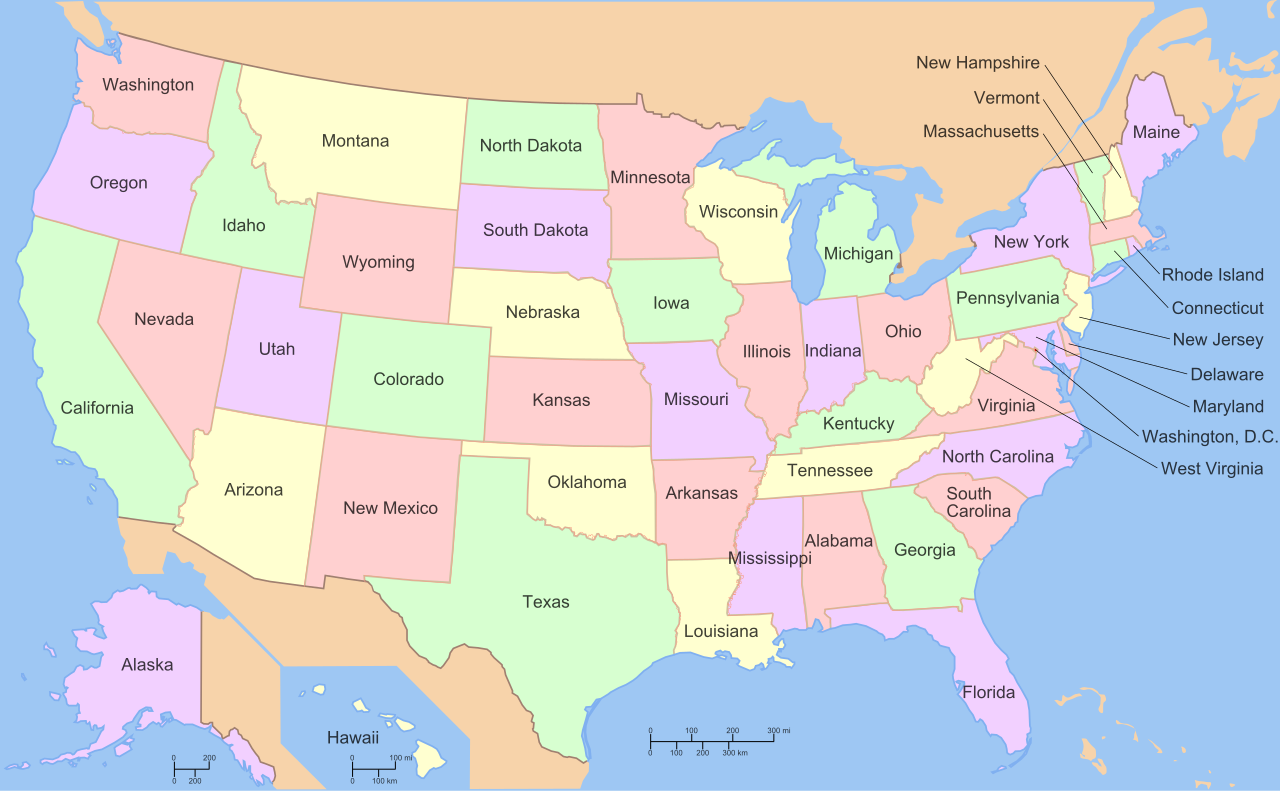
Via Wikimedia Commons: Map of USA with state names 2 by The original was edited by User:Andrew c to include Nova Sco, CC BY-SA 3.0.
Geography
Heights and depths
The highest point in the country is Mount McKinley, also called Denali, in Alaska, given as 20,320 feet (6,194 metres) in a United States Geological Survey (USGS) booklet. The lowest is in Death Valley, California, 282 feet (86 metres) below sea level.[32]
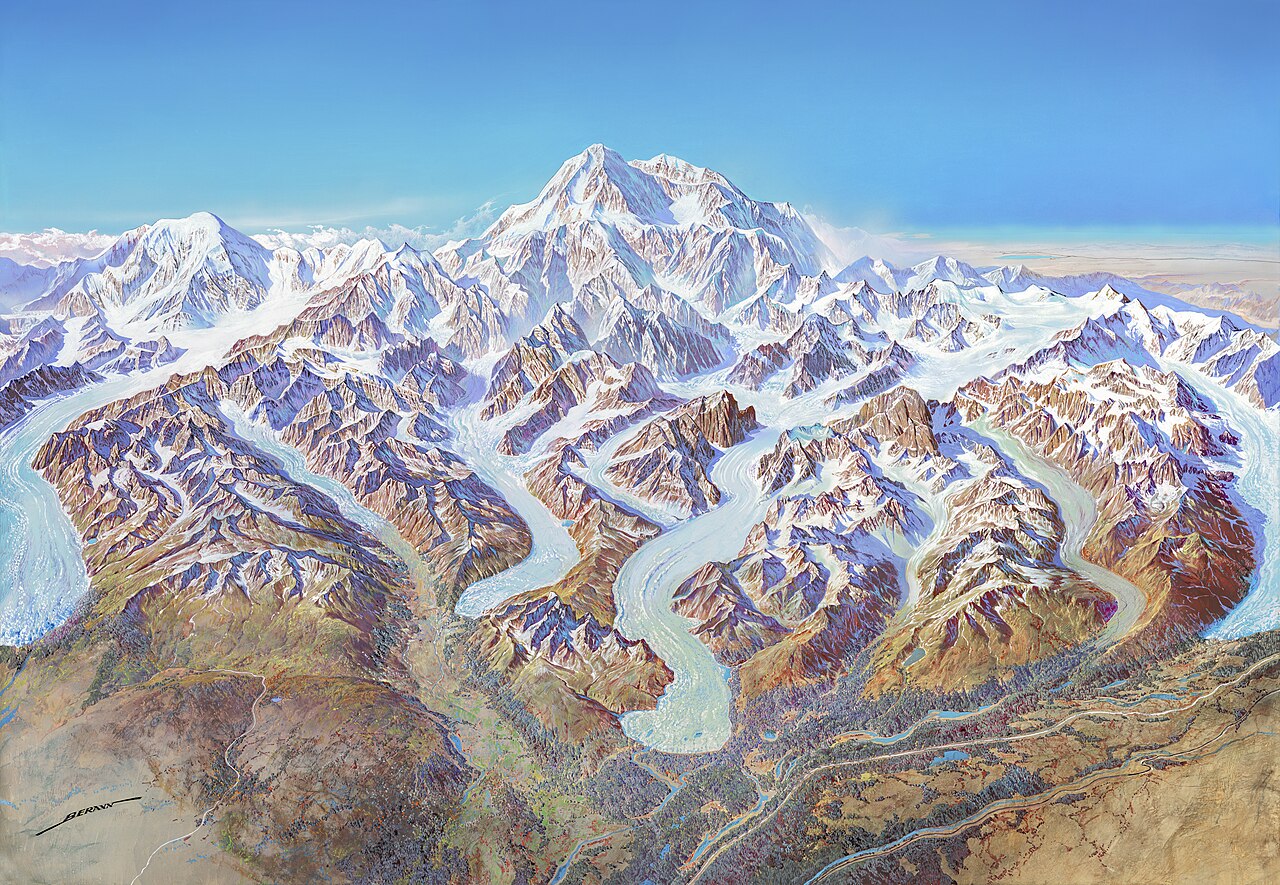
Via Wikimedia Commons: Heinrich Berann NPS Panorama of Denali without labels by Heinrich C. Berann, public domain.
Rivers
The Mississippi system is the largest river system in the country by the volume of water it carries. A USGS fact sheet gives an average flow of about 651,000 cubic feet per second, counting the Missouri and other tributary basins and the Atchafalaya channel.[33] In the west, the Colorado River runs 1,450 miles from the Rocky Mountains to the Gulf of California.[34]
Climate extremes
The country spans very different climates. Death Valley is, according to the National Park Service, the hottest place on earth and the driest in North America: it holds the world record air temperature of 134 degrees Fahrenheit (57 degrees Celsius), measured on 10 July 1913, and averages less than 2 inches of rain a year.[35]
Native peoples
American Indians and Alaska Natives lived across the land long before the United States existed. As of November 2026 the Bureau of Indian Affairs counts 575 federally recognised tribes.[36] A recognised tribe has a government-to-government relationship with the United States and certain inherent rights of self-government, known as tribal sovereignty.[36] About 56.2 million acres are held in trust by the United States for tribes and individuals, and there are about 326 Indian land areas administered as reservations; not every recognised tribe has one.[36]
Removal
As demand for Indian land grew, President Andrew Jackson signed the Indian Removal Act on 28 May 1830, authorising treaties to move tribes living east of the Mississippi to land in the west.[37] By the end of his presidency nearly 70 removal treaties had led to the relocation of nearly 50,000 people to what later became eastern Oklahoma, opening 25 million acres to white settlement.[37] Many Cherokee opposed the 1836 Treaty of New Echota, and soldiers under General Winfield Scott were sent when they refused to leave.[37]
Allotment and later law
The Dawes Act of 8 February 1887 allowed the president to break up reservation land held in common into small plots for individuals, treating Native Americans as individuals rather than as members of tribes.[38] In 1953 Congress gave certain states criminal jurisdiction over American Indians on reservations.[36]
See also Wampanoag.
Government
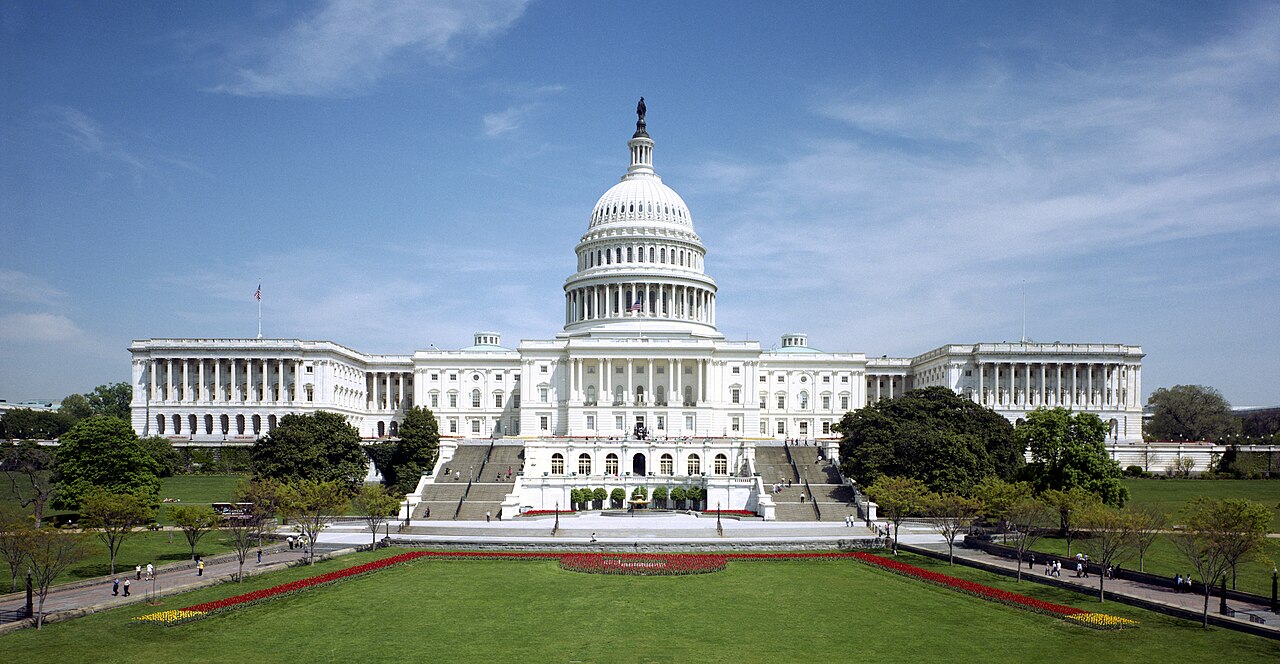
Via Wikimedia Commons: United States Capitol - west front by Architect of the Capitol, public domain.
The Constitution divides the federal government into three branches so that no person or group holds too much power.[3]
- Congress, made up of the Senate and the House of Representatives, makes law. See United States Senate.[3]
- The president is head of state, leads the executive branch and commands the armed forces, and may veto legislation. The vice president presides over the Senate and breaks tied votes.[3]
- The courts, headed by the Supreme Court, can overturn unconstitutional laws. Justices are nominated by the president and confirmed by the Senate.[3]
Power is also divided between the federal government and the states. The Tenth Amendment reserves to the states, or to the people, the powers that the Constitution neither gives to the federal government nor forbids to the states.[7] Each state has its own government, headed by a governor, and there are local governments beneath it.[13]
The Constitution and its amendments
In September 1789 the First Congress proposed twelve amendments; the ten then ratified became the Bill of Rights.[7] Later amendments abolished slavery, guaranteed equal protection of the laws, extended voting rights and set the voting age at eighteen.[9][14][15][16] The Eighteenth Amendment, which established the prohibition of alcohol, was later repealed.[16]
History
Independence and founding
The Continental Congress declared the colonies independent of Britain on 4 July 1776.[4] The Treaty of Paris of 3 September 1783 recognised independence and settled boundaries.[5] A convention that met in Philadelphia from May 1787 drafted a new Constitution, which took effect after ratification, with nine states required, following a hard-fought argument between Federalist supporters and Anti-Federalist opponents.[6] George Washington became the first president.
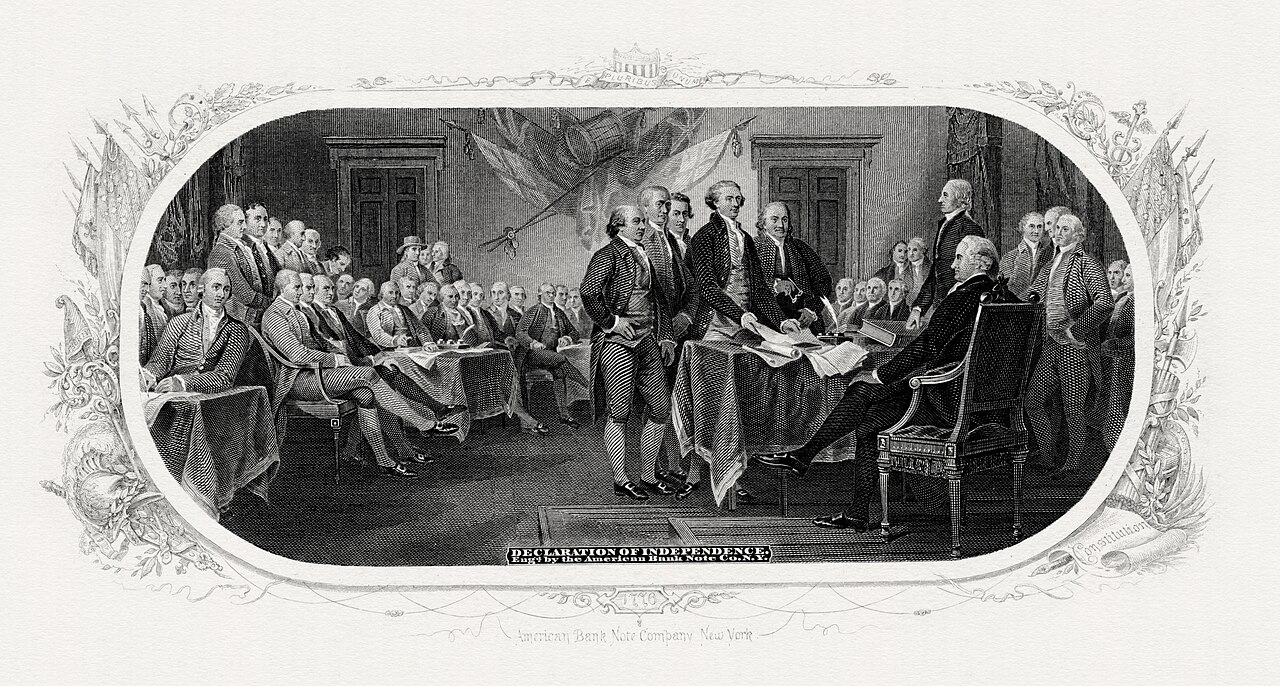
Via Wikimedia Commons: BEP-GIRSCH-Declaration of Independence (Trumbull) by Frederick Girsch at the American Bank Note Company , for the, public domain.
Expansion
In 1803 the country bought the Louisiana Territory from France for 15 million dollars, far more than President Thomas Jefferson's envoys had been told to seek to acquire.[8] The Homestead Act of 1862 offered heads of families 160 acres of surveyed public land for a small fee and five years of residence, which sped western settlement.[17] The National Archives notes that few labourers could afford to set up a farm, and that most land under the act went to people from nearby areas.[17]
Civil war and Reconstruction
Conflict over slavery led to the American Civil War, during the presidency of Abraham Lincoln. Three amendments followed as part of Reconstruction, the rebuilding period after the war. The Thirteenth abolished slavery.[9] The Fourteenth, ratified in 1868, gave citizenship to people born or naturalised in the country and required states to provide due process and equal protection of the laws.[14] The Fifteenth, ratified in 1870, gave African American men the right to vote.[15]
Immigration restriction
The Chinese Exclusion Act of 1882 barred Chinese labourers from immigrating for ten years. The National Archives calls it the first significant law restricting immigration to the United States.[18]
The twentieth century
The Nineteenth Amendment, ratified in 1920, gave women the right to vote.[10] The country fought in World War I. Amid the Great Depression, President Franklin D. Roosevelt signed the Social Security Act on 14 August 1935, creating old-age benefits, unemployment insurance and aid for several other groups.[19]
During World War II, Roosevelt's Executive Order 9066 of 19 February 1942 led to the forced removal and incarceration of Japanese Americans from the West Coast; many lost homes and businesses.[20]
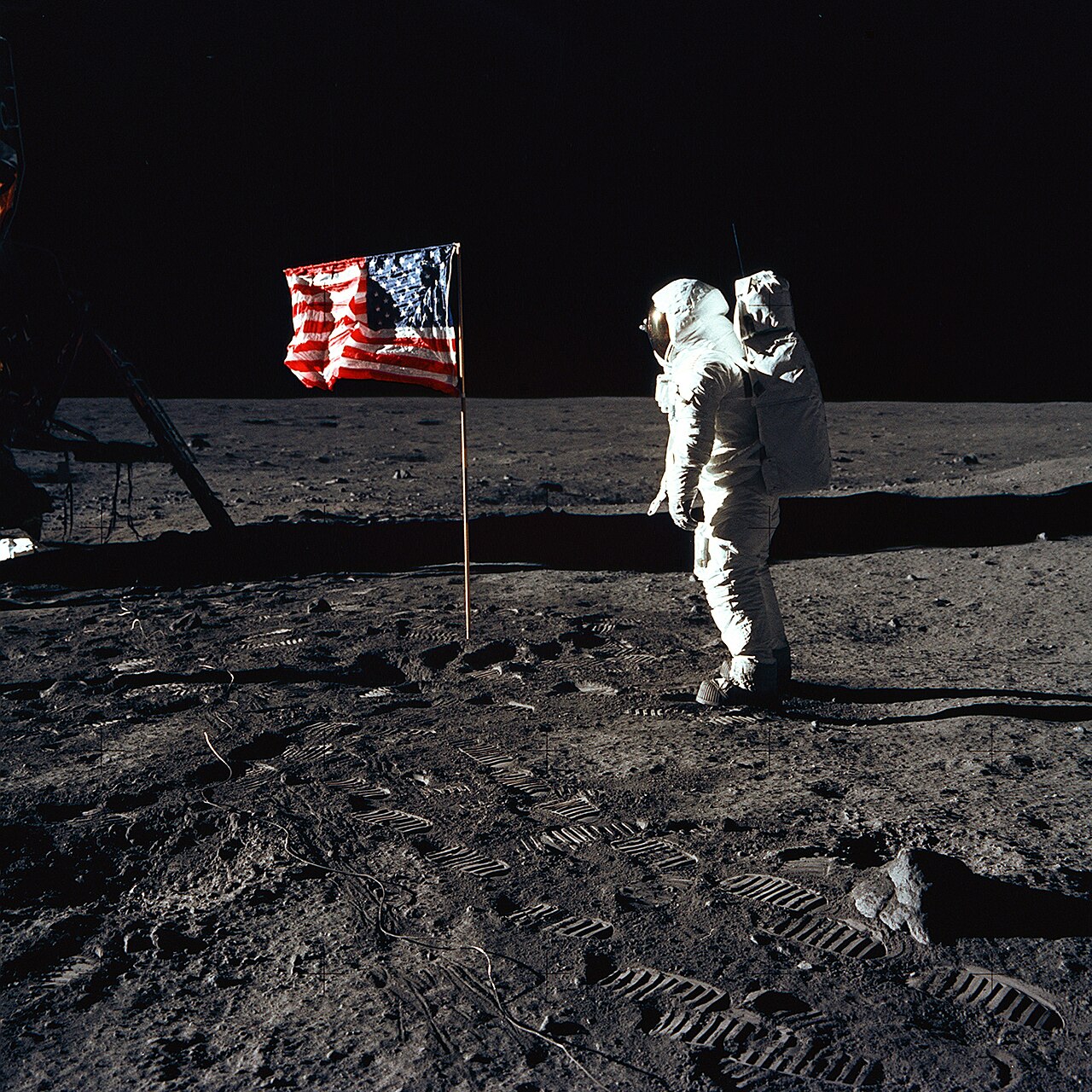
Via Wikimedia Commons: Buzz Aldrin and the U.S. Flag on the Moon (9460188482) by NASA/Apollo 11, public domain.
Cold War
The Cold War was a long rivalry with the Soviet Union short of direct war between them. Under the Truman Doctrine the United States undertook to support Greece's government against communist forces, reorienting its foreign policy.[21] President Harry Truman signed the Marshall Plan, aid to rebuild Europe's economies, on 3 April 1948.[22] In 1949 the United States, Canada and Western European states created the North Atlantic Treaty Organization (NATO), a mutual defence alliance.[23] The period included the Vietnam War. In July 1969 American astronauts of Apollo 11 landed on the Moon.[24] The Soviet Union broke up in 1991.[25]
Civil rights
The Civil Rights Act, signed by President Lyndon Johnson on 2 July 1964, banned discrimination in public places and employment and provided for school integration.[11] Johnson signed the Voting Rights Act on 6 August 1965; the National Archives calls it the most significant change in federal and state relations over voting since Reconstruction.[26] See Martin Luther King Jr.
Since 2000
The September 11 attacks of 2001 are covered in their own entry. Recent national elections are covered in the 2016, 2020 and 2024 presidential election entries.
Culture
Expression and belief
The First Amendment protects freedom of speech and of the press and the right to assemble and petition the government, and bars the government from creating or favouring a religion.[39]
Language
An executive order of March 2025 designated English as the official language of the United States, saying it had long served as the national language.[40]
Institutions
The Library of Congress began in 1800 and now holds materials in 470 languages, including what it describes as the world's largest collection of legal materials, films, maps, sheet music and sound recordings.[41] The National Endowment for the Arts, set up by Congress in 1965, is an independent federal agency and describes itself as the largest funder of the arts and arts education in communities across the country.[42] Its Jazz Masters Fellowship, awarded since 1982, is the nation's highest honour for jazz artists.[43]
Popular culture and holidays
American music, film and sport reach audiences worldwide. Micwyn has entries on Elvis Presley, Michael Jackson, Dolly Parton, Judy Garland, Marilyn Monroe, Muhammad Ali, Kobe Bryant, Ansel Adams and Star Wars. Widely kept holidays include Thanksgiving.
Economy
The Bureau of Economic Analysis measures output as gross domestic product (GDP), the value of goods and services produced. Its second estimate for the third quarter of 2026 showed real GDP, adjusted for inflation, growing at an annual rate of 4.3 per cent, after 2.2 per cent in the second quarter.[12] Such estimates are revised. President Trump has disputed official growth figures published before the 2026 elections.[27]
Recent events
- Government shutdown: a 43-day lapse in federal funding, a record, ended on 12 November 2025.[28]
- War with Iran: Israel and the United States attacked Iran on 28 February 2026; later talks and renewed fighting followed.[29]
- Tariffs: in February 2026 the Supreme Court ruled against global tariffs imposed under an emergency powers law.[30]
- Midterm elections: in November 2026 the Democrats won control of both the House and the Senate from the president's Republican Party.[31]
What's unsettled
As of 26 November 2026, the new Congress had not yet taken office. The outcome of the war with Iran and of disputes over tariffs was open, and economic estimates remained subject to revision. These are the parts of this entry most likely to change.
Sources
- U.S. Census Bureau. "U.S. Population Growth Slows Due to Historic Decline in Net International Migration". 27 January 2026. census.gov/newsroom/press-releases/2026/population-growth-slows.html
- U.S. Census Bureau. "State Area Measurements and Internal Point Coordinates". census.gov/geographies/reference-files/2010/geo/state-area.html
- USAGov. "Branches of the U.S. government". usa.gov/branches-of-government
- National Archives. "Declaration of Independence: A Transcription". archives.gov/founding-docs/declaration-transcript
- U.S. Department of State, Office of the Historian. "The Treaty of Paris". history.state.gov/milestones/1776-1783/treaty
- National Archives. "Constitution of the United States: A History". archives.gov/founding-docs/more-perfect-union
- National Archives. "The Bill of Rights: A Transcription". archives.gov/founding-docs/bill-of-rights-transcript
- Office of the Historian. "Louisiana Purchase, 1803". history.state.gov/milestones/1801-1829/louisiana-purchase
- National Archives. "13th Amendment: Abolition of Slavery (1865)". archives.gov/milestone-documents/13th-amendment
- National Archives. "19th Amendment: Women's Right to Vote (1920)". archives.gov/milestone-documents/19th-amendment
- National Archives. "Civil Rights Act (1964)". archives.gov/milestone-documents/civil-rights-act
- U.S. Bureau of Economic Analysis. "Gross Domestic Product". bea.gov/data/gdp/gross-domestic-product
- USAGov. "State and local governments". usa.gov/state-local-governments
- National Archives. "14th Amendment: Civil Rights (1868)". archives.gov/milestone-documents/14th-amendment
- National Archives. "15th Amendment: Voting Rights (1870)". archives.gov/milestone-documents/15th-amendment
- National Archives. "The Constitution: Amendments 11-27". archives.gov/founding-docs/amendments-11-27
- National Archives. "Homestead Act (1862)". archives.gov/milestone-documents/homestead-act
- National Archives. "Chinese Exclusion Act (1882)". archives.gov/milestone-documents/chinese-exclusion-act
- National Archives. "Social Security Act (1935)". archives.gov/milestone-documents/social-security-act
- National Archives. "Executive Order 9066 (1942)". archives.gov/milestone-documents/executive-order-9066
- Office of the Historian. "The Truman Doctrine". history.state.gov/milestones/1945-1952/truman-doctrine
- National Archives. "Marshall Plan (1948)". archives.gov/milestone-documents/marshall-plan
- Office of the Historian. "North Atlantic Treaty Organization (NATO), 1949". history.state.gov/milestones/1945-1952/nato
- NASA. "Apollo 11". nasa.gov/mission/apollo-11/
- Office of the Historian. "The Collapse of the Soviet Union". history.state.gov/milestones/1989-1992/collapse-soviet-union
- National Archives. "Voting Rights Act (1965)". archives.gov/milestone-documents/voting-rights-act
- PBS News. "Trump calls GDP figures 'fake' and demands an investigation of Commerce Department". November 2026. pbs.org/newshour/politics/trump-calls-gdp-figures-fake-and-demands-…
- Associated Press. "Trump signs government funding bill, ending record 43-day shutdown". PBS News, November 2025. pbs.org/newshour/politics/trump-signs-government-funding-bill-endin…
- PBS News. "Trump frequently announces he's halting strikes in Iran. But they keep happening". 2026. pbs.org/newshour/politics/trump-frequently-announces-hes-halting-st…
- Associated Press. "Supreme Court strikes down Trump's sweeping tariffs". PBS News, February 2026. pbs.org/newshour/politics/supreme-court-strikes-down-trumps-sweepin…
- PBS News. "Democrats win control of U.S. House, in major rebuke to Trump". November 2026. pbs.org/newshour/politics/democrats-win-control-of-the-u-s-house
- U.S. Geological Survey. "Elevations and Distances". pubs.usgs.gov/gip/Elevations-Distances/elvadist.html
- U.S. Geological Survey. "Largest Rivers in the United States" (Open-File Report 87-242). pubs.usgs.gov/of/1987/ofr87-242/
- National Park Service. "Park Statistics: Grand Canyon National Park". nps.gov/grca/learn/management/statistics.htm
- National Park Service. "Weather: Death Valley National Park". nps.gov/deva/learn/nature/weather-and-climate.htm
- Bureau of Indian Affairs. "Frequently Asked Questions". bia.gov/frequently-asked-questions
- National Archives. "President Andrew Jackson's Message to Congress 'On Indian Removal' (1830)". archives.gov/milestone-documents/jacksons-message-to-congress-on-in…
- National Archives. "Dawes Act (1887)". archives.gov/milestone-documents/dawes-act
- National Archives. "The Bill of Rights: What Does it Say?". archives.gov/founding-docs/bill-of-rights/what-does-it-say
- The White House. "Designating English as the Official Language of The United States". March 2025. whitehouse.gov/presidential-actions/2025/03/designating-english-as-…
- Library of Congress. "General Information". loc.gov/about/general-information/
- National Endowment for the Arts. "What Is the NEA?". arts.gov/about/what-is-the-nea
- National Endowment for the Arts. "NEA Jazz Masters Fellowships". arts.gov/honors/jazz
