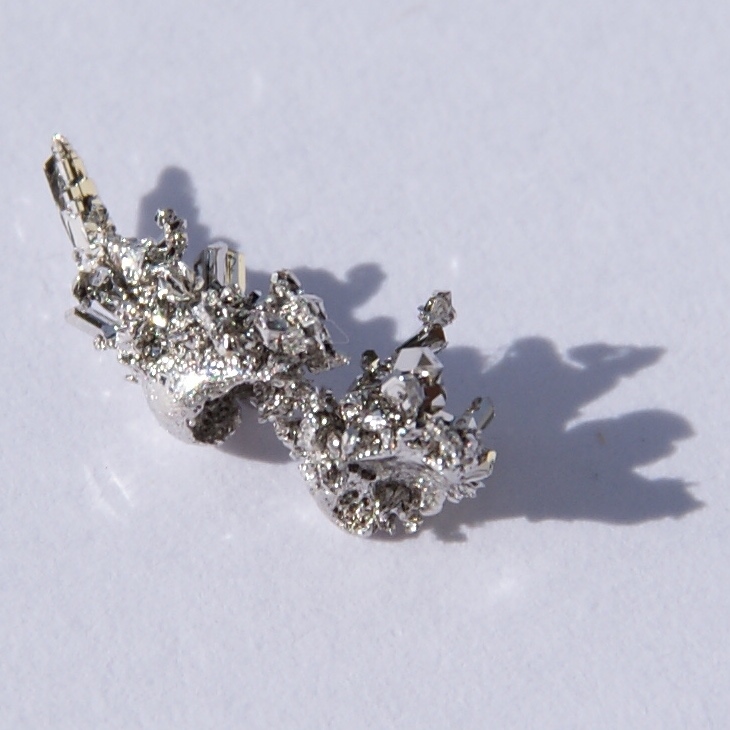
Palladium is the chemical element with atomic number 46 and the symbol Pd, a metal in group 10 of the periodic table that is used in car catalytic converters and named after the asteroid Pallas.[1][3]
This entry is about the element. Its relative atomic mass is 106.42, it is in group 10 of the periodic table, and it is a solid at room temperature.[1] For its place in the table and its basic facts, see the [periodic table page for Palladium](/element/Q1089/palladium).
Properties
The Royal Society of Chemistry lists palladium's melting point as 1554.8 °C (1828 K), its boiling point as 2963 °C (3236 K), and its density as 12.0 g/cm³.[1] Its standard atomic weight is 106.42(1), unchanged since 1979 according to the atomic weights commission of the International Union of Pure and Applied Chemistry; NIST gives the same value.[3][2]
Isotopes
Palladium has six naturally occurring isotopes. The Royal Society of Chemistry gives their proportions as 1.02 percent for palladium-102, 11.14 percent for palladium-104, 22.33 percent for palladium-105, 27.33 percent for palladium-106, 26.46 percent for palladium-108 and 11.72 percent for palladium-110, and NIST gives the same figures as fractions.[1][2]
Discovery and name
The English chemist and physicist William Hyde Wollaston discovered palladium in 1803, according to the atomic weights commission, one year after the discovery of the asteroid Pallas, and published the discovery anonymously to establish priority. The Royal Society of Chemistry says he isolated it from platinum residue and sold it as "new silver."[1][3] The name comes from Pallas, itself named after the Greek goddess of wisdom.[1][3]
Where it comes from
The Royal Society of Chemistry gives palladium's crustal abundance as 0.000037 parts per million. It is extracted commercially as a by-product of nickel refining and of copper and zinc refining, and South Africa, Russia and Zimbabwe are listed as the top three producers, without a date.[1]
Uses
The Royal Society of Chemistry lists car catalytic converters, jewellery, dental fillings and crowns, ceramic capacitors, hydrogenation catalysts and hydrogen purification. It says palladium has no known biological role and is non-toxic.[1]