Joseph Stalin (born Ioseb Jughashvili, 1878–1953) was a Bolshevik revolutionary from Georgia who became General Secretary of the Soviet Communist Party in 1922 and, after Lenin's death in 1924, ruled the Soviet Union until he died in March 1953.[1][2]
Birth and early life
Stalin was born Ioseb Jughashvili (Iosif Dzhugashvili in Russian) in Gori, Georgia, then part of the Russian Empire, the son of a shoemaker.[1][2] Church and party archive documents, including a baptismal record from Gori, give his birth date as 18 December 1878 (6 December, Old Style), while his official Soviet biography gave 21 December 1879.[3] Information about his early life was suppressed after he rose to power in 1922.[3]
In 1894 he entered the Orthodox seminary in Tiflis, where he first read Marxist writings; he joined the Russian Social Democratic Workers' Party in 1898 and was expelled from the seminary in 1899 for revolutionary activity.[1]
Revolutionary career
When the party split in 1903, he sided with Lenin's Bolshevik faction.[1][4] He was exiled to Siberia, escaped, and from 1904 organised robberies to raise money for the revolutionaries, including a 1907 raid on a state bank branch in Tiflis.[1] Between 1907 and 1913 he was arrested and sentenced several times.[1] In 1912 Lenin appointed him to the Bolshevik Central Committee, and he took the name Stalin, from the Russian word for steel.[1][4] Exiled again in 1913, he returned after the fall of the tsarist government in 1917 and, once the Bolsheviks took power, served as People's Commissar (head of the government department) for Nationality Affairs until 1923.[1][4]
General Secretary and rise to power
In 1922 Stalin became General Secretary of the party's Central Committee, a post he held until his death and used to build his power base.[1][2] Lenin had described him as "excessively rude" and proposed removing him from that post, as Nikita Khrushchev later told the party in 1956.[5] Stalin nevertheless kept his positions after Lenin's death in 1924 and defeated his rivals one by one, among them Leon Trotsky, Grigory Zinoviev, Lev Kamenev and Nikolai Bukharin.[1][4] By late 1934, according to the Library of Congress, he had eliminated all likely potential opposition to his leadership.[6]
Collectivization and the famines of 1932–1933
From the late 1920s Stalin pursued rapid industrialization through Five-Year Plans and the forced collectivization of agriculture.[1][6] Collectivization meant merging private peasant farms into large collective farms under state control, with the stated aims of supplying grain to the cities and industry and bringing the peasantry under political control.[6] Wealthier peasants, called kulaks, were singled out: the Library of Congress states that about one million kulak households, some five million people, were deported, while historian Nicolas Werth gives about two million people deported in 1930–1932.[6][7]
Famine followed.[7] In 1932 Stalin raised Ukraine's grain procurement quotas by 44 percent; officials, troops and secret police seized grain, including seed grain, and internal passports kept peasants from leaving their villages.[6] The famine in Ukraine is known as the Holodomor, a Ukrainian word rendered as "death by starvation"; the Harvard Ukrainian Research Institute notes that it is widely considered in Ukraine and beyond to be a genocide.[8]
Death tolls vary by source and method.[6][7][9] The 1992 Library of Congress exhibit gave six to seven million deaths in Ukraine.[6] Werth estimates about six million famine deaths across the Soviet Union in 1931–1933, including 3.5 to 4 million in Ukraine and about 1.5 million in Kazakhstan.[7] A demographic team led by Oleh Wolowyna (University of North Carolina) estimated about 3.9 million losses in Soviet Ukraine and 8.73 million Soviet-wide, and notes that virtually all scholarly estimates for Ukraine fall between 2.6 and 5.0 million.[9]
The Great Terror
The murder of the Leningrad party leader Sergei Kirov on 1 December 1934 set off a chain of events leading to the Great Terror, which peaked in 1937 and 1938.[6] The secret police, renamed the NKVD in 1934, was no longer bound by party control or law and became "a direct instrument of Stalin."[6] Khrushchev later stated that mass repressions grew sharply from the end of 1936.[5] Werth gives about 1.5 million people arrested and about 800,000 shot in sixteen months in 1937–1938.[7] Leading old Bolsheviks were tried in show trials and executed.[1] According to Khrushchev, 98 of the 139 full and candidate members of the Central Committee elected at the 17th Party Congress were arrested and shot.[5]
The Gulag
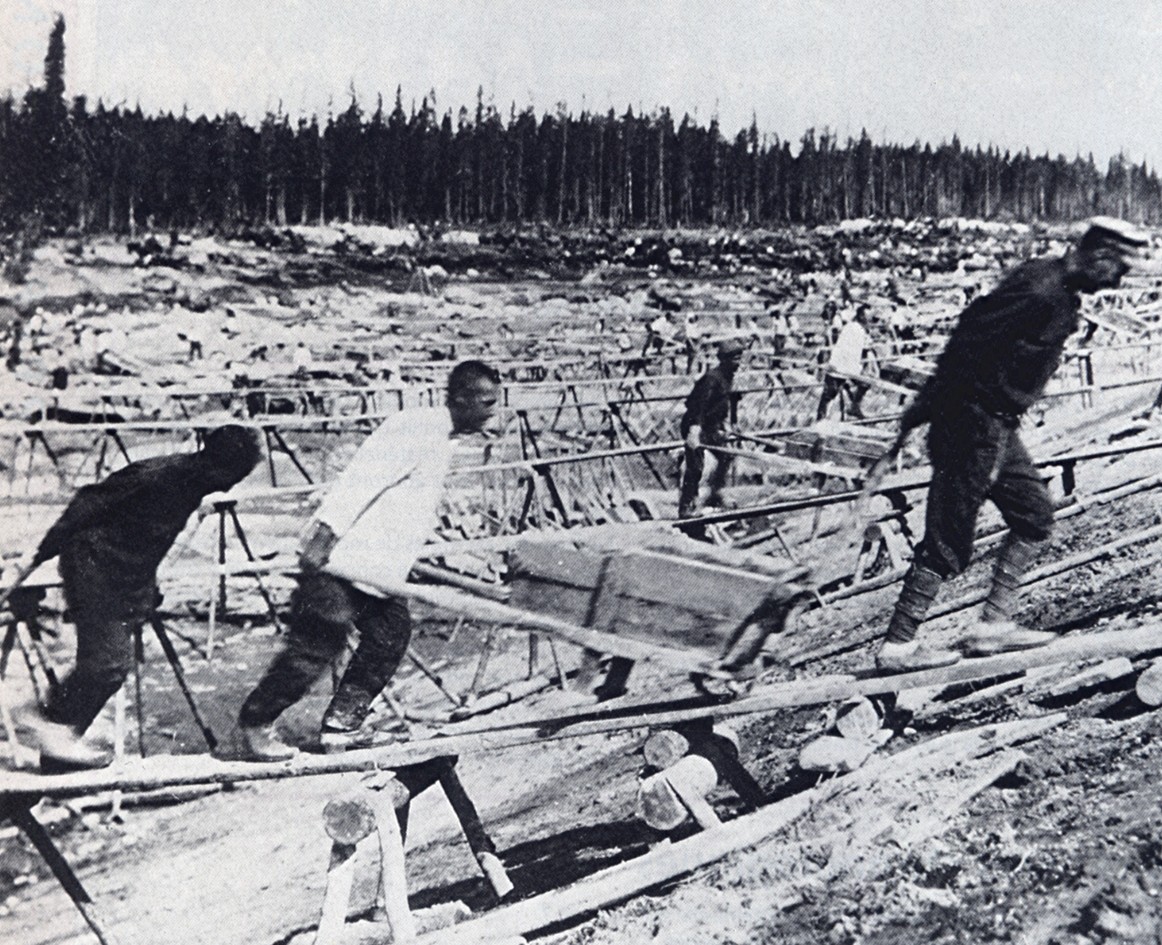
"Gulag" is the abbreviation of the Russian name of the Main Directorate for Corrective Labor Camps, the system of forced-labour camps run by the secret police.[6] Prisoners built canals and railways and worked in logging and mining under conditions that caused high death rates.[6] Werth writes that 17 to 18 million Soviet citizens spent time in a camp between 1929 and 1953 and that about 1.8 million died in camps and colonies in 1930–1953.[7] Historians cited by a George Mason University exhibit put Gulag deaths at no fewer than 1.6 million, noting the real number may be higher.[10] During the Second World War whole peoples, among them Chechens, Ingush and Crimean Tatars, were deported.[7]
Prisoners at work on the White Sea–Baltic Canal, one of the large construction projects built with Gulag forced labour in the early 1930s.
Via Wikimedia Commons: Canal Mer Blanche by Unknown author Unknown author, public domain.
Pact with Nazi Germany
On 23 August 1939 Nazi Germany and the Soviet Union signed a non-aggression pact, with a secret protocol dividing eastern Europe into German and Soviet spheres of influence.[11] Germany invaded Poland on 1 September 1939, the Soviet Union invaded from the east on 17 September, and in 1940 the Soviets occupied and incorporated Estonia, Latvia and Lithuania.[11]
Second World War
Germany and its allies invaded the Soviet Union on 22 June 1941.[12] Khrushchev later said that warnings of the attack had been received but the necessary preparations were not made.[5] Stalin became head of government in 1941, directed the war and allied with Britain and the United States.[1][2][4] German forces at Stalingrad surrendered in early 1943, and Berlin surrendered to Soviet forces on 2 May 1945.[12] More people fought and died on the eastern front than in all other campaigns of the war combined.[12]
Postwar settlement and early Cold War
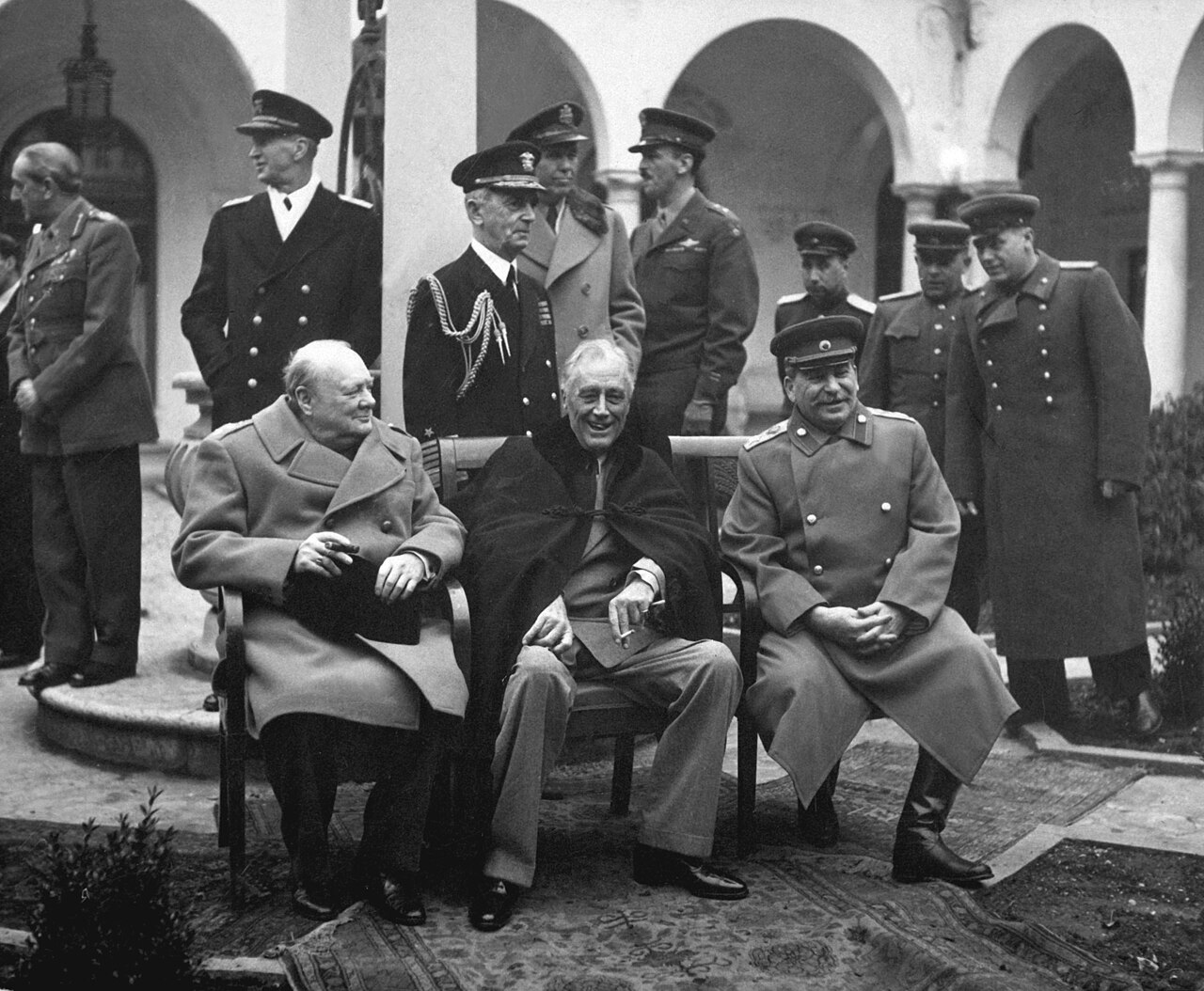
At Yalta in February 1945, Stalin, Franklin D. Roosevelt and Winston Churchill agreed that the Soviet Union would enter the war against Japan; the Western leaders accepted that eastern European governments should be "friendly" to the Soviet regime, and the Soviets pledged free elections.[13] At Potsdam in July and August 1945 the leaders agreed to divide Germany into four occupation zones but disagreed over reparations, and they never met together again.[14] Soviet support for communist regimes in eastern Europe shaped the postwar order there.[1] In 1948–1949 Soviet forces blockaded the western sectors of Berlin, a crisis that the State Department's historians say solidified the division of Europe.[15] Repression continued, and when Stalin died he was preparing another purge following the so-called Doctors' Plot.[1][4]
Winston Churchill, Franklin D. Roosevelt and Joseph Stalin seated together at the Yalta Conference in February 1945.
Stalin died at his dacha near Moscow on 5 March 1953.[1] The official medical report stated that he had suffered a brain haemorrhage.[16]
Khrushchev's "secret speech"
On 25 February 1956, at a closed session of the 20th Party Congress, Khrushchev gave the speech "On the Cult of Personality and Its Consequences," condemning the glorification of Stalin and the mass repressions under him.[5][17] He limited his criticism mainly to abuses against the party and did not challenge collectivization.[17] The speech was not published in full in the Soviet Union until 1989.[17] It began a campaign of de-Stalinization, led to the release of political prisoners, and contributed to the 1956 revolts in Poland and Hungary.[17]
Sources
Manfred Wichmann, "Josef W. Stalin 1878/79-1953", LeMO (Lebendiges Museum Online), Deutsches Historisches Museum, Berlin, last updated 20 January 2016. dhm.de/lemo/biografie/josef-w-stalin
Nikita Khrushchev, "On the Cult of Personality and Its Consequences" (speech to the 20th Party Congress of the CPSU, 25 February 1956), English translation, Wilson Center Digital Archive, History and Public Policy Program. No date shown; accessed 25 November 2026. digitalarchive.wilsoncenter.org/document/115995
"Internal Workings of the Soviet Union", Revelations from the Russian Archives (exhibition, 1992), Library of Congress. No date shown; accessed 25 November 2026. loc.gov/exhibits/archives/intn.html
Nicolas Werth, "State Violence in Stalin's Regime: Outline for an Inventory and Classification", conference paper, France-Stanford Center for Interdisciplinary Studies, Stanford University. No date shown; accessed 25 November 2026. web.stanford.edu/dept/france-stanford/Conferences/Terror/Werth.pdf
"Great Famine Project", MAPA: Digital Atlas of Ukraine, Ukrainian Research Institute, Harvard University. No date shown; accessed 25 November 2026. gis.huri.harvard.edu/great-famine-project
Andrij Makuch, "Oleh Wolowyna: Measuring Mortality in the Holodomor", News at the CIUS, Canadian Institute of Ukrainian Studies, University of Alberta. No date shown (filed under March 2018); accessed 25 November 2026. ualberta.ca/cius/news-and-events/news-at-the-cius/2018/march/oleh-w…
"The Yalta Conference, 1945", Milestones in the History of U.S. Foreign Relations, Office of the Historian, U.S. Department of State. No date shown; accessed 25 November 2026. history.state.gov/milestones/1937-1945/yalta-conf
"The Potsdam Conference, 1945", Milestones in the History of U.S. Foreign Relations, Office of the Historian, U.S. Department of State. No date shown; accessed 25 November 2026. history.state.gov/milestones/1937-1945/potsdam-conf
"The Berlin Airlift, 1948–1949", Milestones in the History of U.S. Foreign Relations, Office of the Historian, U.S. Department of State. No date shown; accessed 25 November 2026. history.state.gov/milestones/1945-1952/berlin-airlift
"Stalin's Death" (excerpts from The Current Digest of the Soviet Press, Vol. V, Nos. 6 and 7, March 1953), World History Sources, Roy Rosenzweig Center for History and New Media, George Mason University. No date shown; accessed 25 November 2026. chnm.gmu.edu/worldhistorysources/sources/stalinsdeath.html